
A new Boston development is prioritizing first-generation home buyers. It could help close the racial wealth gap.
Brookley Flats in Jamaica Plain is slated to open to residents in 2025.
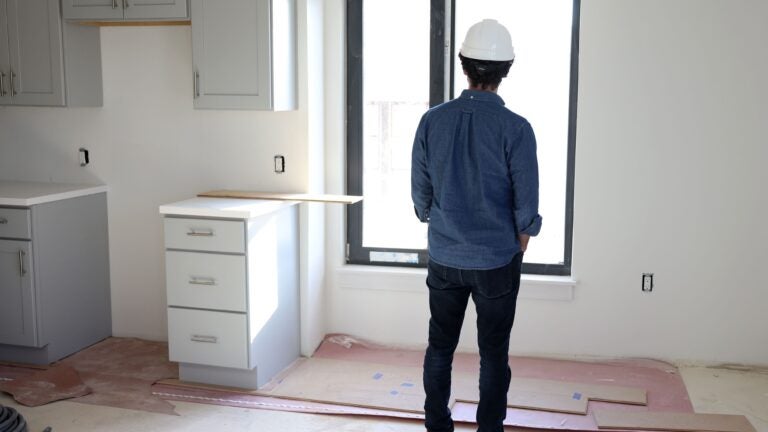
The units in the Brookley Flats housing development in Jamaica Plain appear about as cookie-cutter as most of the new, high-end houses and condominiums cropping up throughout Boston. There’s the crisp white walls, light gray cabinetry, and shiny tile bathroom floors. Although the appliances were not yet installed on a recent Monday evening tour of one of the condos, those will be stainless steel.
But there is a notable difference between the units in this building and the ones elsewhere that look like them: About half of the 45 condos in the affordable housing complex are set aside for applicants whose parents have never owned a home in the United States — or first-generation home buyers.
The forthcoming Brookley Flats complex is the city’s first affordable homeownership community for such home buyers, selecting residents based on their parents’ status as renters or homeowners. It’s an effort that, Brookley Flats’ proponents say, could help close the region’s staggering racial wealth gap by helping Black and Latino residents — who are less likely than their white counterparts to have parents that are homeowners — become homeowners themselves.
“When families were not allowed to or couldn’t purchase homes, their lives were very different,” said Sheila Dillon, Boston’s chief of housing. “It’s really time for us to look at historic patterns in what has happened in this city and country, and be very intentional in our efforts to right past wrongs.”
Brookley Flats will offer 45 units for city residents making no more than 100 percent of the area median income, or $163,200 for a family of four. Twenty of the income-restricted homes have a preference for first-generation buyers. Applicants are currently undergoing an extensive lottery process.
The $26.4 million project was developed by the Jamaica Plain Neighborhood Development Corporation, or JPNDC, and Causeway Development, and partially funded by a mix of public subsidies.
First-generation home buyer assistance programs have sprouted in Massachusetts, Rhode Island, Minnesota, North Carolina, and California, but few solutions setting aside units for these prospective buyers exist. Proponents of first-generation home buyer programs said this preference could make homeownership attainable for more families in a cutthroat real estate market like Greater Boston, where the median price for a single-family home is nearing $1 million.
On broad terms, affordable homeownership development is often touted as an effective way toward ensuring people priced out of the private market can buy a home, but some advocates say their impact is limited because they don’t target buyers with the highest need.
Rebecca Mautner, vice president of real estate development and assets at JPNDC, said that only considering an applicant’s income for income-restricted properties could include both people who are first-generation home buyers and those who lean on their wealthy parents to help finance a mortgage.
For years, Mautner said, she had seen affordable homes go to well-off medical students, children of parents with deep pockets, or people with little intention in settling in a specific neighborhood.
“You get five or 10 years out, and someone sells it. They want to move to Weston, and they rent their unit,” Mautner said. “And you realize, ‘This is completely not working.’”
JPNDC tested out a first-generation pilot with one home in Sumner Hill last year. The first eligible application included a middle-class household, with a Massachusetts Institute of Technology employee. But because the developer prioritized applicants who didn’t have home-owning parents, the property went to a working-class household.
“Once you see those applications, you can never unsee it,” Mautner said.
Mautner said JPNDC was inspired by the Massachusetts Affordable Housing Alliance’s STASH First-Gen Home program. STASH is limited to state residents whose parents never owned a home or who lost one to foreclosure in the United States, and provides eight hours of financial literacy and up to a $20,000 savings match in down payment assistance.
Symone Crawford, executive director of the Massachusetts Affordable Housing Alliance, or MAHA, said that being first-generation is an effective proxy for race. Ninety-six percent of MAHA’s STASH participants are people of color, she said.
“It’s not exclusive, it’s inclusive,” Crawford said. “But because of the generational disenfranchisement of low- and moderate-income people of color, you find that those are the people that bubble up most times” in first-generation programs.
The few existing initiatives that widen access for first-generation home buyers in Boston such as STASH are grant-based, and focused on giving these often low-wealth, low-income families an extra financial boost to make a down payment. But even with financial assistance, they are still left to navigate a housing market where low-income households are often pushed out by the highest bidder.
“We need both buyer-side solutions and production-side solutions,” Crawford said. “One can’t work without the other.”
In all, Brookley Flats received 1,008 applications. The first-generation units received 509 applicants, meaning that only 4 percent of these families will move into these homes.
“It appears from these numbers that this really has worked,” Dillon said.
The city has been working on meeting the demand for homeownership in Boston, Dillon said, where more than a third of residents are homeowners. Since 2022, more than 2,000 income-restricted homes are either completed, undergoing construction, or in the development pipeline, according to city data.
First-generation home buyer programs have only emerged across the US in the last few years, and how they define the term varies greatly, said Aniket Mehrotra, policy assistant for the Urban Institute’s Housing Policy Finance Center. Some require that an applicant’s parents be lifelong tenants; others say their parents can’t have owned a home in the last three years; then there are those, such as Brookley Flats, which say they must have lost a property to foreclosure or not owned in the US at all.
Still, Mehrotra said, such efforts are done best when they make it easier for potential buyers to apply. “We want to ensure that as many households can have assistance as possible while making sure that assistance is well targeted,” Mehrotra said.
Mautner said Brookley Flats’ applicants signed an affidavit pledging their first-generation homeownership status, and that a project representative will search through state deed records to confirm eligibility.
Construction on Brookley Flats is expected to be completed by early 2025, with residents moving in later that same year. As the project nears completion, JPNDC is ironing out a forthcoming first-time homeowner project in Grove Hall and Nubian Square for 2026.
This story was produced by the Globe’s Money, Power, Inequality team, which covers the racial wealth gap in Greater Boston. You can sign up for the newsletter here.



To comment, please create a screen name in your profile
To comment, please verify your email address
Conversation
This discussion has ended. Please join elsewhere on Boston.com