
What life is like on a private island. Plus, see photos of islands for sale in New England.
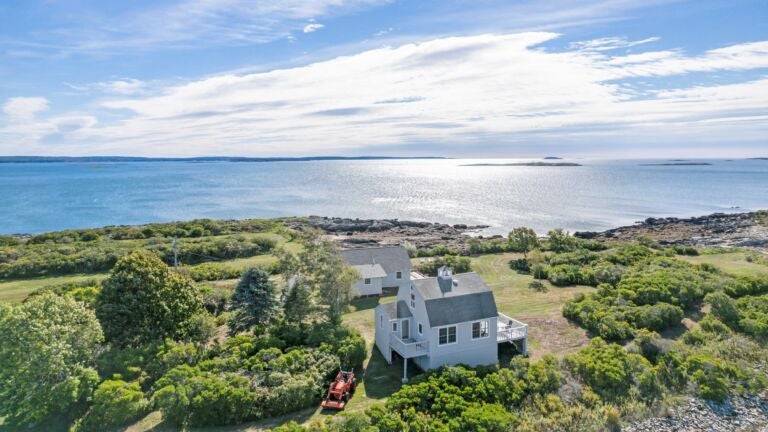
Ann and Barry White scoured the New England coast for years in search of a waterfront property of their dreams. On a chance visit to Maine one weekend, a local realtor threw out an idea they’d never considered: purchasing a private island just off the jagged shore.

Intrigued, the couple toured a few properties. With its spectacular scenery, Long Point Island in Harpswell surpassed every expectation. Boats rocking on the waves. Views stretching to the horizon. Fishermen throwing out nets to catch schools of baitfish.
That was in 2000. More than two decades later, the Whites are preparing to part ways with their secluded slice of heaven. They are getting older, and the time has come for a more conventional spot on the mainland.
“We’ve completely immersed ourselves and have truly had the infinite amount of joy,” Ann, 71, said. Barry, 77, quickly chimed in, “We’re not done yet,” and they shared a laugh.
“It’s on to the next adventure,” she agreed.


That sense of exploration, freedom, and solitude is what draws people to live on an island in New England, private retreats whose charms and challenges are intertwined, according to residents and realtors.
The properties are a limited commodity in the region and rarely go on the market. When they do, they quickly spark fascination, as seen with a Maine island, featuring a lighthouse and cottage, that recently went on sale.
Bruce Davis, broker and owner of Engel & Völkers Casco Bay, has sold a number of private islands during his career and is the agent for the longtime property of the Whites. The almost 6-acre island, which has two homes and on-the-grid power, is listed for $3,695,000 — on the higher end for New England islands on the market.

Islands in the region are generally priced lower than those in warmer climates or near populous cities, but the cost depends on a number of factors, including the size of the island, its proximity to the mainland, whether it has existing infrastructure, and what amenities — if any — it offers. Of some of the available listings in New England, primarily in Maine, prices vary from $49,900 to $3,695,000.
“Island properties are the total discretionary purchase. Nobody needs an island, and fewer and fewer people can afford an island. Islands are cyclical. When the economy is good, island sales are very active,” Davis said. “Because of the economics, generally these folks have other investments and properties in different places.”


A former island owner himself, Davis said he learned early on to emphasize the realities to potential buyers. As serene as the life can be, having no neighbors and being fully absorbed in nature, it comes with no shortage of quirks, like remembering to stock up on essentials when shopping in town and keeping a keen eye on the weather and tides.
While most islands are only accessible by water, Long Point Island has a granite road, created before standards that are in place today, to the mainland. For about four or five hours during every 12-hour tide cycle, it’s exposed and passable, and he can drive or walk homebuyers over. Otherwise, they travel by boat, which can take a while, so people need to show they are serious.
“I’m happy to go out in the middle of winter to show an island, but I want to narrow the field down before. Showing an island can be four or five hours pretty easy, and it can involve a fairly long boat ride,” he said. “If they’re not relatively mobile, it’s not easy ownership,” and buyers have to be able to work around the weather.

Many of his clients hail from southern New England, live in big cities, and have high-powered careers, he said. Living on an island offers an escape, a place to recharge. Unlike the Whites, who live on their island year-round, the vast majority of owners make use of their property from around May to October before closing down. Most islands are off-the-grid and do not have heating systems or insulation.
A number of undeveloped islands have been bought by conservation groups and land preservation groups, so “you pretty much have to buy an island that has a home on it,” Davis said. In the past few years, the market “has had a lot of appreciation on the coast of Maine,” with properties that have a higher degree of access to the water increasing the most in value, he said.
“Most of the people that I’m dealing with are fulfilling a lifelong dream, so I get to help them do that,” Davis said.


But for billionaire Ernie Boch Jr., buying an approximately 4.3-acre island in Swansea for $850,000 last year was more of a spur-of-the-moment decision. He had never considered owning an island, but when he saw one for sale on the news he “thought it would be a good idea.” He made a few calls and the once-beloved summer spot, which he called a “diamond in the rough,” soon was his.
“I have to do a bunch of things to bring it up to par,” said Boch, 65.
Boch hasn’t come up with specific plans but said he is “excited to enhance the community” and that his top priority is to replace the 300-foot bridge that connects it to the mainland. He praised the surrounding beaches but said he doesn’t think he will build a summer home on the island.
“Maybe a really cool B&B,” he said.

Sue Bishop, a broker with Four Seasons Sotheby’s International Realty in Vermont, is the agent for the 3.8-acre Rabbit Island on Lake Bomoseen, which is listed at $1,175,000 and will be on the market once the property is fully opened for the season.
This is the first island that Bishop has tried to sell, and it’s been a memorable undertaking. So far, people who visit the island often recall childhood memories. Many said they spent time on the water growing up and now want to “impart that same experience on their children,” she said. But safety concerns gives people pause given how elevated the land is above water, as does the challenge of navigating the narrow channel by boat or kayak.


Surrounded by mountains, the on-the-grid island includes a main and guest cottage and has been with the current family for more than two decades, Bishop said. But with their children grown and visiting less, the owners are looking to live year-round on the mainland.
Island life can be hard to leave behind, but the Whites feel as though they have left no stone unturned. The couple warmly recalled hosting enthralled visitors, listening to the waves crash against the ledges like thunderclaps during storms, and looking for blooming flowers during their daily walks.
And for Elizabeth Arey, 85, who is looking to sell her 5-acre Greer Island in Maine, it’s the place she shared some of her most cherished moments with loved ones.

In 1961, the year she married her late husband, Jim, they planted trees and wild flowers. After they had two sons, it became their family place, where the boys hunted “pirate treasure” like washed up lobster buoys, Arey said. They picnicked, had fresh steamed lobster cookouts, read poetry, and basked in the sun. When Jim died from cancer, she continued to take a small inflatable boat to the island to carry out their tradition.
“It is thus the rich heritage of happy family times, wonderful summer nights camping under the stars, and delicious sea breezes kissing our faces on Greer Island that I hope will be passed on to another lucky family to enjoy for the future,” she said.





To comment, please create a screen name in your profile
To comment, please verify your email address
Conversation
This discussion has ended. Please join elsewhere on Boston.com