
Pieces of a house lost to the flooding of the Quabbin Reservoir live on inside of this author’s home
Salvaged components of a forgotten home have had a second life in Ware, and are reminders of the communities that were destroyed nearly a century ago.
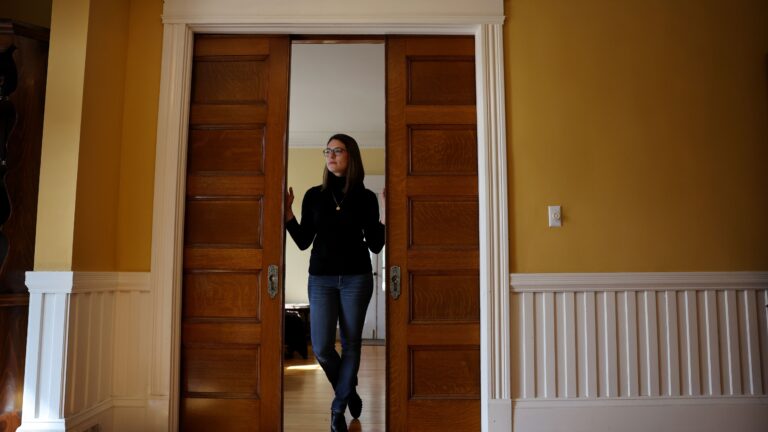
When Elena Palladino and her husband, Matt, were house-hunting in 2015, they couldn’t help but fall in love with a stately Colonial they found in Ware.
It was clear there was something special about the property, and the couple was charmed by its historic character and antique finishes. Inside, it was full of touches like an elegant central staircase and Victorian pocket doors with ornate brass pulls.
“We were drawn to it,” said Palladino, who purchased the property soon after seeing it. “You could tell it was different.”
But it wasn’t until they moved in and met their neighbors, who called her new home “the Quabbin house,” that Palladino began to uncover the small pieces of history that made it so unique.
She would soon learn that many of the home’s most eye-catching elements had once been part of a home that stood in Enfield, one of four towns flooded nearly a century ago to create the Quabbin Reservoir. The pieces might have been lost forever were it not for the woman who once owned them, and spared no expense to ensure they lived on.
The revelation inspired Palladino to learn more about the home, the family it had housed, and the communities uprooted by the Quabbin project in the 1930s.


Last year, Palladino released a book on her findings called “Lost Towns of the Swift River Valley: Drowned by the Quabbin.” It details the history of her home’s former owner, Marion Andrews Smith, the surviving member of a wealthy family that ran a mill and had a section of Enfield, known as Smith’s Village, named after them.
When the state tried to force residents in Enfield — and Dana, Greenwich, and Prescott— to leave the area to make way for the reservoir, built to provide water for Boston and other municipalities, Smith was among those who fought desperately to stay.

Unlike her neighbors, she refused to sell her land, which the state later took by eminent domain. Smith, who was in her 70s at the time, didn’t budge until July of 1938, staying at the property down to the town’s last moments.
“They all were devastated,” Palladino, who grew up in Sturbridge, said of Enfield’s last holdouts. “They didn’t want to go. It wasn’t easy for them to start over, just pick up and build a new home.”
When it came time to leave, she said, Smith had hoped to pick up her entire home and move it to higher ground as others had. But that proved impossible, and her house — one of the largest in town — had to be demolished.

As a last resort, Smith spared what she could, and took her favorite components with her.
Construction workers removed floorboards, moulding, doors, and wainscoting, and reinstalled them in the new location. In perhaps the most difficult task, they cut out her wooden staircase in one piece, and then hauled it to Ware.
While the new house had a different floor plan, the foyer was built as a replica of the original. That way, Smith would be reminded of her former home every time she crossed the threshold.
Palladino tracked down all of this information in records from the company Smith hired to move the artifacts. They kept detailed notes on the entire project — and their challenging client.
“She was, in their view, very, very difficult,” Palladino said. “But I think it’s because she was so determined to have this house be what she wanted.”
After spending years poring over records in local archives, special collections, and museums, Palladino has come to cherish the furnishings in her home even more than when she bought it, given the pains its builder took to keep them.
“As I was writing [my book], Marion felt very present to me, because I’m in all these spaces that she inhabited,” she said.
The plot thickened in 2018, when she discovered an unmarked envelope in her mailbox that contained black-and-white photos of the home when it was first built. She still doesn’t know who put them there — or why — but is thankful they did.
Other treasures have also landed on her doorstep.
During her research, she connected with Marian Tryon Waydaka, whose parents were Smith’s chauffeur and groundskeeper (and named their daughter after their employer).
Palladino and Waydaka, then in her late 80s, became close and talked for hours about her memories in the home — including how the room Palladino used as an office was Smith’s favorite place to drink tea and gaze out on the lawn.
After she died in 2021, Waydaka’s son gave Palladino a collection of Smith’s books and a piano bench that once sat in the Enfield home. Both are now prominently displayed in Ware. He also gave her the pieces of a mantle that once adorned the original home’s fireplace, which she plans to restore and install.


Palladino, who will discuss her book at the Copley branch of the Boston Public Library on Thursday, said she was initially only somewhat familiar with the history of the reservoir, but living in a “Quabbin house” has made her think more deeply about the displacements required to create the body of water.
Now, when she drives past its 412 billion-gallon expanse, or takes her two daughters there to visit, her mind goes back to Smith, and the communities the project washed away.
“It’s a beautiful place to walk and hike and enjoy. But there’s a feeling of sadness there, too, and a beauty born of the loss of thousands of people who had to leave their homes,” Palladino said. “I think they would be devastated to think that their sacrifice was forgotten.”





To comment, please create a screen name in your profile
To comment, please verify your email address
Conversation
This discussion has ended. Please join elsewhere on Boston.com