
Woodpile art strikes a chord in New England
A stack of firewood is so much more than just a pile of logs. It’s a rustic manifestation of hard work completed.
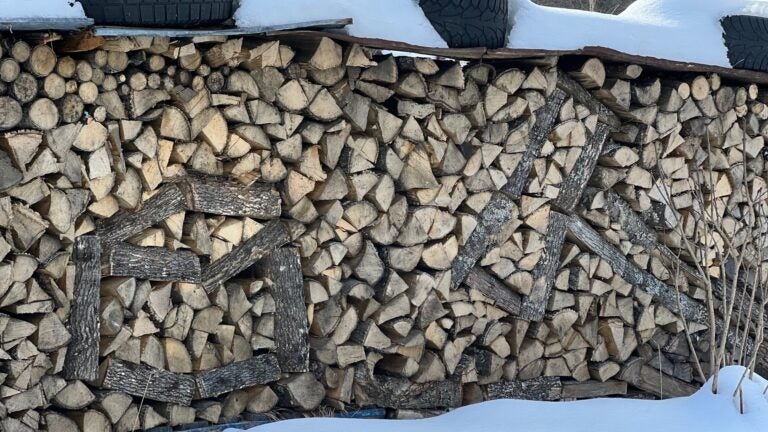
A stack of firewood is so much more than just a pile of logs. It’s a rustic manifestation of hard work completed, a symbol of coziness to come. Changing shape with the seasons, it embodies both the rugged and relaxing elements of a New England winter. Suffice to say, stacked wood doesn’t need much help looking beautiful.
But that doesn’t stop some folks from elevating their wood stacks to something more than a practical, pretty pile of fuel. Whether by using contrasting logs to create a picture in the face of the firewood, or taking a more artful approach to the structure itself, wood-burning homeowners across New England (and around the world) are adding a touch of whimsy to their woodpiles.
Visitors to the Ipswich River Wildlife Sanctuary in Topsfield for the past year have enjoyed the graceful likeness of a felled tree displayed in the woodpile built by Mass Audubon regional property manager Richard Wolniewicz. “People really seem to gravitate towards it,’’ Wolniewicz said. “They’re always posing and taking pictures in front of it.’’

Wolniewicz has been adding imagery to the face of the sanctuary’s wood stack for a few years now, ever since a volunteer sent him a picture of woodpile art. “We stack the wood anyway, so why not go for it?’’ he said to himself. “And for three years, that’s what we’ve been doing.’’
The first year he tried the technique, Wolniewicz used a bare tree that beavers had left barkless to create a picture in the pile. The next year, the black wood of an Amur corktree provided the contrast. “We did an owl, with its wings outstretched, and we used different types of wood to outline the owl,’’ he said. “Some people thought it was a butterfly, others a bat, but most people thought it was an owl.’’

Wolniewicz uses care to wedge and weigh down the illustrative face-out logs so they don’t fall out over the winter. “Sometimes I want to put a nail in it just to hold it,’’ he joked. The current stack is two piles deep — the rear one adding support — buttressed by Jenga-style bookends. “On the ends of these sculptures, we do a crosshatch pile, and that way it locks the center,’’ Wolniewicz said, “and that adds a lot of integrity and strength to support the whole structure.’’
The stack holds six or seven cords of firewood, Wolniewicz said, which the sanctuary uses in March to support its maple sugaring operations — including a series of demonstrations open to the public on the first three Saturdays in March. With 12 miles of trails to keep clear, fallen trees yield plenty of firewood to stack in early spring, which is when Wolniewicz starts thinking about ideas for next year’s pile. Sometimes the stacking feels effortless; other times it’s a struggle, and that’s when he walks away. But when the process is flowing, he said, “I can get completely lost and absorbed in it, and not have a care in the world while I’m putting it together.’’
For Vermont homesteaders Ben Servoz and Nicole Antal, a stack of firewood is already a beautiful sight in its reassurance. “We’re 100 percent off-grid, so to us, it is sustenance, right?’’ Servoz said. “All year long, we walk past these woodpiles, and they give us comfort. It’s very comforting to see the wood and to know that it’s going to be hot water, it’s going to be heat … it has a deep psychological effect on us.’’
For the past few years, Servoz has also taken to embedding a picture in their woodpile, which faces the road and, he hopes, makes neighbors and visitors smile. One year it was a fish and a snake; this winter, he placed some of the logs bark-side out to resemble a maul hammer and chopping block.
“People do gradients and amazing things, and I’m not there yet — I’m still figuring out the medium,’’ Servoz said. Incorporating a picture takes a little more effort, he added — “You do need to plan, and sometimes undo a couple of logs so it actually kind of looks OK.’’ But like Wolniewicz, Servoz enjoys the work of splitting and stacking wood; it’s something productive he can do in short bursts. “It’s repetitive in a way that you can kind of lose yourself in it, but it’s not going to become boring,’’ he said, “because not all wood pieces are the same.’’
It’s also a great whole-family activity, Servoz added — just challenging enough to keep kids interested, but simple enough to keep a conversation going. “It’s actually one of the things that we can do together as a family, and there’s a little task for everyone.’’
Though Servoz grew up in France, it was in New England that he discovered woodpile art. But people create unique and impressive wood stacks all over the world, said Ayumi Horie, a studio potter in Portland, Maine, who founded the International Society of Woodstack Enthusiasts.
“As far as scale goes, the most impressive stacks are in China, where some are so massive that they’re bigger than tiny houses,’’ Horie said. In Japan, she added, long, thin pieces of wood — meant for quick- and hot-burning pottery kilns — are often tied into tidy cylindrical bundles and then stacked like round logs.
“In Norway, there’s at least one farmer who tucks his firewood under stone ledges in a mountainside for drying, bringing to mind a world where trolls are real,’’ Horie said. And in Scandinavia, as well as northern Maine, “a common way to stack is to place firewood on end and lean them into something resembling a haystack,’’ Horie said — creating a “very magical’’ look when a collection of them dots the landscape.
After watching many a woodpile topple over during winter storms, contractor Rob Cagnetta, founder of Heritage Restoration in Rhode Island, decided there had to be a better technique and started looking for global inspiration. “Over these thousands of years of burning wood, somebody has had to come up with a better option than our linear stack,’’ he figured — and that’s when he learned of the German holz hausen method. He was quickly intrigued by the “beautiful little beehive-shaped structure’’ that marries both form and function, and has used the technique for the past seven years.

To make a holz hausen, Cagnetta starts by laying down a ring of logs, end to end, into a 6-foot-wide circle. (Ideally, this would be on gravel, stone, or pallets, to keep the bottom layer off the soggy ground.) Then he stacks a layer of logs perpendicularly, with one end resting on top of the ring and the other end tilting down into the center of the circle. “It doesn’t have to be tight, because you want air to flow through it,’’ he said. Then, just keep going around in that circle, stacking the wood like spokes on a wheel — and making sure they tilt inward.
“The idea is that every piece of wood you put on is pitching inward, so it’s almost like falling in,’’ he said. As the stack gets higher, it will start to level out, and you may need to place another ring of horizontal logs on the outside edge to maintain the desired inward slope. “Some people can do it without putting that horizontal piece in — I can’t,’’ he said. “But it allows everything to kind of fall into the center.’’
And as for the hollow center created inside the stack, Cagnetta gradually fills it with two layers of logs standing vertically, straight up on end, before topping it off with odd-shaped pieces that won’t stack well. That inner chimney design can actually create a sort of convection current to dry out and season the firewood faster.
Perhaps best of all, from an aesthetic standpoint anyway? A holz hausen doesn’t need a tarp, instead exploiting tree bark’s natural water resistance to keep the inside of the pile dry. “At the end, I put all of my bark facing up for like another two layers on top, so then it sheds the water,’’ Cagnetta said.
“If you’re wondering how wood can dry without a cover, there’s a difference between the moisture trapped deep inside wood and surface wetness,’’ Horie said. “I love round stacks myself, because of the way they collect a cap of snow on top like a knitted hat or a dollop of frosting. They take a bit more time, but are worth the beauty that they bring.’’

This year, Cagnetta strung holiday lights on the holz hausen in his yard. (Each holds about a cord of wood, which he burns in a wood stove to warm up his drafty old Victorian.) But beyond their attractiveness, he’s found them to be incredibly practical. It took him a few tries to get the technique down, but now Cagnetta says that if he accidentally backed his truck into one of the stacks, it probably still wouldn’t fall over.
After all, when it comes to something as useful as firewood, practicality is beautiful in its own right. “The temporal nature of wood stacks, and experiencing them through the seasons, has always made me think of art installations — but without any of the pretense,’’ Horie said. “The beauty of function is enough.’’
And even a simple, unembellished stack of wood can tap into our emotions the way art can. Servoz said he can read his woodpile almost like a photo album as the winter goes on. “You can recognize the layers, and you can recognize the things that happened during those layers,’’ he said. “Like, my brother came over and helped me drop a birch, and I’ll arrive at that birch when we go through the pile, and I’ll be reminded of all our adventures together.’’
Jon Gorey blogs about homes at HouseandHammer.com. Send comments to [email protected]. Follow him on Twitter at @jongorey. Subscribe to our free real estate newsletter at pages.email.bostonglobe.com/AddressSignUp. Follow us on Facebook, LinkedIn, Instagram, and Twitter @GlobeHomes.





To comment, please create a screen name in your profile
To comment, please verify your email address
Conversation
This discussion has ended. Please join elsewhere on Boston.com