
Cambridge home strikes balance between urban edge, pastoral calm
The property, which fronts a busy street but has a pastoral view out back, represents the best and worst of urban living.
Architect Robert Linn, half of the Boston team of Moskow Linn Architects, chuckles as he explains the history of his neighborhood in Cambridge, Massachusetts.
“This was the last subdivision in Cambridge, created just after World War II,” he says. “At the far end of the city, almost in Belmont, it stretched along Grove Street and Blanchard Road with about 20 house lots. They were supposed to be available to returning veterans, but before they had a chance to buy anything, local politicians bought all the lots. The area became known as ‘Politician’s Row.’ ”

Being snapped up by greedy politicians was only the beginning of a conflicted situation. By the time Linn found one of the houses on Grove Street for sale five years ago, its location embodied the best and the worst of urban living. “The neighborhood has an edge feeling. It fronts a constantly busy road but has a beautiful, pastoral view,” Linn says.

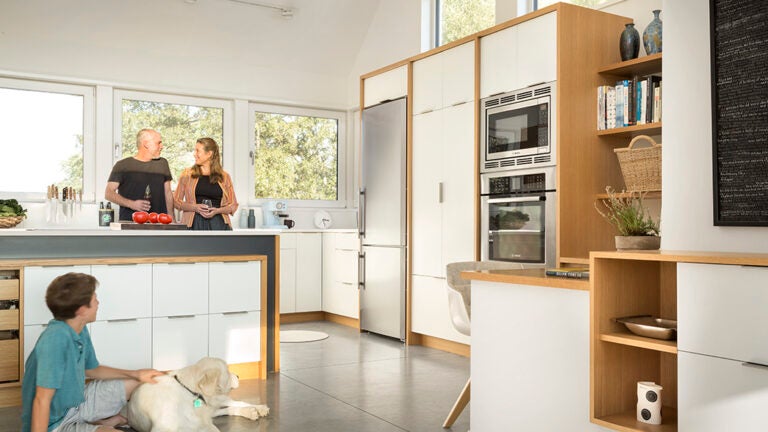
The house occupies a narrow strip of land between Grove Street and Fresh Pond. While traffic steams by the front of the house, the rear looks out at water and greenery. That was what sold the Linn family, which includes Robert, his wife, Erin Driver-Linn, an associate provost at Harvard University, and their son, Jackson, a student at Cambridge Rindge and Latin School. Their English cream golden retriever, Moby, rounds out the family.
Linn, who has lived in Cambridge for 20 years, was steered to the site by builder Duncan MacArthur of MacArthur Construction in Cambridge, who had worked with him on a house down the street. “By the time we found it in 2013, the house that had been standing on the site since the late forties or early fifties was falling apart,” says Linn. “We kept the edge of the original foundation, but the city considers this new construction.”

Linn, who worked with Moskow Linn associate Sarah Carlisle on the project, designed a 2,600-square-foot house with a traditional New England profile. The steeply pitched standing-seam metal roof sheds snow and echoes vernacular forms. To make the most of the view to the rear and to minimize the road noise at the front, living spaces and the master bedroom are located on the upper, main floor. Jackson’s bedroom, the guest bedroom (which is also the family room), storage space, and utilities are on the lower level. The staircase is built along the front wall, acting as an additional noise buffer.

“The stairs are also a library, like another of the rooms,” Linn says. “We designed the staircase to mute road noise but also to be functional space. Other elements that help with noise negation are triple-glazed windows and heavy insulation.”
The heating and cooling system, while not designed to achieve net-zero-energy status, is efficient, with radiant heat under poured-concrete floors, a Scandinavian wood-burning fireplace, and an oil burner assisted by a Mitsubishi heat pump.

Most of the main floor is given over to a great room encompassing the kitchen, dining, and living rooms under the peaked ceiling. The fireplace is built into the wall at one end; at the other end is the Linn–designed kitchen, which includes cabinetry finished with white conversion varnish, an induction cooktop, and a large central island connected to a long dining table. “When we were building this, I was afraid that the table would be too long,” Linn says. “Now I realize that we live at this table, dining and doing everything else, and I wish I had made it longer.”

Front-facing windows are high on the wall and shaded, while the opposite side of the room overlooks Fresh Pond from a variety of large glass openings, including sliders. A deck, used as an outdoor living room during the warmer months, is edged with raised planting beds where Driver-Linn, a passionate gardener, grows herbs. Below the deck, bluestone pavers line terraces leading toward the pond. More raised beds, built against the side of the house, face south for optimum vegetable production.

Except for one bright orange wall in Jackson’s bedroom, the interior decor is white, accented by natural wood tones. In the great room, a jolt of color is provided by a large, abstract red oil painting hanging beside the fireplace. Homage to Vermeer was created by Linn’s father, John W. Linn, an artist who was dean of the Henderson State University School of Art in Arkansas.
Space is used efficiently and allows for such luxuries as double sinks and a deep soaking tub in the master bath.

“This house is designed to be just big enough,” says Linn. “We literally use every inch.”
The only thing he might add, he says, is a small building in the backyard to serve as office space and guest quarters. Right now, an alcove in the master bedroom serves as a tiny office. “This house is bespoke for us, with a wonderful connection to the outside and the view. It brings us real pleasure to come home.”





To comment, please create a screen name in your profile
To comment, please verify your email address
Conversation
This discussion has ended. Please join elsewhere on Boston.com