
Look inside transformed top-floor unit of 1850s South End brownstone
MASS Design Group cofounder creates a space that conveys loft-like openness and a lightness of feeling.
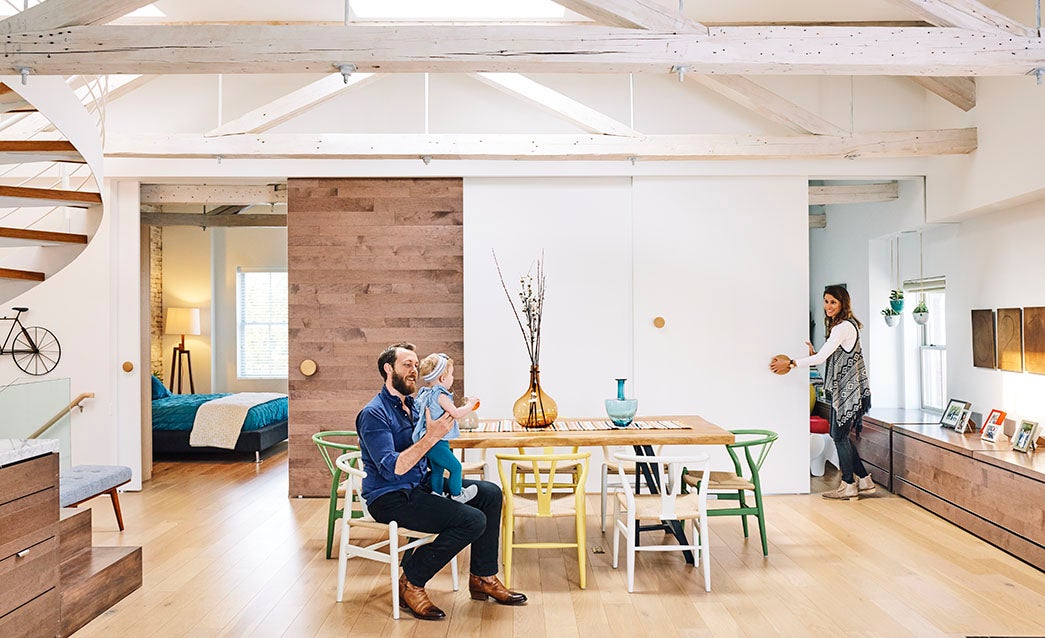
Art, beauty, architecture, family. Alan Ricks cares deeply about all these things, and has brought them together in the top-floor unit of an 1850s brownstone in Boston’s South End. There he lives with his wife, Cristina de la Cierva, a senior product designer for Harvard Business School, and their daughter, Siena, who just turned 1.
Ricks is the chief operating officer and a cofounder of MASS Design Group, an innovative and award-winning studio committed to public interest architecture that improves the lives of people and the communities in which they live. A 501(c)(3) nonprofit organization, it focuses on the importance of dignity and beauty in one’s surroundings, be it a primary school in Rwanda or a tuberculosis hospital in Haiti. Founded in 2008, while Ricks was a student at Harvard Graduate School of Design, the company now has 80 employees and offices in Boston and Kigali, Rwanda. In 2013, he was a speaker at the TEDCity2.0 Conference in New York and this year, MASS (an acronym for Model of Architecture Serving Society) won the 2017 National Design Award for Architecture Design from the Cooper Hewitt, Smithsonian Design Museum, the most recent of many accolades.

Not bad for someone who didn’t initially study architecture. Ricks, who was raised in Dallas (“in a traditional, single-story ranch”), studied studio art at Colorado College and worked in the art world for a few years. Acting on an earlier interest in architecture, he headed east to Boston and Harvard. “I wanted to see design that could have a physical impact on people’s lives,” he says. There, in addition to studying architecture, he found time to play on the Harvard Business School rugby team, important because it was a teammate who introduced him to de la Cierva.

Today, Ricks commutes between MASS Design’s Boylston Street office and his South End condo on foot, enjoying the mile-long walk for the urban cityscape and the neighborhood feeling. In renovating his home, he applied several of his company’s concepts. “We think a lot about behavior change, and that applies to home as much as anything,” says Ricks. “Opening up the space here was to make it conducive to social interaction, making sure there is room to gather around the kitchen while cooking. I thought about how a small space could facilitate a big group.”
The space conveys loft-like openness and a lightness of feeling — with the happy punctuation of Siena’s first footsteps — but the place was anything but serene when Ricks purchased it in 2011, right around the time he and de la Cierva started dating.

Although the living area had a vaulted ceiling with exposed wood trusses, which Ricks believes were installed when the brownstone was converted to condos sometime in the 1970s, the dark-stained timbers and the wall between the living area and the two bedrooms created several tight, enclosed spaces. Dropped ceilings in the bedrooms added to the boxed-in feeling.

The building is on a corner, so the 1,138-square-foot condo has windows on its front, back, and side and gets natural light from the north, east, and west. To take better advantage of that, Ricks ripped out the wall between the living area and bedrooms and removed the bedroom’s dropped ceilings. “Immediately, you felt the difference from having the light on three sides, which is great in a brownstone,” says Ricks.
To have both an open plan and privacy, Ricks devised a set of 10-foot-tall doors that slide barn-style on a concealed track. When the doors are open, the view is from one end of the condo to the other; when closed, the bedrooms are out of sight.





To comment, please create a screen name in your profile
To comment, please verify your email address
Conversation
This discussion has ended. Please join elsewhere on Boston.com