
Architect transforms cornfield into 41-acre ecofriendly home, landscape
It's a garden that never really slumbers. Tour the landscape with Design New England at realestate.boston.com.
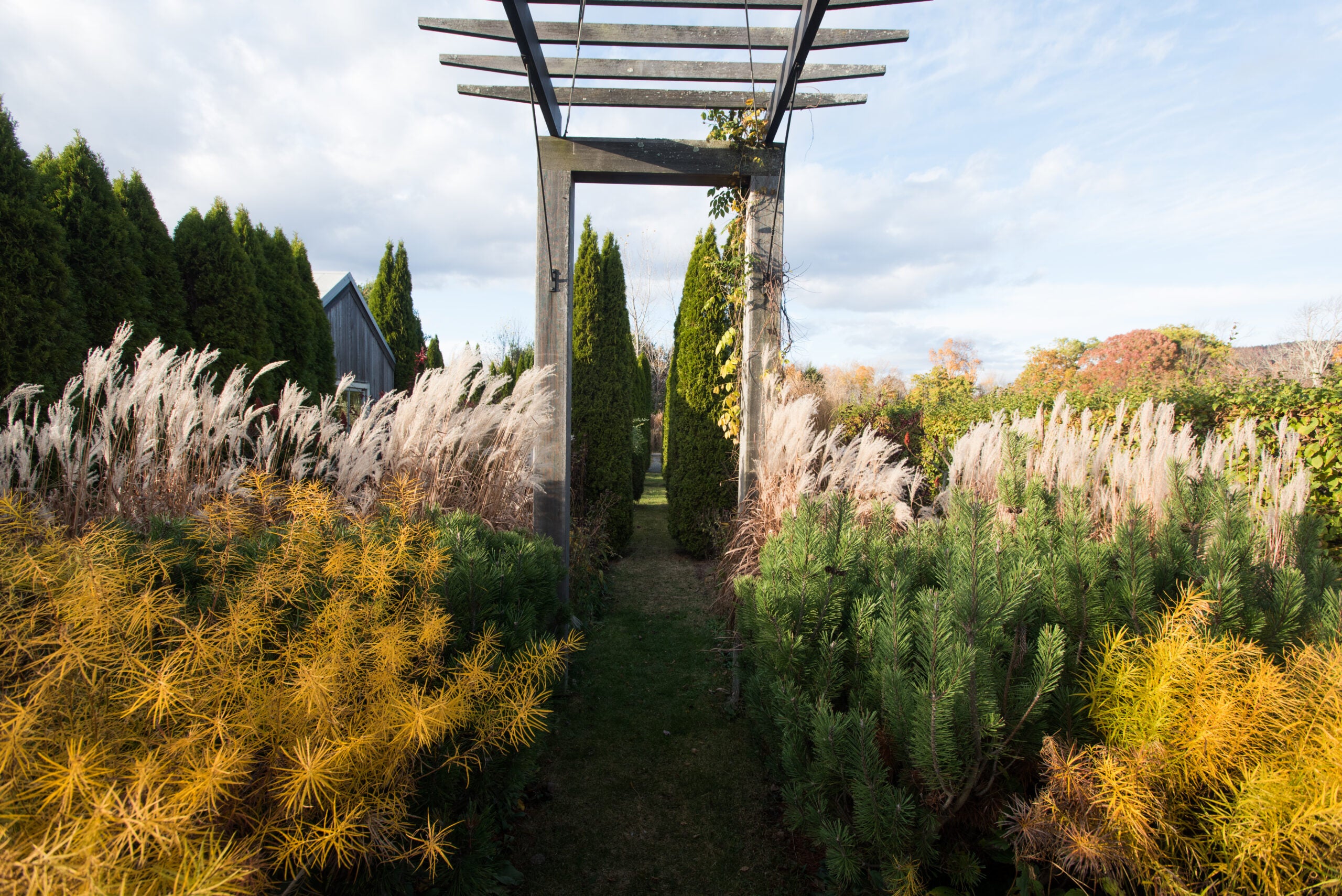
By autumn, they’ve spent their summer energy and performed their full repertoire. But Larry Wente, an architect with Gertler & Wente LLP in New York, and the late Jack Hyland, an investment banker, had longer-term plans for the landscape around the house they designed for themselves on the Connecticut-New York border. Synchronized to show off just when the neighboring valleys, forests, and hayfields are cloaked in many colors, their garden steps up when most others have bowed out. Grassy plumes sway on the knoll, oakleaf hydrangeas blush radiant shades, while hostas blanch flaxen hues, all mirroring the surrounding spectrum.

It took a spectacular package to lure Hyland and Wente from their in-town home in Sharon, Connecticut, where they were perfectly happy. The period house with an in-garden studio suited them fine — until they spied a “For Sale” sign while driving around the nearby countryside. “Did you ever see a cornfield for sale?” Hyland asked Wente as they tooled along. Soon, Wente waded into the cornfield, where, standing on a ladder, he surveyed the view of a lifetime. In that August 2000 instant, as they took in the panorama of Oblong Valley, Indian Lake, a quintessential dairy barn, and a broadloom of farm fields, the two decided the 41-acre property was their future.

Wente was poised for the forward-thinking challenge. He had long hungered to play with ecologically sensitive, energy-efficient, and construction-waste-frugal design. Creating his own home and garden on this parcel would afford him that opportunity. His was a no-apologies plan that celebrates its futuristic approach. Solar panels would be woven into the design. The solar greenhouse would speak to a matching storage shed on a “look at me” central axis. A handsome stand of white pine and spruce, seemingly part of the hedge system, would act as a windbreak protecting the house, while adjacent fields, 30 acres of which were planted with corn and alfalfa, would lap at the foundation, integrating the building into the agricultural landscape.

Besides the year-round dialogue with the setting, the plan is based on a magic number. Everything, says Wente, is done in multiples of four to avoid waste of materials: Paths are 4 feet wide, the pool is 16 by 48 feet, even the orchard was planted with apple trees (rescued from a soon-to-be-abandoned grove) set 20 feet apart.

Before deciding on the final plantings, Wente and Hyland visited gardens and decided what they didn’t want. “We found that we lost interest in endless perennial beds,” says Wente. Instead, they created short and sweet statements such as a series of color-themed checkerboard pocket gardens planted with white, red, blue, and yellow blossoms in a tight grid. Wente calls them modules. “Initially, it was a single brushstroke of design,” he says. But the brushstrokes never ceased and they extended the garden outward.

Although the view was the paramount lure, they chose not to lay the garden bare to the elements in an effort to admire the scenery. Instead, they used peekaboo hedges that frame vistas at key points, and vertical shrubs such as Thuja occidentalis ‘Degroot’s Spire’ serve as exclamation points.

Plantings do not compete with the view. Using ornamental grasses with bulky footprints, statements are broadened. Hyland, who passed away in August, believed that only bold moves could compete with the large-scale distant landscape. Massing and proportion accomplished, they had a field day with color, planting bright red salvias, purple verbenas, and other annuals with hues that remain until the killing frosts.

Autumn is momentous in the cycle of this landscape, but even in winter it has a presence when glittering frost, blustery winds, and the beauty they set in motion are all in the playbill. For a garden that never really slumbers, the view and the outlook are forever.



To comment, please create a screen name in your profile
To comment, please verify your email address
Conversation
This discussion has ended. Please join elsewhere on Boston.com