
California influences shape a Cohasset beach house renovation that embraces sea and sky
Facing the sea, a full-length deck off the main floor had the unfortunate effect of plunging the house’s lower level into darkness, making it dungeon-like and unusable.
Architect Kelly Monnahan studied architecture in California and called on his West Coast inner self in redesigning a 1970s pool house in Cohasset, a coastal town on Massachusetts’s South Shore. “The homeowner and I share a love of the California aesthetic, and the waterfront location of the house meant we could really open up to the view,” says Monnahan, principal of Kelly Monnahan Design in Boston.
Homeowner Ashley Garelick, an interior designer, indeed wanted an open, beach-house sensibility for the dwelling, which she shares with her husband and children, a boy, 11, and a girl, 14, so Monnahan knew that windows would be a major part of the design. “We wanted walls of glass,” he says.
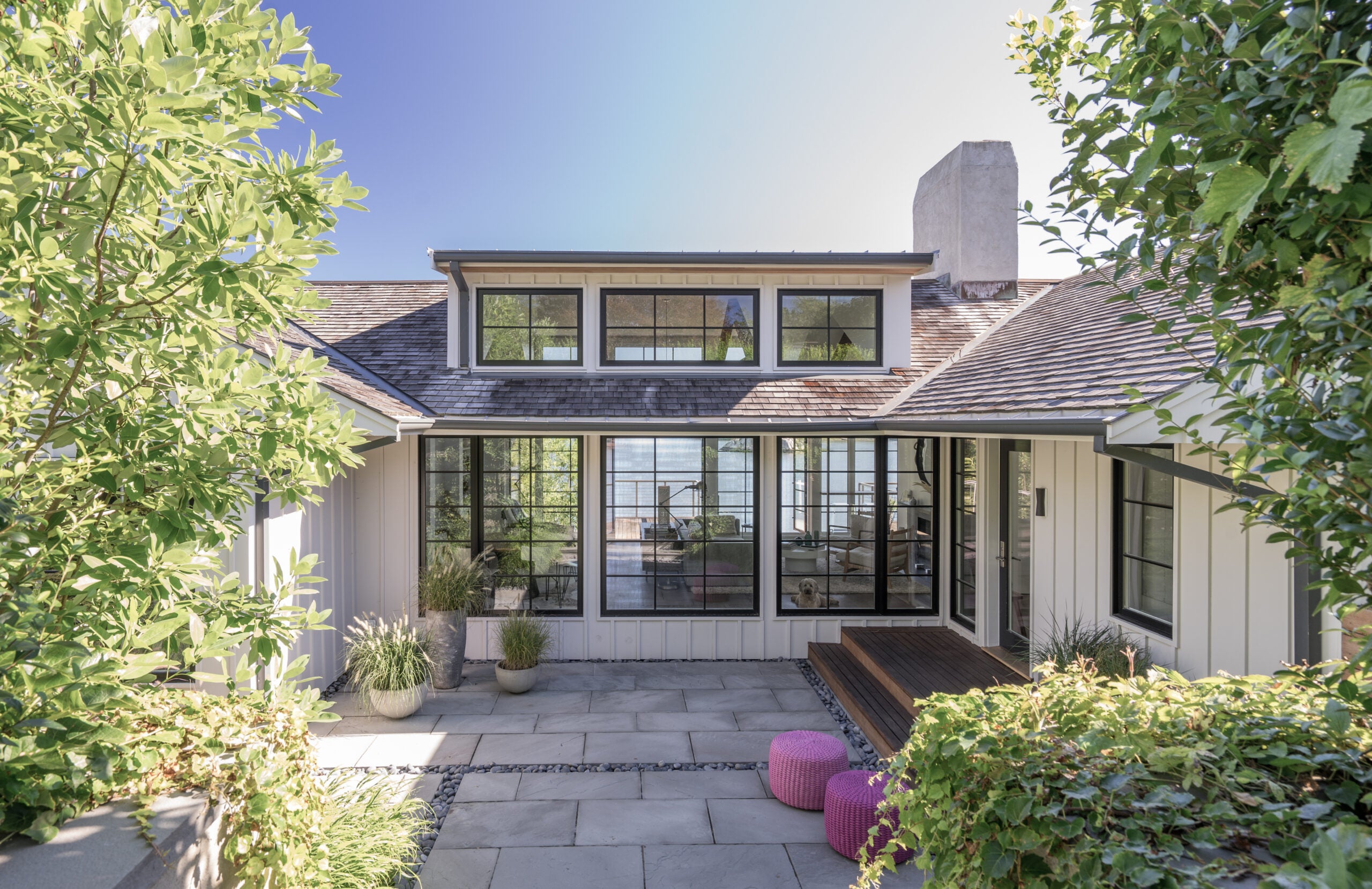
Today, the house is a celebration of windows and water, but that was hardly the scene when the homeowners bought the property in 2010. Built as a pool house for an adjoining property, the 2,600-square-foot structure’s clapboard facade was punctuated by only a few windows on the entry side, giving little indication of the 1-acre-plus waterfront location. Facing the sea, a full-length deck off the main floor had the unfortunate effect of plunging the house’s lower level into darkness, making it dungeon-like and unusable.
Monnahan’s solution for the dual-level ranch-style structure involved two strokes of genius: one, adding windowed shed dormers to the street and waterfront facades, and two, eliminating the full-length deck in favor of a sectioned replacement that would allow light to penetrate the lower level.

“The biggest transformation in the main part of the house,” says Monnahan, “was putting the dormer windows in the living room to expose the light.” Although the room had a vaulted ceiling the new clerestories gave it a sense of spaciousness and volume that set the tone for the entire house.
“As soon as Kelly popped in those clerestory windows, the entire feeling changed,” says Garelick, who specializes in sourcing unusual raw materials through her business, Plankd. With the new dormers, the 16-foot ceiling height now extends across most of the living room, not just at the peak as before.
The living space is made all the more inviting by the view to the sea and the indoor-outdoor connection provided by the new mahogany decks. One, which Monnahan calls a “diving platform” because of its oblong footprint oriented toward the water, is accessed through French doors off the living room. The other wraps around the house, embracing the breakfast area/den and kitchen; doors lead from both areas to the deck, which connects the house to the kidney-shaped pool.

With such an open layout, Monnahan was careful to add built-ins to provide storage. He gave the fireplace, which serves as a room divider between the living area and the breakfast area/den, a new surround that includes 8-foot-tall closets. In the kitchen, he tucked a walk-in pantry in one end of the room to make up for the lack of wall cabinets, which were removed to make way for new windows.
In the private wing, Monnahan kept the three-bedroom, two-bath configuration but added plenty of storage and built-ins. The children’s bedrooms, for example, each include a built-in closet/dresser unit that is accessed by a sliding barn-style door.
The lower level of the house, with its new exposure to light, now functions as a family room with a large flat-screen television, built-in desks for homework or office work, and a glass door to the lawn. From there, it’s a quick jog to water’s edge, where kayaks, kiteboards, and other watercraft are stowed for easy access.
Throughout the house, Garelick infused her beach-house sensibility with materials that include fumed-oak engineered floors and streamlined furnishings primarily in whites and neutrals. “I love a beachy, modern, soft palette,” she says. “What’s important to me with interiors is that they are whimsical, not too serious.”

Keith LeBlanc, principal of LeBlanc Jones Landscape Architects in Boston, transformed the outdoor space. He remade a sad brick-and-concrete area near the driveway into an enticing bluestone-and-pebble entry courtyard with a mahogany landing at the glass front door and plantings that cover an unsightly retaining wall. Facing the sea, he added native plantings to complement the sloping lawn. “On the waterfront, we kept everything much more open, with native plants framing the water,” says LeBlanc.
“In the end,” says Monnahan, “the footprint of the house did not change, but everything else did. The inside feels larger because of the view of the water, and the landscape now feels more connected to the water.”
For Garelick, everything — from the glass walls of the living area to the comfortable lower-level family room to the storage built-ins throughout the house — adds up to exactly what was needed: “It’s a perfect family house.”
See more photos of the home:





To comment, please create a screen name in your profile
To comment, please verify your email address
Conversation
This discussion has ended. Please join elsewhere on Boston.com