
See how this family combined two condos in Bay Village to keep living in the city
The charming neighborhood of Boston’s Bay Village is a hodgepodge of 19th-century row houses and early-20th-century Art Deco office buildings erected by movie studios as film distribution centers.
The charming neighborhood of Boston’s Bay Village is a hodgepodge of 19th-century row houses and early-20th-century Art Deco office buildings erected by movie studios as film distribution centers. Although the vicinity is close to the Theatre District and the Public Garden, changes to the city’s infrastructure eventually left it disconnected from surrounding neighborhoods — and residents here prefer it that way.
“It’s a secret,” says Jeremy Macdonald, who with his wife, Justine, purchased a Bay Village condo in 2008. “A lot of people still don’t even know it’s here.” They made the decision during the economic downturn, when buying real estate in some of the city’s most desirable neighborhoods was an option for the couple. “But I still felt Bay Village was the best place to be in the city,” says Jeremy, who for years had lived in Boston’s Back Bay. That he could walk to work in 20 minutes was a bonus.
Their unit was one of three on the top floor of what was once the Columbia Pictures building, a cornerstone property in the heart of Bay Village. (Stone lion heads decorate the former MGM Studios across the street.) The two-story midcentury brick-and-concrete structure had been turned into condominiums a few years prior, when a third story was added. A few years later, the adjacent condo became available. With one child already, Demarest, now 6, and a desire to grow their family — Julian was born in April — yet stay in the city, the couple seized the opportunity to expand their existing space.
Although the two units were nearly mirror images, fitting them together was no small challenge. There were ceiling heights to reconcile, heating, cooling, and ventilation systems to combine, and neighbors to consider.

The Macdonalds also had high expectations for the 2,700 combined square feet: designated kid space, a retreat for the adults, an open-plan great room, a sophisticated kitchen, and enough outdoor space to satisfy playful children and rejuvenate parents, plus plenty of room for entertaining guests. “We wanted to achieve an open space, with private space for my wife and me, but also space for the child … or children,” says Jeremy. “But how do you make it seamless, so it all flows naturally?”
To answer that question, the Macdonalds turned to architect Derek Snare, who had been working with them on plans for a roof deck before they decided to purchase the second unit. Together, they developed a plan to reconfigure the twin spaces into a U-shaped layout. Now, wings on each side of a new entry and great room house bedrooms — one side for children and one for adults.
“The entry and the kitchen were the big question marks,” says Snare, whose firm, Snare + Snare, is based in Somerville, Massachusetts. He started with a new centrally located entry, a 90-square-foot space that acts as a welcoming vestibule. Due to ductwork above, the ceiling here is just less than 8 feet high. Through a doorway, however, the home launches into a large, open space with wide views from one end of the condo to the other and ceilings at a lofty 11-foot height. The effect is an airy, open-plan space that functionally connects the two private wings with the home’s shared spaces — a sleek kitchen and dining and living areas, with plenty of room for a grand piano that Justine plays frequently.
To make a smooth visual transition between the two areas, the couple chose open shelving for a kitchen wall that can be seen from the dining and living areas. Custom cabinets are faced with glossy cream-colored and mottled coffee-brown doors. The cooktop was placed in the island to keep the chef facing the action in the common area. Above it, the requisite exhaust hood was installed nearly flush with the ceiling to keep sightlines clean.
Now, with window exposures on the north, west, and south sides, the great room and kitchen are flooded with light from dawn till dusk. That was a welcome change, but the existing yellow oak floors and white walls made the space unbearably sunny. “Brightness can be blinding if it’s too white,” says Jeremy, so he and Justine chose Benjamin Moore’s warm Revere Pewter paint for the walls, a dark stain for the floors, and natural reed window treatments that help ground the space.
Warm red tones in the accent wall around the fireplace and in a blown-glass chandelier complement the couple’s large collection of Asian artworks, gathered during their travels to Laos, Indonesia, and Cambodia. An appreciation for the art and craftsmanship of those countries combined with a desire for clean, modern lines led to a transitional design that Jeremy describes as “Asian fusion with Italian Modern architecture.”
Off the living area, a hallway opens into a multipurpose salon, which functions as a sitting area, lounge, home office, and sometimes party space. Like the kitchen, this area also leads to a small terrace. Outfitted with teak built-in cabinetry, this flexible room efficiently serves its many masters but elegantly hides its multi-use status. “We have work to do,” says Jeremy, peeking into a cupboard that hides gadgets and office supplies, “but we don’t want it to be seen. It really is a functional room.”

Between the cabinets, the design-build team, which included Essex Restoration of Wilmington, Massachusetts, installed an ornately carved teak door acquired in Indonesia. Beyond it lies a hidden gem: a former master bath that was transformed into a wine cellar and fully stocked bar, perfect for when friends come by.
On the other side of the room, pocket doors lead to the master bedroom. Here, too, necessities stay tucked out of sight, allowing teak panels to drive the decor. The adjacent master bath features a screen also made of teak, a pebble-tile floor, and art tile from Bali. Although the size of the room is not majestic, the combination of materials makes it seem grand.
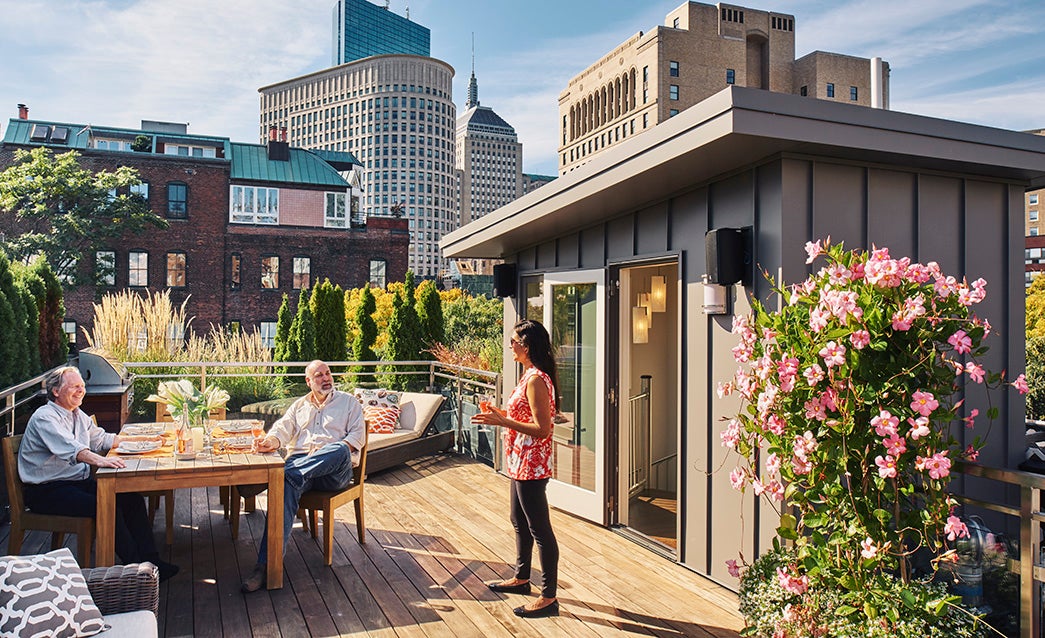
In the hallway off the master suite, a custom-built powder-coated steel spiral staircase leads to a roof deck accessed through a small head house that has just enough space for a compact kitchenette. With an elevator block on one side and ductwork popping out all over, building on the rooftop was a tricky proposition. “It was really challenging — the engineering of it,” says Walter Beebe-Center, owner of Essex Restoration, who led construction on the renovation. The team had to establish how and where to penetrate the roof, move neighboring ductwork, calculate the weight of the structure and furnishings, build it safely to code, wire it for speakers, and install an irrigation system for the rooftop garden.
“One 500-square-foot roof deck gave me 100 problems to solve,” says Beebe-Center, “which is cool. That was the fun part — figuring out the geometry and what would fit.” Now a large grill, herb and flower gardens, and play space for the children provide everyone with ample opportunities for outdoor fun.
“This is modern city living,” says Jeremy, scanning the 360-degree view. In one direction, the city skyline is marked by Liberty Mutual Insurance Co. headquarters, Hancock Tower (now officially dubbed 200 Clarendon Street), and the landmark 200 Berkeley Street building, a.k.a the Old Hancock Building. The other way, it’s clear blue skies with no structure higher than this three-story spot to block the southerly view. “Most people move to the suburbs because they want more space, and so their kids can play outside,” says Jeremy. “But up here, I can get my grilling fix and my son can throw around a ball. It really is the best of both worlds.”
See more photos of the home:





To comment, please create a screen name in your profile
To comment, please verify your email address
Conversation
This discussion has ended. Please join elsewhere on Boston.com