
Address Newsletter
Our weekly digest on buying, selling, and design, with expert advice and insider neighborhood knowledge.
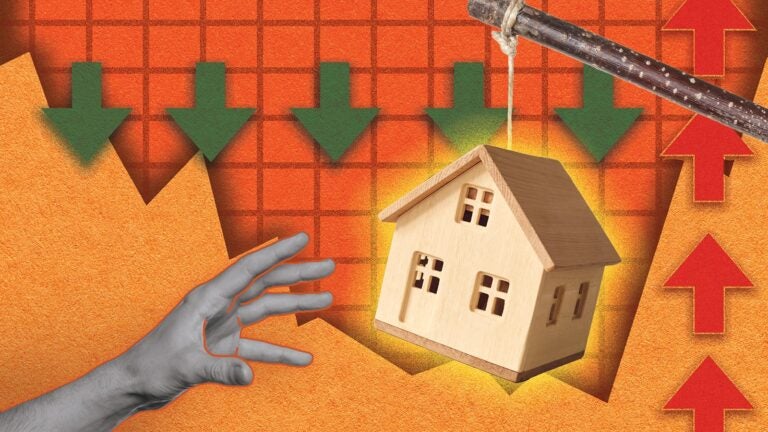
Just a few weeks ago, things were finally looking up for Greater Boston’s housing market.
After a four-year-long freeze with a shortage of interested buyers and sellers, mortgage rates were finally on a sustained decline, easing the vice of high borrowing costs that had kept so many people out of the market. Real estate agents and economists foresaw a gangbusters spring.
It only took a few weeks for all of that optimism to be wiped out.
Mortgage rates shot back up in March amid global instability and rising oil prices related to the war in Iran. And now, a big group of prospective buyers who thought they might be able to afford Greater Boston’s sky-high home prices if their monthly costs were lower are back where they have been for the last few years: priced out, and waiting.
“It has certainly had an impact,” said Melvin Vieira Jr., a real estate agent at RE/MAX Real Estate Center in Boston. “You have a pool of buyers who were looking very seriously at buying this year … who are looking at interest rates now compared to a few weeks ago and saying, ‘I don’t think I can make this work anymore.’”
Indeed, after widespread hope that homes would start changing hands again this spring — what is typically Greater Boston’s peak home-buying season — economists and real estate agents are now forecasting a far milder few months of sales.
Consider: Just 388 single-family homes sold in the region in February, according to the Greater Boston Association of Realtors, and just 643 homes were put on the market for sale. Both of those figures are down from the same month in 2025, which was one of the slowest years for home sales in recent memory. Those numbers were recorded before mortgage rates spiked.
The problem is the same dynamic that has kept the housing market effectively frozen since mortgage rates first began to rise in 2022.
While home prices in Greater Boston have been high for decades, they have soared to new heights over the last decade. But until recently, that period of home price growth coincided with historically low mortgage rates, with the average on a 30-year fixed-rate loan dipping below 3 percent in 2021. That meant middle-income families could still afford to buy because monthly loan payments were low.
Rates more than doubled in 2022 and have remained elevated, meaning prospective homebuyers now have to contend with both high price tags and high monthly payments. Roughly 100,000 people who could afford an entry-level home in the region in 2021 could no longer afford that home in 2025, according to one estimate.
The rise in mortgage rates has kept many residents from selling their homes, too, because most homeowners have a mortgage rate below the current 30-year average, meaning they would have to trade a lower rate on their current home for a higher rate on a new one.




In other words, for the past four years, no one could afford to buy, and no one wanted to sell. Spring housing market seasons reflected that fact, with few homes changing hands.
The average on a 30-year fixed-rate mortgage peaked near 8 percent in October 2023, and since then, rates have been slowly trending down, including a sustained period of declines in 2025 that led real estate agents to believe that this spring could finally see Greater Boston break out of its housing market malaise.
That prospect seemed imminent in early March when the 30-year fixed-rate average dipped below 6 percent for the first time since 2022.
“We were seeing more inventory … modest price increases, and decreasing rates, which meant that housing affordability was improving,” said Brad Case, chief residential economist at the real estate listing site Homes.com. “Those were all precursors for a strong spring market.”
But the downward trend in rates has reversed sharply in the weeks since the United States went to war in Iran, with the average on a 30-year fixed-rate mortgage hitting 6.46 percent. That shift is not likely to halt the spring season entirely, but it will certainly slow things down, said Case.
“Buying and selling will continue to happen,” he said. “But lots of people who had been putting off their buying or selling for a couple of years now in hopes of things starting to get more affordable are going to think to themselves, ‘Well, maybe I can put this off for one more year.’”
But regardless, some real estate agents are still hopeful for a big spring.
Sage Jankowitz, a real estate agent based in Cambridge who owns the brokerage Cambridge Sage Real Estate, said he is already seeing signs that buyers may be more serious this spring than they have been in the past few years.
Many of the properties he has seen on the market in recent weeks are drawing significant competition, with multiple buyers putting in offers over the sellers’ asking price. One of his clients recently secured a single-family home in Arlington — a simple house with a two-car garage and a nice family room — that had offers from seven interested buyers.
“I was definitely feeling pessimistic going into this year, with the state of the economy and the war in Iran,” said Jankowitz. “But from what I’ve seen so far, it feels like buyers are more serious about going out and getting a home than they have been the last few years.”
Joselin Malkhasian, a realtor at Lammachia in Waltham and the president of GBAR, said she is seeing intense competition, including bustling open houses and bidding wars, for homes in the suburbs of Boston, particularly the band of wealthy towns west of the city.
Economists have wondered for several years now if, at a certain point, buyers and sellers who have been holding out for lower mortgage rates will finally get tired of waiting. After all, mortgage rates were above 6 percent for decades leading up to the Great Recession, and people still bought homes. There’s a possibility that this spring is when home buyers and sellers finally accept that elevated mortgage rates could be here to stay.
“It’s actually more affordable to buy a home right now because rates are still lower than they were last year,” said Orphe Divounguy, a senior economist at Zillow. “So I think it’s fair to expect a modest uptick in activity this spring.”
Beyond mortgage rates, Vieira Jr. said, the sense of uncertainty that many people feel about the state of the economy and broader global instability, including the war in Iran, could also put a damper on the housing market this spring.
“It’s difficult for people to feel confident making the biggest purchase of their lives when they don’t know which way the economy is going to go,” said Vieira Jr. “You don’t want to be on the hook for a mortgage when you don’t know if you’re going to have a job next week.”
Our weekly digest on buying, selling, and design, with expert advice and insider neighborhood knowledge.




Be civil. Be kind.
Read our full community guidelines.To comment, please create a screen name in your profile
To comment, please verify your email address