
Sign up for the Today newsletter
Get everything you need to know to start your day, delivered right to your inbox every morning.
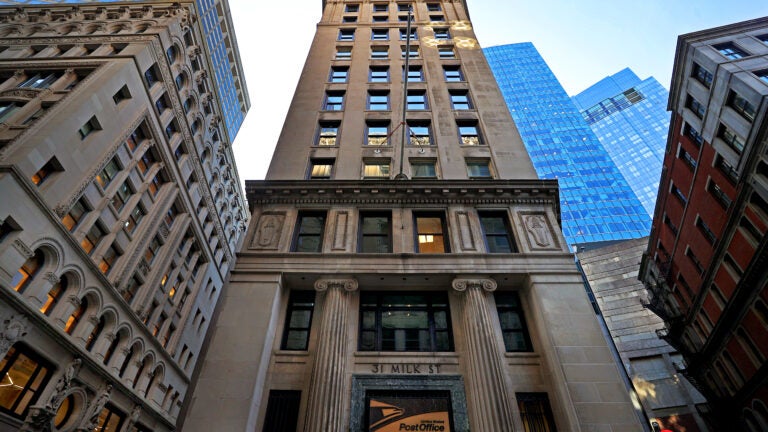
Two downtown Boston office buildings — one in the Financial District and the other in the North End — will soon be converted into housing, following approval last week by the Boston Planning and Development Agency.
Both projects will bring in residential units to underutilized, historic office buildings.
“It’s exciting to see more and more of these residential conversions come before the board,” Matt O’Malley, a board member and former city councilor, said at the hearing. “It’s a fantastic location and brings vibrancy and life — and the fact that there’s a significant number of affordable units is terrific.”
Developer Dinosaur Capital Partners is converting 9 Arch St., also known as 16-18 Hawley St. and 31 Milk St. in the Financial District, into 110 new rental units, 22 of which will be affordable, in an 11-story building.
The historic exterior facade will remain the same, and the U.S. Post Office will remain on the ground floor.
Copper Mill developers are behind the North End project at 123 N. Washington St., which will create 45 new rental units, seven of which will be affordable, in a five-story building. About 500 square feet of restaurant or retail use will remain on the ground level.
Both projects have zero parking included.
At the meeting, board members discussed how the Washington Street building used to be a kitchen supply store. Mark Callahan, the head of development for Copper Mill, mentioned at the hearing that the building used to have a toilet showroom, with some toilets still in the basement.
However, in the 1900s, he said, the building was a candy factory that later became a biscuit company.
“I think this building has a fairly interesting history, and I hope that when you do the conversion, you find some ways of memorializing that,” board member Ted Landsmark said at the hearing.
The approvals were part of a tax incentive program to boost residential development in the city’s core.
According to a recent city presentation, the city has received 15 applications to create 762 housing units across 20 buildings and convert over 600,000 square feet of office space. Once completed, the projects will bring in over 1,500 new people living downtown.
Boston’s downtown office vacancy is about 20% and expected to rise to 30%, whereas residential vacancy is about 4%. The city hopes to convert the offices to help revitalize Boston’s downtown following the COVID-19 pandemic.
The conversion program allows developers to have a 29-year, 75% residential abatement. It also gives builders as-of-right zoning in the downtown area and a fast-tracked Article 80 permitting process to save time and money.
Projects must have 17% residential units at 60% area median income (AMI) and preserve ground-floor retail. The city aims to revitalize 1,000 new housing units and 1 million square feet by 2026. Developers have until December to apply.
Callahan said at the hearing that the tax incentive was why Copper Mill decided to proceed with this project.
It was “a great key to unlock the potential in this building because it’s been empty for a long time,” he said.

Get everything you need to know to start your day, delivered right to your inbox every morning.


To comment, please create a screen name in your profile
To comment, please verify your email address
Conversation
This discussion has ended. Please join elsewhere on Boston.com