


Address newsletter
Get the latest news on buying, selling, renting, home design, and more.
It takes creativity, compromise, determination — and more money than ever — to buy a home in America right now.
Last year, just over 4 million existing homes sold in the United States — the lowest number in nearly three decades, according to the National Association of Realtors. Loans have gotten more expensive, as mortgage rates have more than doubled in three years and are now about 7 percent, for a typical 30-year loan.
Still, resolute buyers are managing to make the big purchase. Nine households across the United States that bought real estate in the past year told The Washington Post how they navigated the buying process during tumultuous times – and what advice they have for others.
Ryan Smith was determined to buy a home, but he needed assistance to make a down payment.
“That was the barrier for myself — and for a lot of people,” Smith said.
So Smith, a Washington, D.C., resident for five years, started researching programs that help first-time home buyers make down payments. Lydia’s House, a community development nonprofit organization, helped him apply for D.C.’s Home Purchase Assistance Program.
The selective program gives interest-free loans to first-time home buyers with low to moderate incomes. Smith was approved in November, a month after applying.
Smith, 43, sees his purchase as a chance to increase the representation of Black homeowners.
“It’s really important, in my eyes, especially for minorities in marginalized communities to be in those numbers,” he said.
Just 7 percent of recent home buyers are Black, compared with 81 percent who are White, according to a National Association of Realtors survey released last year.


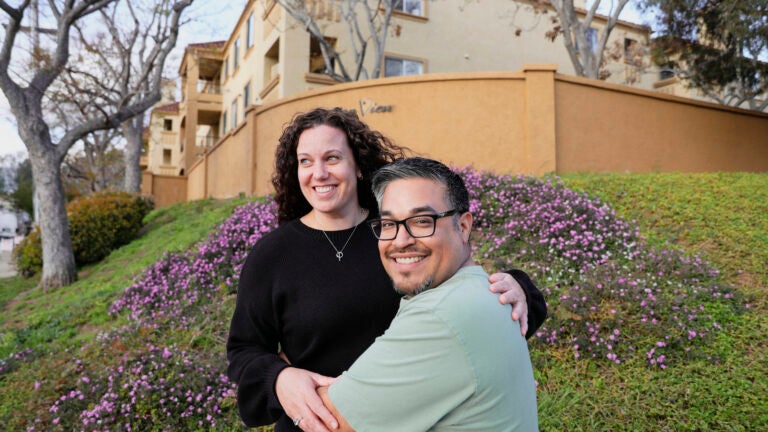
For years, Jennifer Morris and Joel Cuevas, both 39, had been dutifully tracking their spending. But they had no idea what kind of mortgage they could afford, and a bank offered little advice.
Cuevas’s boss at the University of San Diego connected the couple with a real estate agent, who set them up with a mortgage lender. Unlike the bank, the lender answered their questions and helped calculate their mortgage payments with current interest rates. They started their hunt in earnest.
Morris and Cuevas were determined to stay in the city, but they didn’t have the money to compete with all-cash offers or big down payments. “Three or four places, we got denied,” Cuevas said.
With each failed attempt, the couple got more competitive with their offers. Finally, they offered to close on a condo in just 11 days.
“We didn’t have the highest offer,” Morris said. But she thinks that quick timeline sealed the deal.
The condo gives them financial flexibility to continue to travel, see shows, go out to eat — and keeps them in the city close to the beach.
“We’re not sacrificing what’s important to us just to own a home,” Morris said.


Sarah and Mitch Shervin used a nontraditional approach to stay in the Jackson Hole region in Wyoming amid rising prices: They moved into their Sprinter van with their three dogs.
Sarah, 37, and Mitch, 33, both work full-time jobs — as a paralegal and an IT specialist — but part of their income comes from freelance work, a combination that proved difficult when they were trying to secure a loan from the bank.
“We couldn’t even afford to stay in our hometown,” Sarah Shervin said. The cheapest place they saw in Jackson was an $800,000 two-bedroom condo, and that was out of their budget.
Then they heard about Shacks on Racks, a local organization that moves old houses that are scheduled for demolition and sells them. They bought a 1947 home that had been lifted from Jackson and moved to a vacant lot 45 miles south of the town.
Even after Shacks on Racks extensively renovated the dwelling, the Shervins’ new-old house was significantly less expensive than anything else they had found in Jackson, where the median sale price for a home in February was nearly $2.8 million, according to Redfin.
“I’m kind of glad the bank threw up so many roadblocks to us staying in Jackson Hole,” Sarah Shervin said. “It honestly worked out better.”


Lucy Lopez, 42, and Damon Holmes, 49, intended to buy a move-in-ready home for them and their child. But after searching for nearly three years, they ended up with a 100-year-old brick home that was previously condemned and in need of a total remodel. The house, including renovations, will cost just $2,000 under their $400,000 budget.
“We wouldn’t move there the way it is,” Lopez said, “but the bones are beautiful.”
Initially, she said, she would have been “so scared” to do a big remodel project like this. But after years of investing in property and touring houses, the couple decided the risks of construction were worth it to get their own perfect space.
In 2021, they used a combination of their personal savings and a first-time home buyer loan to buy their first property together — a multifamily that they fixed up and rent out. The process prepared them to later buy their own home.
In the end, their home’s total construction project will cost more than $250,000 — the largest chunk of their $400,000 budget. But when it’s done, the family is looking forward to moving into a customized home.


Stephanie Yaa Annor, 34, started looking for a multifamily — where she could live while making rental income — in January 2023. She was thrilled when her offer on a remodeled home, with a separate back unit, was accepted the next month.
Then came the inspection. The seemingly perfect house needed to be rewired, the water heater needed to be moved, the siding was collecting moisture, and it had foundation issues.
“I think that inspection really just kind of opened my eyes,” Annor said.
She found similar issues with her next accepted offer, on a duplex. An inspection revealed it had been built too close to the house next door.
“It was a major fire hazard,” Annor said.
Annor was finally released from the duplex contract in July. But in those five months, the interest rates she was quoted for her loan climbed from 5.625% to 7.125 %.
Finally she found a 1940s bungalow with a rental unit in East End, one of Houston’s oldest neighborhoods. The inspection wasn’t perfect, but the seller was committed to making the necessary repairs because the house had been on the market for more than a year. Annor closed in November.
The back unit, which she rents on Airbnb, has been occupied nearly every weekend since February.
“The next time I do this, I’ll be well-informed,” she said. In the meantime, she’s happy where she ended up.


First-time home buyers Jasmin and Dan Deitrick, 28 and 30, once estimated they could afford a $300,000 home. But as they learned more about buying a property, they decided to shave $100,000 off their upper limit, in part so they could keep their monthly payment below $1,400, similar to their rent.
Their real estate agent and lender also helped them analyze their savings and how much to use for a down payment, insurance and maintenance.
The couple also found they were eligible for a Federal Housing Administration loan. The loan, which is popular with fellow first-time home buyers, is guaranteed by the FHA and allows buyers to put down as little as 3.5% of the purchase price.
Even with financing in place, the search was frustrating. The loan requires certain inspection qualifications, such as having a roof that will not need to be replaced right away. In their first month, the Deitricks lost out on two properties and pulled a third offer because the house “failed miserably in the inspection stage.”
So when Jasmin Deitrick saw a two-bedroom home in their budget with a large fenced yard in good condition, she raced to put in an offer — even though Dan hadn’t even seen the home.
“This house had only been on the market for, like, a day, and it already had 119 showings scheduled,” Jasmin Deitrick said.
She was the first to make an offer, and Dan loved the house when he saw it that night.


When searchin gto buy a short-term rental property north of New York City, Karl and Owen Rutter realized they had to become experts in the municipal laws of New York’s Hudson Valley region.
Short-term rentals, like those on Airbnb or property management sites, have exploded in popularity in the last decade. But across the country, many towns are cracking down on rentals.
The Rutters, who wanted to know how those laws would apply to their new home, found some of them limiting. One town allowed only 12 permits for short-term rentals each year. Another had put permitting on pause as it figured out how to navigate the growing industry.
Finally, the couple found Saugerties. The rural town about two hours north of New York City would allow them — with proper permits — to buy a house to rent out on a short-term basis.
Originally, they wanted a multiunit building to invest Karl Rutter’s inheritance, but such properties were out of his budget, so Rutter, 55, pivoted to single-family houses. Even with an all-cash offer, it took them nine months.
The Rutters worked with contractors to fix up the foundation, kitchen, and bathroom before renting it out this spring.
“We put in a lot of sweat equity,” Owen Rutter, 32, said.


As an active-duty Army officer, Rosa Maria Robertson, 30, doesn’t always have a choice about where she lives. But when she was relocated to her hometown of Miami, she started thinking seriously about buying an investment property there.
Robertson realized she had an advantage because she qualified for a loan partially guaranteed by the Department of Veterans Affairs, allowing her to skip the down payment. She figured out that she could use the loan to buy a multifamily property and live in it, while renting out the other units.
“What I did was look for a little bit of a rougher house in a good area and then invest the money in doing the renovations,” Robertson said.
But it hasn’t been easy, and Robertson leaned on her real estate agent, her contractor, and other landlords for advice on navigating city regulations while renting and renovating.
“I ended up reaching out to someone I trusted,” Robertson said. “She helped me through the entire process.”


When Alan Bergstrom’s financial industry support company went fully remote during the pandemic, he and his wife, Rebecca, started thinking about relocating from Wisconsin to a warmer climate and smaller home.
Alan, 68, and Rebecca, 53, had friends in the Tucson area, and they decided to visit to see whether the city might be right for them.
Seven months and a dozen house tours later, they found a house with a view of the Santa Catalina Mountains and made an offer in July. It was accepted the next day — and the Bergstroms paid under asking after the house appraised for less than the list price.
However, the Bergstroms’ home in Wisconsin still hasn’t sold. They are hopeful that as the weather warms up — and perhaps interest rates go down — the market will improve.
“We left a 2.9 percent mortgage in Wisconsin,” Alan Bergstrom said. “It’s 7.5 percent here.”
Still, he believes they made the right choice.
“It’s just a matter of time,” he said.


Get the latest news on buying, selling, renting, home design, and more.





To comment, please create a screen name in your profile
To comment, please verify your email address
Conversation
This discussion has ended. Please join elsewhere on Boston.com