
Address newsletter
Get the latest news on buying, selling, renting, home design, and more.
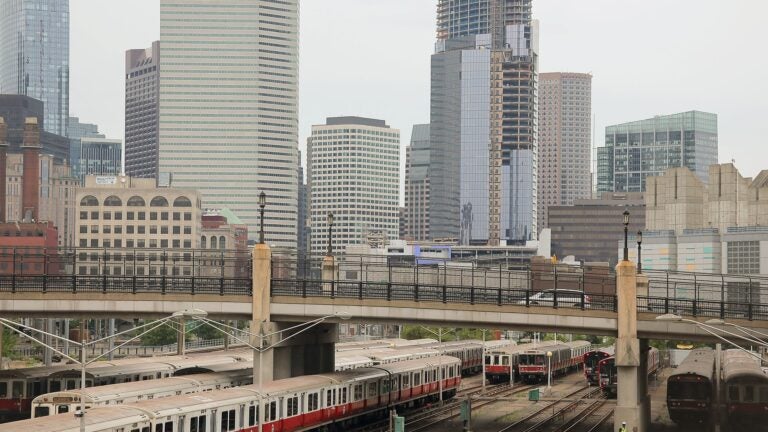
Drill, baby, drill — that is, if you want to connect two of Boston’s busiest rail hubs and the Northeast Amtrak network.
Transit proponents have said this for years of the North–South Rail Link, a proposal that would connect North Station and South Station via a rail tunnel running under the heart of downtown.
Critics say the project, now dubbed the “Rail Link,” could cost tens of billions of dollars and be a wash-rinse-repeat of Big Dig budget overruns and disruption. In 2018, the Massachusetts Depart of Transportation estimated the rail project would cost $12.3 to $21.5 billion, depending on the scope of the project.
But supporters now have the backing of one of the region’s top politicos, who is touting the project’s potential housing benefits.
“The Rail Link is the single most important project for transportation in Massachusetts,” US Representative Seth Moulton of Salem said in a statement earlier this summer.
“Every conversation we’ve had with the private sector has been not just positive, but enthusiastic,” he added in an interview with the Globe in October. “These private sector leaders understand what this would do to energize the Massachusetts economy. The overall economic benefits are absolutely transformative. It just completely changes our transportation system, which is fundamental to the health of our economy because everyone in the private sector knows how much time people are spending stuck in traffic.”
Moulton revived support for the rail project earlier this year by touting it would generate roughly $30 billion in economic benefits and incentivize the creation of more than 150,000 housing units. That is more than 10 times the number of units permitted statewide last year, according to Moulton’s office.
Additionally, Moulton said modern tunnel-boring technology will keep costs in check. Further, the Rail Link’s costliest four-track option would provide connection-free service from southern parts of the state to points north of the city, as well as Amtrak routes from Springfield to Maine, according to the MassDOT study.
Moulton’s project cost and housing figures come from an ongoing Harvard John F. Kennedy School of Government reexamination of the Rail Link project. The team’s latest estimate pegs it at $8 billion.
“Part of the whole point of this lab is to say we know costs change. We get it. We agree they are going to be higher, but let’s not forget all the benefits,” said Brian Iammartino, an adjunct lecturer in public policy at the Kennedy School who is overseeing the working paper.
The Globe reached out to the offices of Governor Maura Healey, Boston Mayor Michelle Wu, and US Senators Edward J. Markey and Elizabeth Warren for their stance on the project.
“History teaches us [that] investing in transformational passenger rail projects has always increased the value and availability of housing in communities,” Markey said in a statement. “There is no doubt that projects like the Rail Link, West-East Rail, Compass Rail, and beyond can both spur more housing development and connect more affordable communities with downtown Boston via efficient rail and transit.” While the Rail Link and West-East Rail are fairly well-known proposals for better connecting Boston with towns and cities across the state, Compass Rail is a broad term used by MassDOT to describe proposed improved intercity rail coverage with north-south service through the Connecticut River Valley and east-west service between Boston and Albany, where Springfield is the hub.
Warren said one of her top priorities is to lower the cost of housing “and to do that, we need more housing supply in Massachusetts. I’m a big fan of thoughtful transit policy that incentivizes the construction of more housing units, improves access to affordable housing, and creates new jobs.”
Boston transit circles have talked about the Rail Link, and its various iterations, for decades. When a Plymouth commuter who works in the West End arrives at South Station on a cold January morning and must trudge through the snow for 20 minutes to get to work, the rail-link concept may seem appealing.
But transit talk these days appears to have shifted more toward fixing and maintaining the existing network rather than expanding it. The MBTA estimated last year that it would need $24.5 billion just to keep the existing system in good repair. It may be time to think differently about the future of the system before pumping that much into the status quo.
“We have tried for decades to fix the MBTA by simply patching up a 19th-century system,” Moulton said. “We need to build a 21st-century transportation system for Boston and for Massachusetts.”
Lately, talk of fixing the congestion at South Station seems to be focused on expanding the facility, not connecting it to North Station. The 2018 MassDOT study said the expansion would cost $4.69 billion. The project hinges upon striking a deal with the Postal Service to move its local headquarters, something that gained support last year but still hasn’t panned out after years of talks.
MassDOT’s 2018 study noted that the Rail Link would eliminate the need for the Widett Circle layover facility the South Station expansion would require. Further, the Rail Link would open up redevelopment potential at North Station because the surface-level tracks there would no longer be needed.
There also is redevelopment potential around South Station should leaders decide to pursue the Rail Link: three significant spots in Boston’s urban core, in addition to the areas around commuter rail stations.
Transit experts interviewed for this story point to the Réseau Express Régional rail network in Paris as a leading example for Massachusetts. The high-frequency rail system, better known as the RER, first opened in the 1970s and connects the French capital with towns and cities in the region’s periphery, making for significantly reduced travel times.
But don’t brush off your best “Emily in Paris” beret to board the MBTA’s commuter rail: The RER runs trains sometimes at 2-minute intervals, according to the International Association of Public Transport. Local regional rail advocates want to see a regional rail network here with trains arriving every 10 minutes in the urban core, every 15 minutes within Route 128, and every half-hour in the suburbs.
“We have tried for decades to fix the MBTA by simply patching up a 19th-century system. We need to build a 21st-century transportation system for Boston and for Massachusetts.”
US REP. SETH MOULTON
“What is true [is] that the creation of the RER system in the Paris region, which is similar in some ways to what is being proposed in Boston, was associated with very significant growth in the suburban areas along the rail line,” said Yonah Freemark, a principal research associate at the Urban Institute’s Metropolitan Housing and Communities Policy Center.
London’s Crossrail project (now known as the Elizabeth Line), which became fully operational last year, is expected to have a similar impact as the RER, but it’s still too early to gauge how successful it will be in generating housing. Advocates also had pushed the project’s potential for housing creation.
Those still suffering from that Big Dig hangover may point out that both the RER and Elizabeth Line projects went over budget, but experts advise looking at the big picture. Even Sydney’s iconic Opera House was first viewed as a failure after the project, initially expected to cost $7 million, went 1,300 percent over budget and opened a decade late.
“The point is that what might seem like success one day turns out to be a disaster, and what appears to be a disaster one day could turn out to be a success,” said Philip Mark Plotch, principal researcher at the nonprofit Eno Center for Transportation.
We can see how this played out in our own backyard. Just look at the Rose Kennedy Greenway, the economic boom of the Seaport District, and the better-connected Logan Airport to see how the Big Dig’s cost overruns may have been worth it, after all.
Get the latest news on buying, selling, renting, home design, and more.
But there’s also a lesson to be learned about building these projects to their full potential.
Philadelphia’s Center City Commuter Connection is frequently used as an example of how Boston’s Rail Link could pan out, but those interviewed for this story also noted that the four-track tunnel is underutilized.
“Because of regional economic problems and other issues, the service levels provided on the regional rail network [in Philadelphia] never really lived up to the ambition of the project,” said Freemark, of the Urban Institute. “That means people can’t rely on the regional rail system as well as they should be able to get from place to place very frequently.”
Today’s tunnel-boring technology means a theoretical Rail Link project wouldn’t have the disruptive cut-and-cover building technique of the Big Dig — meaning downtown Boston can hum right along while a new rail tunnel is built nearly 200 feet below street level. But building and materials costs are still higher today than what they were decades ago.
The housing potential has the most ardent watchers of the MBTA onboard.
TransitMatters, an organization that wants the state to go from a commuter-oriented system to a regional one that promotes economic prosperity in outlying areas, released a statement last month saying their stance on the Rail Link has “evolved.”
“Regional Rail is quickly becoming a reality with a new electric rolling stock for the Fairmount Line and a transformative new operating contract that specifies electrification,” the transportation advocacy group said. “The ultimate version of Regional Rail involves through-running via the Rail Link to allow for higher frequencies, more streamlined operations, and better land use. It will take some time to make this a reality, so we applaud the Congressman’s vision in thinking about the future.
“We believe that we can begin the first phase of Regional Rail while planning for the Rail Link — it doesn’t have to be an either or.”




To comment, please create a screen name in your profile
To comment, please verify your email address
Conversation
This discussion has ended. Please join elsewhere on Boston.com