
Address newsletter
Get the latest news on buying, selling, renting, home design, and more.
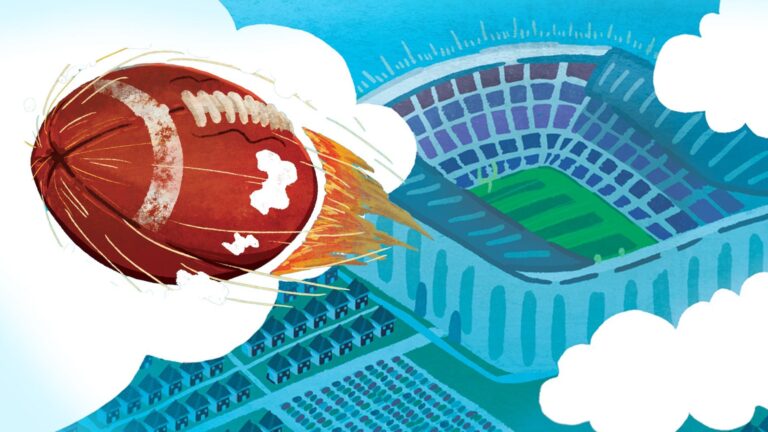
While some may have viewed Boston’s short-lived bid for the 2024 Summer Olympics as a welcome case of “good riddance,” it’s hard this year not to feel a twinge of “what if.”
Supporters of hosting the Olympics in Boston touted plans of converting the Olympic Village and stadium into much-needed housing once the flame moved on. There was also chatter of using the hard deadline of the opening ceremonies as an Olympic flame-sized fire under our you-know-whats to get our transit system in working order.
Well, we aren’t hosting the Olympics, but stadium building in itself can be a catalyst for housing.
“What’s happened over the last ten or fifteen years is a new financing model has emerged that’s usually referred to as public-private partnership,” said Andrew Zimbalist, a Smith College sports economist and professor emeritus who coauthored the book “No Boston Olympics: How and Why Smart Cities are Passing on the Torch.”
Mind you, stadium building isn’t immune to inflation: Gillette Stadium cost $325 million to build in 2002 or about $550 million today, whereas the new Nissan Stadium for the Tennessee Titans in Nashville is slated to cost more than $2 billion to build. (The latter will have a retractable cover.)
Neither sports team owners nor municipal governments want to foot the bill on their own, so that’s why a plan to tether stadium development to a hefty community benefits package has become increasingly the norm.
This typically means finding land adjacent to the stadium to make available for alternative development with a variety of tax incentives, Zimbalist said. The master plan for a Major League Soccer stadium development in New York City’s Willets Point neighborhood includes 2,500 units of affordable housing, as well as a new public school.
“You can’t find a city in the United States anymore that doesn’t have a housing problem,” Zimbalist added. “Part of the come-on about why [a stadium proposal] is going to be good is because they’re going to build new housing.”
The proposed soccer stadium for the New England Revolution could fuel significant redevelopment in Everett, where the Kraft Group and Mayor Carlo DeMaria want to find a new home for the Major League Soccer franchise. The owner of the Philadelphia 76ers points to the Hub on Causeway, a mixed-use development attached to TD Garden, as inspiration for his plans to build a new stadium in the City of Brotherly Love.
“The idea of cities offering up either land or tax incentives or even cooperation in exchange for the development, including these civic goods of housing or schools, makes a ton of sense and are increasingly popular,” said Diana Lind, an urban policy consultant. “For a city like Boston, given its housing crunch, you can’t build something without including housing as part of the package.”
Keep in mind: It took Hub on Causeway — which includes an office tower anchored by Verizon, a hotel, an apartment tower, and numerous retail outlets like the Hub Hall for dining — more than two decades to build after the FleetCenter-now-TD Garden first opened its doors.
“TD Garden opened in 1995, and it has long been my family’s vision to transform the neighborhood into an entertainment district,” said Boston Bruins and TD Garden CEO Charlie Jacobs. “It was crucial to include housing as part of this multi-use development we call the Hub on Causeway. The Hub House is a residential tower including 440 luxury units in a 38-story building. We know the residents love being connected to the convenience and energy of TD Garden, with the building hosting over 250 events each year.”
‘You can’t find a city in the United States anymore that doesn’t have a housing problem.’
ANDREW ZIMBALIST, sports economist and professor emeritus at Smith College
With the right mix of housing options, office, food and beverage, retail, hospitality, and entertainment spaces, you can create a year-round destination experience, said Riki Nishimura, a principal and senior urban designer at arena-designer Populous in San Francisco. “These next-generation developments are being designed to reflect the culture and social fabric of the city and create authentic experiences and lifestyle opportunities. Housing is an essential component for the success of venue-integrated mixed-use developments as they also catalyze urban regeneration by attracting economic growth, attached investment, and creating jobs.”
Representatives of the city of Everett did not respond to the Globe’s request for comment.
It might seem like a head-scratcher to see critics of hosting a Summer Olympics now touting the potential benefit of public-private partnerships on stadium development. But those interviewed for this story noted that in a perfect world, the prime real estate these venues often occupy would go toward housing creation rather than a venue that isn’t used every day.
“When you’re looking at a stadium as a public investment or partially public investment, you should always be asking the question: ‘What’s the opportunity cost of doing the stadium? What is it that we can’t do?’” Zimbalist said.
“It’s a little bit like you’re damned if you do and damned if you don’t,” Lind added. “If you put a stadium out in the middle of nowhere, you’re not going to get the full economic impact. If you do put it in downtown, there’s going to be a lot of controversy and a lot more discussion over how to maximize the benefits and minimize the disruption.”
Inga Saffron, an architecture critic and columnist for the Philadelphia Inquirer, pointed to housing development already underway near the site where the proposed 76ers arena would go.
“My argument has been: ‘Don’t build the arena. The housing will come,’” Saffron said. “We don’t need this arena to create housing. We don’t need a block-and-a-half-sized blob that’s going to be dark all the time to get housing.”
But it does appear housing and community building are increasingly the bargaining chip when navigating an arena proposal through the planning and approvals process. The Chicago Cubs spurred the development of Wrigleyville outside Wrigley Field, while the Boston Red Sox and Fenway Park are similar growth drivers for the Fenway neighborhood.
Eric D. Batista, Worcester city manager, said the construction of Polar Park for the Worcester Red Sox was just a jumping off point for the continued revitalization of the Canal District. “The goal with Polar Park was always more than just a ballpark — it was a catalyst to spark the reclamation and redevelopment of roughly 20 acres of brownfields in the heart of the city. Additional mixed-use projects in the surroundings with a particular focus on mixed-income housing was always part of the plan,” Batista told the Globe via email. “A testament to the city’s Executive Office of Economic Development’s diligent work, to date, 228 units of market-rate housing has been created, and another 173 units of market-rate housing and 83 units of affordable housing will be coming online this summer along with approximately 40,000 square feet of retail. To date, over $150 million of private investment has occurred in addition to the public-private investment that created Polar Park.”
So, it’s a project that’s still in the early innings.
“Additional development projects and private investment are also on the books for the imminent future,” he said.
But building infrastructure to handle the Olympics is a far cry from putting in a baseball stadium as part of a broader revitalization plan.
Should Boston lose sleep over not hosting the Olympics?
“No, you should be experiencing mental bliss,” Zimbalist said.
Send comments to [email protected].
Get the latest news on buying, selling, renting, home design, and more.



To comment, please create a screen name in your profile
To comment, please verify your email address
Conversation
This discussion has ended. Please join elsewhere on Boston.com