
Does Boston Need More Supermarkets?
A Boston supermarket boom is mirroring the city’s residential development boom.
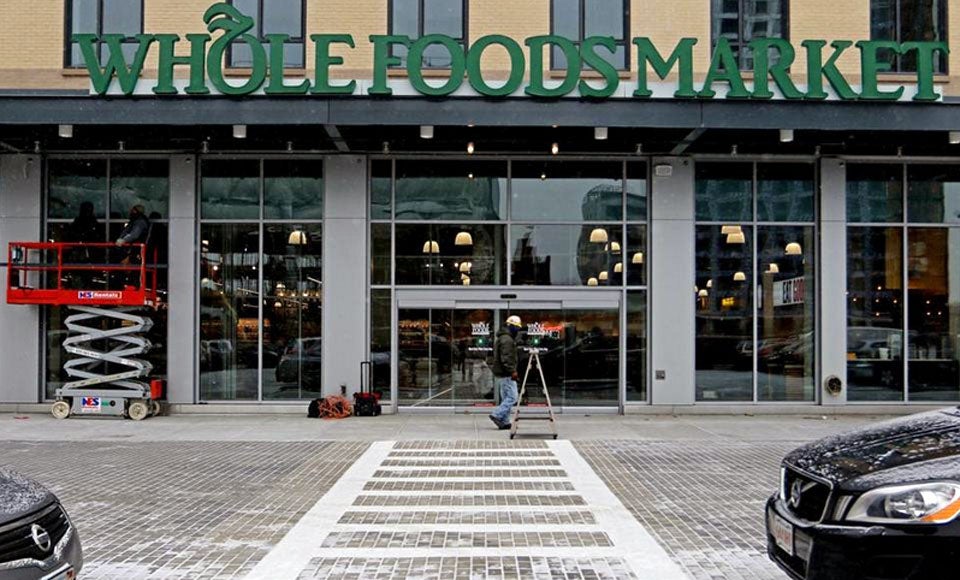
“We went hard after Whole Foods,’’ said Ted Tye, a managing partner at National Development.
His Newton-based development company oversaw the six-acre Ink Block project in the South End, where a 50,000 square-foot Whole Foods opened in January.
Tye and his team did talk to other grocery stores. “But we felt Whole Foods was the closest match to our brand. They’re green, they’re innovative, and they cater to a more upscale market and provide a lot of amenities,’’ he said.
Leasing and sales at Ink Block have been “off the charts,’’ Tye added. “A big reason is that there is a Whole Foods there.’’
The natural and organic foods supermarket is the first of several grocery stores slated to open in Boston, mirroring one of the city’s biggest development booms.
When completed, Ink Block will have created 398 additional residential units (315 apartments for rent and 83 condos for sale) in the South End. Including Ink Block, there are currently seven development projects in the neighborhood, either under construction or approved by the city, according to a Boston.com review of the Boston Redevelopment Authority’s database. These projects will create around 1,600 apartment or condo units in the coming years.
“People are moving in, and people are underserved and want the food,’’ Tye said.
The Grocery Landscape
Boston’s estimated population in 2013 increased by 30,000 since the last official census in 2010. And of the 72 developments currently underway in the city, about 68 percent are residential buildings, according to the BRA.
There are currently 24 chain supermarkets open for business within Boston boundaries, according to the online store locators of Stop & Shop, Shaw’s, Star Market, Whole Foods, Trader Joe’s, and Roche Bros.
[fragment number=0]
“One of the things people have been asking for more than ever has been a supermarket,’’ Rosemarie Sansone said of the Downtown Boston neighborhood. Sansone is president of the Downtown Boston Business Improvement District. “The need is coming up more than ever now.’’
It’s no coincidence that Boston’s newest supermarkets will take shape in some of the hottest neighborhoods for new development.
“Developers are realizing that they can’t just put in a building and call it a day, unless it’s already an established neighborhood,’’ said Laura Ahmes, vice president of The Collaborative Companies, a residential real estate marketing firm.
The family-owned Roche Bros. will follow Whole Foods’ suit by moving into Downtown Crossing’s historic Burnham Building, where it will anchor Millennium Tower. The store — which is also opening a Somerville location — is scheduled to open soon, and the residential tower will open next summer.
Roche Bros. will be accessible to other nearby residential buildings currently in the works — a new dorm for Emerson College, 390 residential units at Kensington Place, and 404 residential units at 45 Stuart Street.
In the Fenway, the New York-based Wegmans will be occupying the Landmark Center. A Target with a full grocery section is also in the works for the neighborhood.
Not coincidentally, across the street from the Landmark Center, The Point will take shape, adding 240 apartments and 109 condos in the area. The tower’s developer, Samuels & Associates, will have added more than 1,500 apartments and condos to the neighborhood over a course of a decade, according to The Boston Globe.
In the West End, a 63,000-square-foot Star Market is coming to a $950 million mixed-use development project at the TD Garden. The project will include a hotel, offices, residences, stores and restaurants.
The Urbanscale Grocery Store

A symbiotic relationship is growing, one where grocery stores are following new construction, at the same time that new residential developments are securing amenities like a grocer in order to attract tenants.
“Grocery stores aren’t easy to fit into an urban area, so you need a large enough scale project to accommodate a good-sized footprint,’’ Tye said. “When things are getting built, that provides a good opportunity for grocery tenants.’’
Most stores are popping up in mixed-use projects — developments that blend residential, retail, or other cultural and commercial users.
“We’re equally dependent on each other. Without the residents living there, there won’t anything strong enough to support a supermarket,’’ Gary Pfeil, president of Roche Bros. told Boston.com. “Without a supermarket there, it doesn’t support a residential preference.’’
At DotBlock, a proposed mixed-use development in Dorchester, there are plans for 500 apartments, a cinema, a hotel, shops, restaurants, and potentially a grocery store.
There has been no retail commitment yet, since the project is still seeking appropriate approvals. But Catherine O’Neill, a resident and acting spokesperson for project, said there’s a dearth of grocery stores in the Savin Hill area of Dorchester.
“If you were a retailer, and here are 64 more condo units, I believe they’ll be beating down our doors once we get our permits,’’ she said.
City-dwellers have come to expect a certain level of convenience, which is especially attractive to empty-nesters and millennials living in the city, said Ahmes from Collaborative Companies.
“Empty nesters are selling homes out in the burbs and moving back into the urban core,’’ Ahmes said. “They’re looking for convenience and maintenance-free living, which includes grocery stores. If they have to drive somewhere, that defeats the purpose of living in the urban core.’’
As for millennials who value immediacy in the form of pick-up or pre-made foods, Whole Foods and Wegmans are very appealing, she added.
“Everything is going mixed-use, because everyone is demanding mixed use — they want a convenience store, a pharmacy, a coffee shop,’’ Ahmes said.
Eric Robinson, whose design company RODE Architects is involved with the DotBlock project, said nowadays there’s a desire for any kind of development to have an anchor.
As for an urbanscale grocery store, “it has to be a bit smaller with a higher percentage of ready foods and probably not selling toilet paper in 24-roll packs,’’ Robinson said.
How Affordable?
There are no Market Baskets opening in Boston, although the Tewksbury-based affordable supermarket chain just opened branches in Revere, Littleton, Waltham, Attleboro, and Athol.
Whole Foods, Roche Bros., and Wegmans all fall on the pricier end of the supermarket spectrum. Since the architects generally look for grocery stores that adhere to the general brand of the development it’s attached to, Boston’s surging housing prices may be to blame.
“You’re now dealing with price points that Boston has never seen. Buyers paying those prices expect a certain level or standard of the mixed use retail,’’ Ahmes said.
Tye praised Whole Foods’ natural, organic brand and how it complements Ink Block’s green living creed. The residential complex uses regionally sourced renewable materials, and there’s an electric car charging station and rainwater recharge on site.
The developers behind Millennium Tower want to transform the Downtown Crossing area and Richard Baumert of Millennium Partners saw Roche Bros. as a “perfect fit.’’

“They’re an independent family business with deep roots in the community. It’s a perfect match for the rebirth of the Burnham building and the Millennium Tower,’’ he said.
But housing affordability still remains a pressing issue and is even on Mayor Walsh’s agenda. Lia Tota and her group, the North End/West End/Beacon Hill Supermarket Committee, have been fighting for an affordable and accessible supermarket in the area for 15 years.
Tota is pleased that Star Market is finally opening by the Garden, but costs are still a growing problem.
“Now you have all these supermarkets, how are they going to serve the people who are really in need of being served? Are they just going to have these sky-high prices and not be able to reach the population that’s here?’’ she asked.
Her neighborhood group will continue to appeal to Star Market to keep its prices low. The committee also organizes shuttles to bring residents, mostly elderly, to the Stop & Shop in Medford or the Shaw’s in Somerville, Tota said. Shaw’s and Star Market stores may vary in pricing according to a variety of “area specific factors,’’ according to a company statement.
“People in the neighborhoods have to get together to start voicing their opinions. Call the mayor, call the supermarkets, advocate for a shuttle service,’’ Tota said. “Grocery stores are a necessity. It’s very stupid, if you ask me, to develop a city without facilities.’’



To comment, please create a screen name in your profile
To comment, please verify your email address
Conversation
This discussion has ended. Please join elsewhere on Boston.com