
Address Newsletter
Our weekly digest on buying, selling, and design, with expert advice and insider neighborhood knowledge.
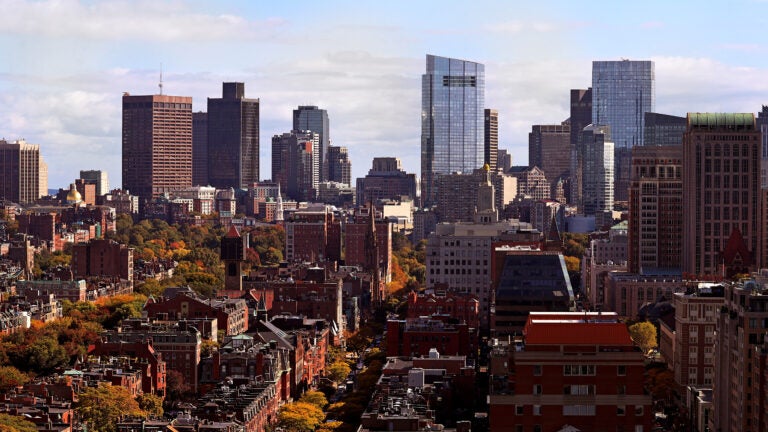
You have to hand it to science fiction writers. Unlike psychics who popped up on daytime TV in the 1990s, this batch of future-pontificating scribes got it right a lot of the time.
Flip phones were popping up on “Star Trek” long before we first saw the rise of the cellphone. Stanley Kubrick’s 1968 epic, “2001: A Space Odyssey,” shows the use of tablets 42 years before the iPad made its debut. 1927’s “Metropolis” showed video calls taking place long before the dawn of FaceTime and Zoom.
But much like wannabe psychic Sylvia Browne on “The Montel Williams Show,” they also don’t always get it right.
“A critical component to the lifeblood of real cities is the often invisible — but critical — process of planning, consensus building, and navigating competing interests,” said Kate Dineen, president and CEO of A Better City, a group of business leaders working to create a vibrant atmosphere in Boston. “Science fiction can inspire us with bold visions, but the true challenge is turning those visions into reality amid the intricate approvals, funding debates, and community conversations that shape every major project.”
Whether it’s the neon canyons of “Blade Runner 2049” or the mile-high towers of “The Fifth Element,” science fiction’s city of tomorrow is a vertical feast of glass and steel, stacked with housing for millions. But back here in the present — and especially in Boston — even modest proposals for new apartments can set off years of zoning hearings, lawsuits, and neighborhood protests regarding shadows or parking or potentially throwing the vibes off behind the Green Monster.
That leap from Hollywood’s skyline fantasies to Boston’s brick-and-brownstone reality is where Loretta Lees, an urban geographer and professor at Boston University, sees the tension between imagination and policy play out.
“The debate itself hasn’t really changed over time,” Lees said. “If we go back to the 1980s, the same discussions about densification are still going through the grinder, and there doesn’t seem to be a solution.”
Densification, even if proposed as a means to generate much-needed housing and affordability, isn’t exactly an easy sell in a city still grappling with a double urban planning hangover from midcentury urban renewal and the Big Dig.
So, is this a case of help us, Obi-Wan Kenobi, you’re our only zoning reform hope?

Lees studied battles from London to Vancouver and said resistance is deeply localized: What works in one neighborhood won’t translate to another.
“If you’ve got a very politically active neighborhood, you’re more likely to get the kind of NIMBYism that we talk about,” she said.
Michael Storper, a professor of regional and international development in urban planning at the University of California, Los Angeles, drew a sharper comparison: “Except for New York, Americans are very resistant to density. They fear it because they believe it brings dis-amenities, such as noise, crime, and ‘otherness.’ This is partly true, but it’s not a natural feature of density, but rather a socio-political particularity of the US, which is that it plans and manages density poorly.”
The inverse of this is Paris, from where Storper emailed. Density there is well-managed, thanks to smart investment in accompanying features like infrastructure. Storper added the that United States had long escaped density pressures by building cheap suburbs on abundant land.
“The bill is now coming due,” he said.
While downtown Boston’s home prices remain stagnant, there is a push to add more density and housing supply as a way to combat the region’s affordability crisis.

“Making more efficient use of our limited land is not just possible, it’s necessary for the city’s prosperity, accessibility, and sustainability,” Dineen said.
The Wu administration launched an office-to-residential conversion program to repurpose underutilized buildings in the current remote work era. There have been 16 applications so far to pursue conversions that, if approved, would add 780 housing units (with 142 being income-restricted) across 21 buildings in Boston.
PLAN: Downtown, a zoning framework still in draft form, aims to “strengthen protections for Downtown’s historic and cultural assets while enabling a mix of uses and housing that Downtown needs to thrive as a vibrant and inclusive neighborhood for generations to come,” per the city’s planning department website.
Elsewhere, the Squares + Streets initiative recently approved in Roslindale is testing more multifamily housing above shops and community spaces in neighborhood centers.
Lees sees potential if these efforts work. If Mayor Michelle Wu’s conversion program and zoning reforms gain traction, she said, it could “retrigger a kind of social and economic uplift of downtown through her densification policies” and set the stage for more density along transit corridors.
But Lees also issued a warning.
“The kind of NIMBYism in Massachusetts is some of the strongest I’ve seen anywhere.”
Developers and planners often argue that new supply will ease the housing crunch, but Lees isn’t convinced unit counts alone will solve the problem. Affordability, she said, is the real crisis. In July, the median price of a downtown home was $1.65 million, according to realtor.com.
Storper noted that “in most of America, density comes with the disadvantages [less personal space, etc.] but without the advantages of urbanity: good public transit, attractive and well-maintained public spaces, the pleasure of the urban scene.”
That tension between the benefits of density in theory and its shortcomings in practice fuels much of the opposition on the ground. Critics of PLAN: Downtown have already rallied around “preservation of character.” And in Boston, those concerns are amplified by a long memory of past urban renewal projects, from the West End to the ongoing fears of displacement in Chinatown.
Where, then, is the path forward? Dineen argues that the answer is “smart” densification, led by transit-oriented development, decarbonized commuter rail, and design that balances growth with resilience and affordability.
And, she said, Boston has proven it can take on daunting projects before: “Boston has proven we can do ‘hard things.’ The Big Dig, for all its complexity and cost, gave us the Rose Kennedy Greenway, new housing hubs, improved airport connections, and economic growth in places like the Seaport. It’s important not to lose sight of these successes.”
Despite that precedent, hesitation lingers.
“It’s almost like we’re scared to do that futurism,” Lees said. “But in a way, we kind of need to get back in there.”
“Looking to the future, now is the moment to think bigger — not smaller — and advance the next generation of transformative, region-shaping projects,” Dineen added.
In science fiction, a city’s transformation happens in seconds. Here, it may take years, but if the vision holds, the urban fabric might one day catch up to the script.
Our weekly digest on buying, selling, and design, with expert advice and insider neighborhood knowledge.





To comment, please create a screen name in your profile
To comment, please verify your email address
Conversation
This discussion has ended. Please join elsewhere on Boston.com