
‘Granny flats’ hit all the right notes in Boston’s push for housing
Despite the Solomonic wisdom they represent — keeping families together in a crowded, high-rent city and providing rental income — ADUs have traditionally met with resistance.
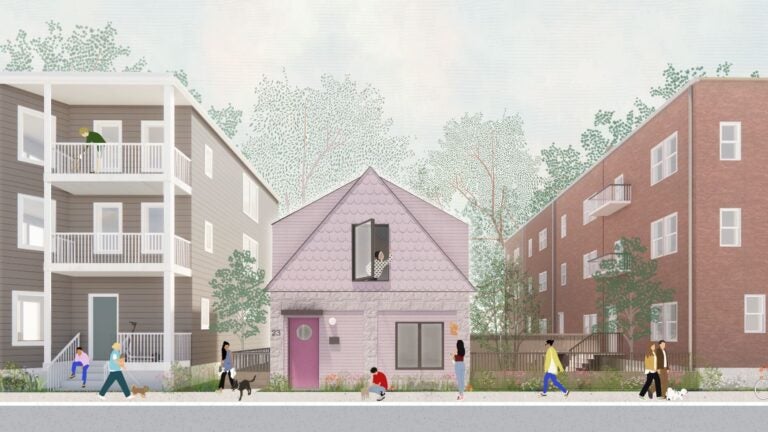
Boston Mayor Michelle Wu is under pressure to increase the housing stock and is pulling out all the stops to make it happen. One of her current initiatives is expediting the building of accessory dwelling units, or ADUs, popularly known as “granny flats,” which will allow multigenerational living in neighborhoods across the city.
“ADUs are among the most effective way to increase housing stock and keep families together,” Wu said. “I live in Roslindale with my husband, kids, and mother. While I don’t have an ADU now, it’s an option for us going forward.”
The city and Commonwealth have worked together to encourage the building of ADUs. On Aug. 6, Governor Maura Healey signed the Affordable Homes Act into law. With this legislation, ADUs are permitted “as of right” in single-family zoning districts in all communities. The final legislation limits ADUs to 900 square feet, prohibits owner-occupancy requirements, and limits parking stipulations if located within a half mile of transit. It went into effect Feb. 2.
It happens that Roslindale, because of its fairly large lots, is one of the key neighborhoods on which the city is focusing. Rose Sargent is a resident of the neighborhood and is in the throes of designing and permitting an external detached ADU in her garage. She said an ADU will help her father by allowing him to come and go as he pleases.
“My dad’s been living in my guest room for a year,” Sargent said. ”He happens to be a retired architect, so the design part we can handle. It’s a really lengthy process, but the city’s new ADU program allows us to skip certain steps.”
Despite the Solomonic wisdom they represent — keeping families together in a crowded, high-rent city and providing rental income — granny flats have traditionally met with resistance.
“We have a culture of deep neighborhood engagement, even on putting in a dormer,” said Mike Firestone, Boston’s chief of policy and strategic planning. “We hope this guidebook gives residents ideas about how adding an ADU can fit into the footprint of their property and the feel of their neighborhood. ADUs are ‘gentle density’ that are designed to work for growing families and a growing city.”
An ADU is considered a secondary or accessory to the primary residence on the parcel. It usually has its own entrance, kitchen, bathroom, and living area. There are three main types of ADUs: interior, interior with modifications, and detached.
Marcy Ostberg, deputy director of the city’s Office of New Urban Mechanics, said her office has “heard from thousands trying to get information on ADUs.” To help educate the public, the city has published a 170-page Accessory Dwelling UnitGuidebook. “The mayor has chosen to lead with ADUs,” Ostberg said. The guidebook lays out numerous financing options the city has put in place to make them buildable. “We have technical-assistance grant programs and loans available from institutions around Boston,” she said. “The city is trying to be a partner.”
Derek J. Thomas, founder and manager of Incremental Developments LLC in Salem, which specializes in ADUs, said his firm most often does basement buildouts. “We sit down with the client and get their vision. Most people are looking at a $150,000 starting cost,” he said, “or $230 per square foot based on the average job of 650 square feet.”


As an architect, Matthew O’Boyle, founder of Valere Architects Inc. of Westfield and Watertown, is concerned about aesthetics and said his firm does mostly detached ADUs, allowing for more creative design freedom. He cautioned that some towns, especially upper-income ones, have design review boards, and “That’s an extra step people have to go through.”
ADUs have been widely celebrated in popular culture for decades. Consider TV shows through the years — from Fonzie in television’s “Happy Days” in the 1970s. (At first, when his grandmother struggled to get up the stairs, Mr. Cunningham agreed to rent the apartment to Fonzie.) In “Full House” from the 1980s and ′90s, the Tanner family needed more space, so they did a DIY remodel on the attic, turning it into a beautiful studio apartment. Finally, in the 1990s and 2000, in the show “7th Heaven,” the Camdens decided to finish the apartment over their garage.


Beyond our shores, ADUs have been the norm rather than the exception. Five percent of the United Kingdom’s housing stock has one, according to the Boston guidebook. In Sweden, a friggebod is an ADU that can be built without planning department permission on a land lot with a single-or multifamily house. Stateside, California — with a housing crisis of its own — in 2020 passed the most lenient ADU codes in the country.
Roslindale resident Sargent, who is planning an ADU for her 77-year-old father, sings this housing format’s praises.
“It’s not very appealing for my father to go to a home. He’s losing his sight. It’s nice to keep him part of our family,” she said. “My kids are 10 and 12. So we have them, myself, and my father, which will make this a multigenerational house. And if my kids end up going to college in Boston, they can live here years from now.”
James McCown is a Newton-based writer specializing in architecture and real estate. Send comments to [email protected], and follow us on X @globehomes.






To comment, please create a screen name in your profile
To comment, please verify your email address
Conversation
This discussion has ended. Please join elsewhere on Boston.com