

Address Newsletter
Our weekly digest on buying, selling, and design, with expert advice and insider neighborhood knowledge.
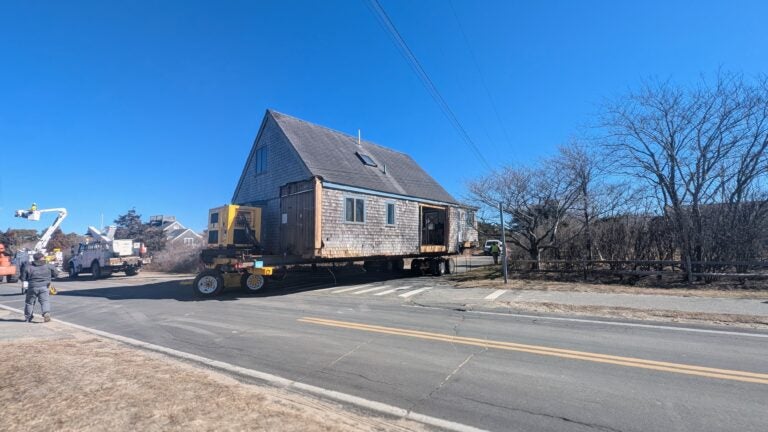
Only on Nantucket can a traffic jam be caused by a three-bedroom Colonial inching its way down the road on a Wednesday morning.
Each fall, as the last of the summer visitors and residents head for the ferries, another local ritual quietly kicks in: house-moving season (and we mean that in the most literal of terms). Between mid-September and mid-June, full-size homes are jacked off their foundations, loaded onto trailers and trundled across the island to new lots —sometimes miles away to a year-round neighborhood, sometimes just a few hundred feet back from an eroding bluff. (Nearby on Cape Cod, dangerously close cliff-front homes are going for about $100,000.)
It might sound like a stunt for TikTok, especially after a recent listing for a multimillion-dollar house that was “free” if you could afford to move it.
But on Nantucket, this isn’t a novelty. It’s a preservation strategy, a climate adaptation tool, and, in certain cases, one of the few semi-attainable ways into a housing market that keeps setting new records.
“House moving really is part of the heritage of the island,” said Rita Carr of the Nantucket Preservation Trust. “It’s been happening on Nantucket for centuries, and it’s a way to give old buildings new life and help sustain our year-round community.”
That tradition is now backed by policy. Under Nantucket’s demolition delay bylaw, if a building doesn’t have to be torn down immediately and has reuse potential, owners must advertise it and give interested parties a window of time to claim and move it before a demolition permit can be issued. The town recently extended that delay to as long as six months, giving would-be movers more time to line up land, permits, and a house-moving crew.

Whole-house moves are generally allowed from Sept. 15 to June 15, with the actual street process usually happening midweek. Wednesdays are house-moving days; Thursdays serve as the rain date. The town administrator works with house-moving companies, police details, and utility crews to choreograph what amounts to a slow-speed parade under power lines and around tight corners.
The physical constraints are often the biggest hurdle. Carr said the island’s narrow streets and low utility lines can force houses to be cut into multiple pieces to make a move possible. In some cases, the solution isn’t a cross-island journey but a smaller retreat: sliding a house as far back on its lot as possible to escape an eroding bluff or raising it higher to cope with flooding in low-lying neighborhoods.
Climate and erosion are increasingly part of the calculation. Carr said she’s seeing more requests to raise structures in areas like Brant Point, while the south shore and Siasconset are hot spots for homes being shifted away from the edge. For many owners, moving a house is a way to buy time in an era of rising seas.

It’s also a way to keep thousands of pounds of lumber, windows, and fixtures out of the trash stream. Nantucket generates a huge amount of construction and demolition waste each year, much of which must be shipped off-island to landfills as far away as Ohio and Maine. The Preservation Trust is pushing not just for more house moves but also for more “deconstruction” — taking a building apart piece by piece and salvaging what can be reused — instead of the standard bulldozer-and-dumpster approach.
But on nearby Martha’s Vineyard, Elliman salesperson and Chilmark Housing Committee member Allison Cameron Parry has seen how much material gets tossed when high-end homes come down. Her husband builds custom wood windows for ultra-luxury projects, and when those mansions get replaced, the castoffs can be shockingly nice.
“There’ll be situations where they’re going to demolish the whole house, and the house has beautiful tile, functioning utilities, rare hardwood,” she said. “When we were building our own house, we got floors, appliances — all free — because it was all headed for the dump otherwise.”
So who actually takes on a whole-house move? Despite the headlines about “free” $5 million houses, this isn’t always a billionaire’s hobby project.

Both Carr and Douglas Elliman agent and year-round resident Nicole Tirapelli say the typical mover is a year-round resident who already has land — maybe a family lot purchased decades ago, or a covenant lot with affordability restrictions — and enough savings to cover the move and new foundation.
“I would say mostly the year-round homeowners take advantage of this opportunity when they have available land and the sufficient remaining ground cover left to move the home onto,” Tirapelli said. “Just because they’re offered for free, there’s [still] a lot of costs involved with the relocation.”
The costs are substantial: jacking the house up, trucking it across town, pouring a new foundation, reconnecting utilities, and finishing interiors. But on an island where new construction costs per square foot can be eye-watering, moving an existing house can still come in cheaper than building from scratch, especially if the structure itself is being given away.
“A 2,500-square-foot home can cost at least $100,000 to move,” a real-estate attorney told Business Insider last year.

For preservationists, that math is only part of the appeal. Nantucket’s National Historic Landmark designation treats buildings constructed as late as the mid-1970s as contributing to the island’s character — even if many homeowners still think anything postwar doesn’t count as historic. Carr worries about those midcentury homes and cottages quietly disappearing under the wrecking ball.
“Those houses are part of our heritage,” she said. “Moving is a great way of saving those structures from being demolished and preserving them in a lot of places.”
Unlike many places, a moved house on Nantucket doesn’t lose its contributing status in the historic district. The National Park Service has signed off on the idea that, because moving buildings is itself a long-standing local tradition, relocation doesn’t make them less significant. That quirk gives owners and preservationists more flexibility to get vulnerable homes out of harm’s way without sacrificing their protections.

None of this is a silver bullet for affordability on an island where even the economical (by Nantucket standards, that is) options require land, capital, and a tolerance for major projects. But for year-round residents with a buildable lot and some financial help — whether from family, affordability programs, or future housing funds — moving a house can be one of the few ways to secure a home that isn’t a condo or a basement apartment.
It may disrupt traffic for a morning, but preservationists say the tradeoff is worth it. Every moved house is one less demolition, one less pile of construction debris shipped off-island and, in many cases, one more year-round home preserved.
Nantucket town officials did not respond to multiple requests for comment.
Our weekly digest on buying, selling, and design, with expert advice and insider neighborhood knowledge.





To comment, please create a screen name in your profile
To comment, please verify your email address
Conversation
This discussion has ended. Please join elsewhere on Boston.com