
Address Newsletter
Our weekly digest on buying, selling, and design, with expert advice and insider neighborhood knowledge.
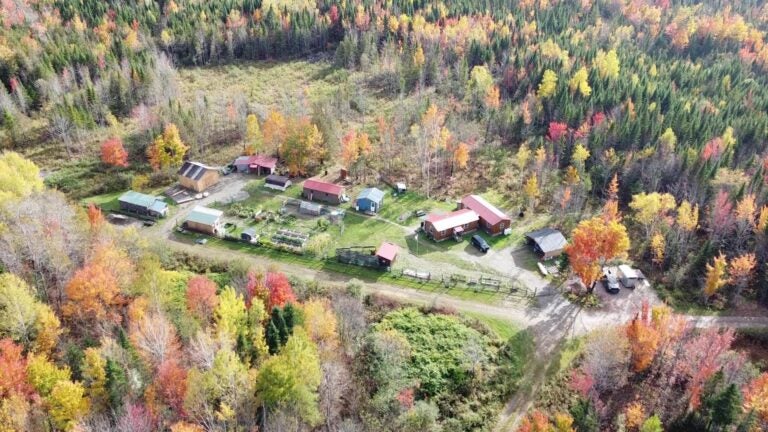
Living off the grid in Maine means your house is not connected to the electrical network, or public water and sewer lines. It could be a large or small home with as much comfort and solitude as you’re seeking. It’s not for everyone, but people who’ve done it say if they can do it, so can you.
Andy Mooers of Mooers Realty in Houlton, Maine, on the Canadian border, said he sells a lot of off-grid properties. The population density in Aroostook County (Maine’s northernmost) is about 10 people per square mile, according to the census. That means about 66,776 people stretched across 6,828 square miles of woods, deer, moose, and predators such as black bears, bobcats, coyotes, and red foxes. Watching his YouTube videos, Mooers’s broadcast journalism background and his love for living simply in Northern Maine are apparent.
“It’s a lot of work to live off the grid,” he said. “Some people couldn’t pull it off. It’s a way of life where you’ve got your garden, you’re heating with wood. It lowers your expenses. You don’t have to worry about the price of oil or electricity. Some people even build or renovate their own homes.”
Mooers explained the folks who live off the grid aren’t looking for an easy life, but they want a simpler life. They’re more than happy to forgo some modern conveniences to escape traffic, crime, and noise. A typical buyer looking to move off-grid is somewhere in their 50s, but he said they come in all ages and from all over.
“The best way to do it is to plan,” he said. “You don’t just quit your job, load up the Subaru, and head north. Some people do it that way, but that makes your chances of success slimmer. You need shelter and four cords of seasoned wood by November. You can’t live in a camper over the winter. Plan your work and work your plan.”
Mooers said the cost of a 10- to 15-acre lot in Northern Maine can run between $24,900 and $34,900, depending on road accessibility, the quality and condition of the woods, and other amenities like great views and the presence of a water source such as a stream.

For 10 years, Jason and Jennifer Remillard, now in their 50s, planned and saved before they bought 54 acres on the Canadian border in 2019. There was nothing but an old hunting cabin on it at the time. In 2021, they moved there permanently and began building what would become Hanbleceya Ranch. The name is an anglicization of a Sioux word for “vision quest.” It’s also the name of their YouTube channel.
“A vision quest is a journey that typically a young person does, where they leave their home, and they go and search for themselves,” Jason said. “For us, we’re middle-aged, all of our kids are grown, and we did well for ourselves, financially. This is our own Hanbleceya. It so happens it’s in the northeast woods of Maine.”
They grow flowers, vegetables, and fruits in raised beds. They’ve even planted an orchard. The cabin has plumbing — well water, an underground gray water system for sinks, shower, laundry, and composting toilets — and electricity powered by solar and a gas generator as well as two woodstoves. They hope to do more hunting and fishing, and even get some horses and other livestock once they’re done building out the ranch’s infrastructure.

“We built out our cabin, which is two Amish-built cabins that we joined with in a T formation,” he said. “That’s the main structure. Then, we have a carport. We built a solar power shed, an outdoor kitchen, a storage shed, which is also the original cabin that was on the property. We built a greenhouse, another small storage shed, a workshop, and a firewood shed.”
Jason said he and Jennifer did all this with virtually no carpentry experience. Most of their projects are documented on their YouTube channel, where they show viewers what life off the grid in Maine is really like — learning as they go.

Their three Australian cattle dogs make cameos in nearly every video and seem to be enjoying life in the woods as much as the Remillards. They say they’ve never been happier or healthier.
They live 26 miles from the nearest gas station, and neighbors are few and far between. They say they’ve found people to be genuinely helpful, giving advice, loaning extra firewood, or engaging in conversation. There’s a sizable Amish population in the North Maine Woods, and while they do live a very different lifestyle, they are unfailingly polite and helpful.
“The Amish play a critical role in everyone’s everyday life here,” Jason said. “They have several businesses that that we all rely on. They have a metal shop where damned near everybody purchases their tin from for their roofs and other metal. They’ve got a construction supply store and several others. It’s a very close-knit relationship, and we are all quite intertwined.”
There are as many ways to live off the grid in Maine as there are people who do it. Barbara Martin, 69, lives alone with two dogs in a cabin on the water near the Canadian border and documents her life on her YouTube channel, Solo in the Woods. She tells viewers if a senior citizen like her can do it, they can, too.

In 2019, after a couple of years driving around the country in an RV, she wanted to live on the water, so she bought 10 oceanfront acres with a 20-foot-by-32-foot, two-story summer camp. She had never lived off-grid, so she learned how to insulate the cabin for Northern Maine’s harsh winters. Then, she paneled the interior with boards from disassembled wood pallets and had a woodstove installed.
“I’m an outdoor person,” she said. “It isn’t work. This is a lifestyle, and it’s incredibly rewarding. If you really want to find out, you have to try it yourself. And I honestly believe most people will find it incredible being so self-sufficient. There’s no way to describe it.”
Here’s one way to describe it. No electricity and no plumbing. She runs a 100-watt gas generator for about an hour each day to charge her phone, computers, and refrigerator.
“I cook on a butane camping stove in the summer and the woodstove in the winter,” she said. “I get drinking water from a public spring a few miles away. And I go through about four cords of wood every winter. I use a composting toilet and believe it or not, I shower outside year-round.”

As she closes in on her 70th birthday later this year, surely she misses some of the comforts and conveniences of conventional living?
“Absolutely nothing,” she said. “I am an extremely independent person. I love my privacy and hate crowds. If anybody down your way is even considering off-grid property, the way the world’s going, I honestly believe this is the best investment you can make for yourself and your family. Just find your spot and go for it.”

Our weekly digest on buying, selling, and design, with expert advice and insider neighborhood knowledge.




To comment, please create a screen name in your profile
To comment, please verify your email address
Conversation
This discussion has ended. Please join elsewhere on Boston.com