
You can buy an entire 62-acre Swedish village for $72 million
The entire hamlet of 70 buildings, known as Satra Brunn, is for sale, with some of its structures dating to 1700.
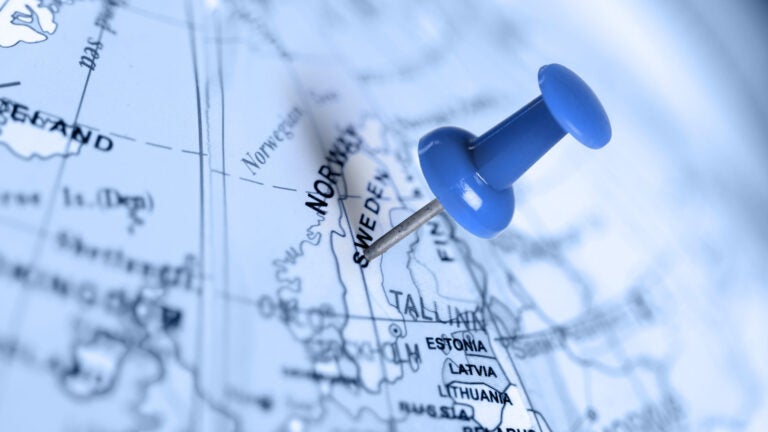
A rare example of Swedish village architecture is on offer in Sala, a rural town in Sweden’s Vastmanland County, about 90 minutes north of Stockholm. Even more rare: The entire hamlet of 70 buildings, known as Satra Brunn, is for sale, with some of its structures dating to 1700. Operated continuously for 300 years, first as a wellness retreat and then as a holistic research and treatment center by Uppsala University from 1747 to 1999, the 62-acre village was built around a natural underground spring heralded for its therapeutic waters.
The property has been owned since 2002 by a group of 15 local residents who wanted to “preserve the unity and history” of the village, said Mats Wikman, one of the shareholders. In addition to its spa operations, the site also hosts festivals and concerts.
Wikman said that with most of the owners now in middle age, “We need other people who can take care of it.”
A journalist who wrote a book about Satra Brunn, Wikman said that of the 10 or so similar health villages built in Sweden during the 18th century, this is the only one to survive with its historical fabric mostly intact. “Despite its history, the place is not very well known outside the area,” he said. “In my point of view, it should be regarded as a world heritage site.”
Jonas Martinsson, who has this listing with Residence Christie’s International Real Estate, said other such properties often are redeveloped beyond recognition, but “when you walk around Satra Brunn, you are following Swedish culture and building history from 300 years back. All these houses have their short or long story.”
The heart of the village is a cluster of the oldest buildings, including the spring house. While some were constructed as dormitories with shared bathrooms and common rooms, others served as family cottages or more decorative homes for professors or wealthy patrons. The smallest are 1,076 square feet and the largest, the Bergabo, a striking building set off by a watch tower in its frame, is nearly 5,200 square feet. Wikman estimated about 45 buildings — many still named for their former occupants — would be good candidates for conversion to personal homes.
“The big challenge would be to choose which houses a new owner wants to start working on,” Martinsson said.
Most of the buildings do not have kitchens, as food was prepared and delivered from a central kitchen, but they all have plumbing and floor plans that would accommodate kitchen conversions. Many houses still have original details such as wood paneling, decorative ceilings, and tiles, and at least three-quarters are insulated for winter. All are timber, made from local materials, some with traditional carved porches. The mostly uniform red color is actually a natural copper and iron-ore paint sourced from local mines and applied as a preservative.
The village includes a 19th-century deconsecrated church and commercial enterprises such as a conference center, restaurant, and a working spa with an indoor pool, sauna, and gym; a bottling line that produces 2 million bottles of high-grade spring water a year; and a preschool for 40 local children, operated by the municipality. The school is three years into its 25-year lease agreement, which provides operating income for the village, Wikman said.
The buyer can choose whether to continue operating the commercial spaces. Because of the COVID-19 pandemic, all operations are currently suspended until the fall, though much of Sweden has remained open.
The municipality of Sala, in south-central Sweden, has about 13,000 residents and draws tourists to its historic silver mine, which dates to the 15th century. Martinsson said many Swedes come to Sala for its lakes, fresh air, and bird-watching. The nearest city, Vasteras, is 20 miles south. Stockholm, Sweden’s capital, is 90 minutes south by car and accessible by high-speed train.
Market overview
Martinsson said Sweden attracts buyers with its “financial balance and society,” adding that “people come from abroad and see that we don’t have gated communities and it’s open.”
Sweden’s housing index saw successive year-over-year gains from 2014 to 2017 before falling 3.7 percent in 2018, the year a change in mortgage regulations required borrowers to pay off their loans faster, said Pontus Kopparberg, chief executive of Residence Christie’s International Real Estate in Stockholm. After those rules were suspended, the housing index recovered, rising 3 percent from 2018 to 2019.
Lars Fredegard, owner of the Lars Fredegard agency in Stockholm, said he recently sold a two-bedroom apartment with about 3,121 square feet there for $6.2 million.
Nationally, prices for multidwelling and commercial buildings, like many on the Satra Brunn site, rose by 11 percent in the first quarter of 2020 from the fourth quarter of 2019. Agents agreed that low interest rates for commercial properties have boosted demand in some areas.
When the coronavirus pandemic hit, Sweden opted not to shut down, relying instead on voluntary compliance to control the spread. As of May 26, the country had recorded 34,440 confirmed cases and 4,125 deaths, many more per capita than its Nordic neighbors.
In Stockholm, agents now show properties by appointment only, and said higher-priced real estate has been mostly unaffected by the crisis.
Who buys in Sweden
In 2019, the national statistics agency reported 37,740 vacation homes in Sweden — 6.2 percent of the total — were foreign-owned, with 87 percent of those owners coming from Norway, Denmark, and Germany. Real estate agents say beyond the traditional market, they have seen queries from the United States and, to a lesser extent, China.
Many foreign buyers have a connection to the country — either Swedes repatriating or newcomers with Swedish heritage. Fredegard said while the market for vacation homes in Sweden is always slower between November and March, contributing to a temporary price drop, “we notice a big demand for vacation homes in the Stockholm area because people are unable to travel abroad because of the corona[virus] situation.”
In Vastmanland County, which includes Sala, foreign ownership makes up less than 1 percent of the available stock of vacation homes.
Buying basics
There are no restrictions on foreign purchases in Sweden, and most transactions require a 10 percent down payment. Attorneys perform due diligence and execute contracts and other transaction matters, and real estate agents can handle post-purchase registrations. The process can take one to six months, depending on the complexity of the transaction.
“Real estate is looked on as a safe investment, so it is generally pretty easy to get a mortgage,” said Magnus Odin, a real estate attorney with Lindskog Malmstrom, a Stockholm firm. He advised potential buyers to consult a tax lawyer for advice on whether to buy as a company or an individual.
Subscribe to the Globe’s free real estate newsletter — our weekly digest on buying, selling, and design — at pages.email.bostonglobe.com/AddressSignUp. Follow us on Facebook, Instagram, and Twitter @globehomes.



To comment, please create a screen name in your profile
To comment, please verify your email address
Conversation
This discussion has ended. Please join elsewhere on Boston.com