
Still upset over tower approval, West End residents warn Mission Hill it could be next
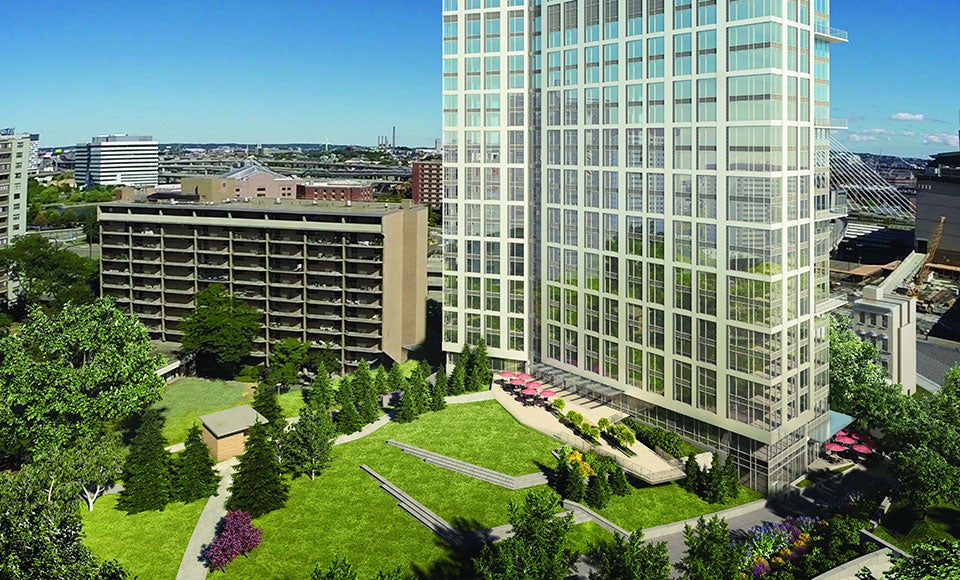
After a seven year odyssey, and despite continuing neighborhood opposition, a project to replace the West End’s Garden Garage with a 44-story residential tower will move forward after receiving approval from the Boston Redevelopment Authority (BRA) last week.
The developer, Equity Residential, plans to bring 470 apartments, along with underground parking, to Lomasney Way near TD Garden, The Boston Globe reports. The parking garage currently on site will be demolished, but the development will include 775 underground parking spots.
Even after numerous revisions to the tower plans over the years, many West End residents are unhappy with the BRA’s vote to finally approve the project. For some, it’s simply too big. Others see it as a threat to the social fabric of the neighborhood, a faint reminder of the destructive “urban renewal” effort 50 years ago.
A project in flux
Back in 2008, Equity, a Chicago-based real estate investment trust, planned two buildings on the site, but public opposition held up the plan until March 2015. Then Equity, having successfully lobbied for an exception to the area’s height restriction of 150 feet, came up with a new plan to build just one 46-story tower.

Many West End residents were still not happy about the tower height and the possibility of added traffic in an already busy neighborhood. As of last March, BRA spokesperson Nick Martin confirmed that the authority had received 620 letters in opposition to the development, which he described as “more than normal.”
On Thursday, February 11, the BRA approved the $390 million project, which is now set to be only 44 stories and includes a few other compromises from Equity, the Globe noted:
“It made the proposed building a bit slimmer and eliminated 55 parking spaces. It also pledged an extra $1.2 million toward the city’s affordable housing fund and $1 million toward traffic improvements in the area.”
Equity could not be reached for comment on the approval of the development.
History relived?
Some current West End residents fear a second round of “urban renewal,” which first occurred in the neighborhood in the 1950s, when the city demolished many of the neighborhood’s buildings. It wasn’t, and still isn’t, protected as one of Boston’s historic districts.

Duane Lucia, the West End Museum curator and a 26-year resident, said since urban renewal the neighborhood has been trying to regain its sense of community. He thinks Equity’s new building will set the neighborhood back by attracting more transient apartment dwellers.
“The radical change in the demographic is going to tear down what the residents have been working for over the last 25 years – to build it into a cohesive neighborhood,” Lucia told Boston.com.
“We are not NIMBYs”
What those in the West End want to make clear is that they are not suffering from anti-development streak known as NIMBY-ism, which stands for “not in my backyard.”
Kathleen Ryan, a long-time West End resident who has been very involved in the Garden Garage project, told Boston.com in an email that she and other neighbors have supported many of the other recent developments in the area.
“People don’t understand that we have actively supported multi millions of dollars of development in our neighborhood in areas where it works,” she wrote. “And contrary to what others are saying, we are not against this garage being torn down and the site redeveloped so we can welcome new neighbors.”
They just want the new tower to look like it belongs in their neighborhood, Ryan said. She echoed this sentiment in a recent email she sent to “No Mission Hill Tower,” an independent neighborhood group fighting against another Equity Residential tower.
45 Worthington Street, Mission Hill
In October 2014, Equity Residential proposed a 35-story, 395-unit residential tower in Mission Hill, just outside of the Mission Hill Triangle Historic District. Equity noted in its letter of intent to the BRA that it would be “seeking zoning relief through multiple variances from the Zoning Board of Appeal.”
Like the West End project, the 45 Worthington Street project has been met with concern, prompting the formation of No Mission Hill Tower, a group that operates under the assumption Equity’s proposed tower is “out of scale and wrong for the Mission Hill neighborhood.”

Though things have recently been quiet regarding the building’s progress, Ryan wanted to warn the Mission Hill protestors of what might happen to their neighborhood. The message resonated with members of the No Mission Hill Tower group.
“It’s one of those things that’s like another shoe dropping,” Gary Walling, a group member and seven-year Mission Hill resident, told Boston.com. “We haven’t heard anything for some time. It was a concern to see something like that [in the West End] coming through.”
Like the West End opponents, Walling and his cohorts don’t want to be labeled as NIMBYs, they just believe this project is not appropriate for their historic neighborhood made up mostly of three-story brownstones.
“We need development,” Walling said. “But we want development that fits within the neighborhood. You can’t build a Financial District tower in a residential neighborhood.”
Walling moved from the South End to Mission Hill in 2009. He has two boys and was growing out of his South End condo. He was attracted to the number of long-term residents in Mission Hill, but he thinks that a large apartment building will attract mostly students, who will leave when they are done with school, and other transient residents.
“There should always be a nice balance between students and also people who want to put down roots,” he added. “That’s the kind of culture we want to encourage. We are against development that is not in line with what is good for the community.”
Walling said there are a variety of other open parcels in the neighborhood with room for developers to propose similar project if 45 Worthington St. becomes a precedent.
“They can put up a tower like this and then other spots in the neighborhood could follow suit,” he said.




To comment, please create a screen name in your profile
To comment, please verify your email address
Conversation
This discussion has ended. Please join elsewhere on Boston.com