
Sale of East Boston church continues church-to-condo trend
Continuing a trend of church-to-housing conversions, the Archdiocese of Boston recently sold an Eastie church to developers for $3 million.
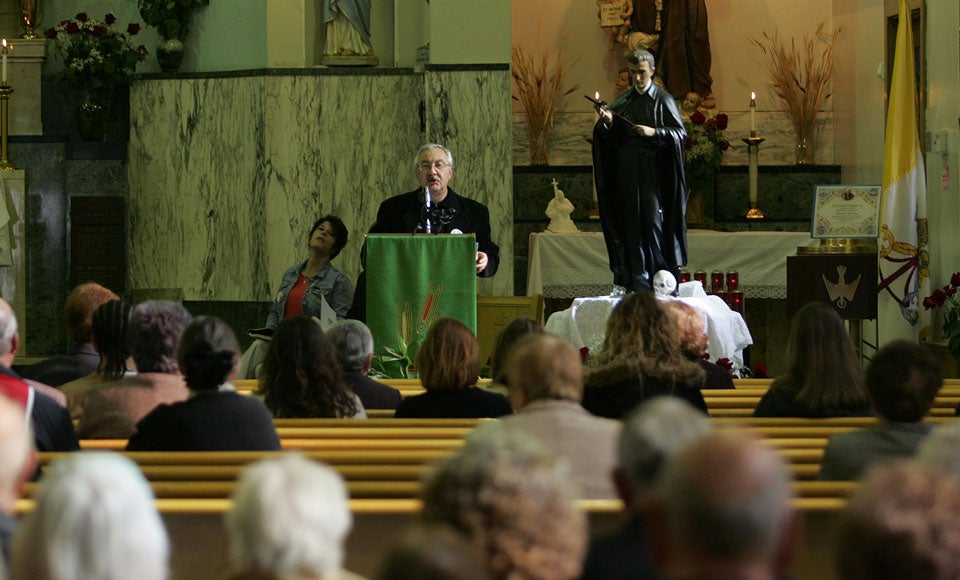
Continuing a trend of church-to-housing conversions, the Archdiocese of Boston recently sold an East Boston church to developers for $3 million, The Boston Globe reports.
Richard Egan and Timothy White who set up and run Frankfort Gove LLC, the group that bought the church, could not be reached for comment, but the archdiocese said they plan on turning the historic Our Lady of Mount Carmel into housing, the Globe said. The news saddened former parishioners, but should they be surprised?
Mount Carmel closed in 2004 when the archdiocese bolted 75 other parishes, citing declining Mass attendance and a shortage of priests. The move reflected a larger trend: From 2000 to 2002, the number of Roman Catholic Churches nationwide fell from 19,236 to 17,644, according to the Center for Applied Research in the Apostolate, a nonprofit research organization that compiles church statistics. Investors hoping to make good on the real estate boom sweeping Greater Boston have scooped up some of these parcels, turning them into extravagant condominiums.
Local developer New Boston Ventures is currently remodeling the former Holy Trinity Church in the South End into a boutique condo building featuring a gym, garage parking, library, and direct elevator access for most units. The homes will range in price from the mid $600,000s up to $4 million.
Other conversions outside Boston proper (and some outside the archdiocese) include St. Theresa Church in Watertown into Bell Tower Place, a development of 11 high-end condos with great views, and Our Saviors Lutheran church in Dorchester, which was broken into a multi-family property with residencies going for $599,000 and up.
The Boston Herald reported in April that one of Beacon Hill’s oldest churches, St. John the Evangelist, was sold to local real estate investment firm Ad Meliora and Rhino Capital managing principal Michael Olson for $4.5 million, with early redevelopment plans hinting at a conversion into a few residential condos and office space.
Meanwhile, Cambridge and Somerville have also seen their own revolution of churches-turned-condos, with Catholic, Unitarian, Methodist, and Universalist churches being sold to developers over the past couple decades. Saint Hedwig Parish in Cambridge became multi-level condos with heated garages in 1998, and Holy Cross Church in East Cambridge transitioned to four luxury condos – some going for as much as $1.3 million. Then there’s Cambridge’s Beth Israel Synagogue, Somerville’s First Methodist Church, and First Baptist Church in Watertown – all condos.
Story continues after gallery.
Churches that became condominiums:
The vast number of changeovers begs the question: Why do people like living in renovated churches?
A Wall Street Journal article pointed out that the architecture of most churches is simply beautiful, often boasting high ceilings, stained glass windows, and exposed wooden beams. Though this makes the conversion process trickier, it also allows developers to sell the properties as luxury condos with price tags well into the six- and seven-figure range.
Homebuyers with the means to purchase such homes say they love owning rare properties. Shankar Sundaram, 34, a research engineer for Boeing, told the WSJ he thinks his two-bedroom townhouse, a former Christian Science Church in Seattle, will have no problem holding its value. “It’s pretty hard to replicate a 100-year-old church,’’ Sundaram said, adding that it’s the perfect place to entertain and play music. “Whatever you play sounds like it’s live, like you’re in a concert hall as opposed to listening through a stereo.’’
Some may wonder whether homebuyers worry about being blasphemed, as former congregations hotly contested many church conversions. Some developers say they’ve had doubts about destroying holy ground, but others comfort themselves by remembering they’re preserving a historic property. Brian Badrigian, who developed a late-19th-century Baptist church in Watertown, told the WSJ, “While the sale allowed the congregation to move to a more suitable location, it was also a move away from a special place. But I have very good feelings about saving a historic building.’’
For those living in former Catholic churches, rest assured: Archbishops must sign a decree stating that buildings are okay for “profane use’’ before being developed.





To comment, please create a screen name in your profile
To comment, please verify your email address
Conversation
This discussion has ended. Please join elsewhere on Boston.com