
Boston is an outlier in this Whole Foods vs. Trader Joe’s battle
One chain is a better predictor of expensive neighborhoods than the other.
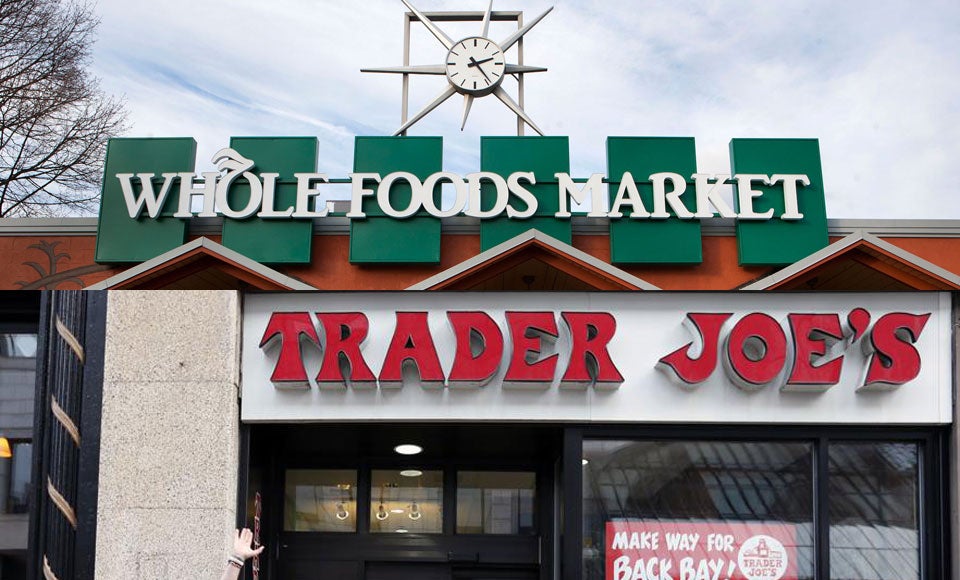
So close, Trader Joe’s.
Sure, we love your “Two-Buck Chuck’’ and your employees’ colorful Hawaiian shirts, but when it comes to predicting high home value, Whole Foods still has you beat in Greater Boston.
According to a recent report by real estate information company RealtyTrac, Boston homes located near a Whole Foods had an average estimated value of $628,956, while homes near Trader Joe’s were valued at $613,156.
“We call it ‘Whole Paycheck’ because it’s so expensive and Trader Joe’s is much cheaper in comparison,’’ said Ginny Walker, RealtyTrac’s public relations supervisor.
Because of Whole Foods’s extravagance, Walker said RealtyTrac’s findings for Greater Boston did not surprise her. What did shock her (and many others,) however, were the results for elsewhere in the U.S.
After examining data for 1.7 million homes in 188 zip codes across the country, RealtyTrac determined that on average, homes that share a zip code with a Trader Joe’s are worth more than those near Whole Foods — $592,339 compared to $561,840, respectively. Researchers also compared current home values to home values at the time the house was last purchased, finding that homeowners living near Trader Joe’s also saw their property values increase more swiftly than those close to Whole Foods. Homes near a TJ’s appreciated by 40 percent, compared to the 34 percent seen by Whole Foods’s neighbors.
“We were actually surprised at what we found,’’ Walker said. “What we were expecting to find was true for Boston Metro but nationally, it was not the same.’’
Locations of Whole Foods and Trader Joe’s in Greater Boston:
[fragment number=0]
Even though Boston homes near Whole Foods are pricier than those near Trader Joe’s, Walker pointed out that homes near Trader Joe’s still appreciated faster – by 64.6 percent, compared to 62.2 percent near Whole Foods.
“We really thought Whole Foods would corner the market no problem, but surprisingly, Trader Joe’s is very smart in their decisions and are only going to go into wealthy neighborhoods where wealthy people can afford to buy there,’’ Walker said.
Story continues after gallery.
The safest towns in Massachusetts:
The good news is, whether you live near a Whole Foods or a Trader Joe’s, you can expect your home value to be high, or to increase if one of the chains moves into your neighborhood. Walker described the niche grocery store chains as having a “chicken and the egg’’ effect.
“We can’t say for sure the impact these chains have on the real estate market, or whether the market was good, so the store moved in,’’ Walker added. Besides upping home value, proximity to either grocery chain influences other retailers and restaurants to move into an area.
The only downside to having access to a Whole Foods or Trader Joe’s?
The property taxes can be brutal. According to RealtyTrac, Boston homes near Whole Foods have it worse, with average taxes of $6,569 compared to the $6,281 those near Trader Joe’s can expect to pay.




To comment, please create a screen name in your profile
To comment, please verify your email address
Conversation
This discussion has ended. Please join elsewhere on Boston.com