
Martha’s Vineyard house designed to be moved if its cliff starts to erode
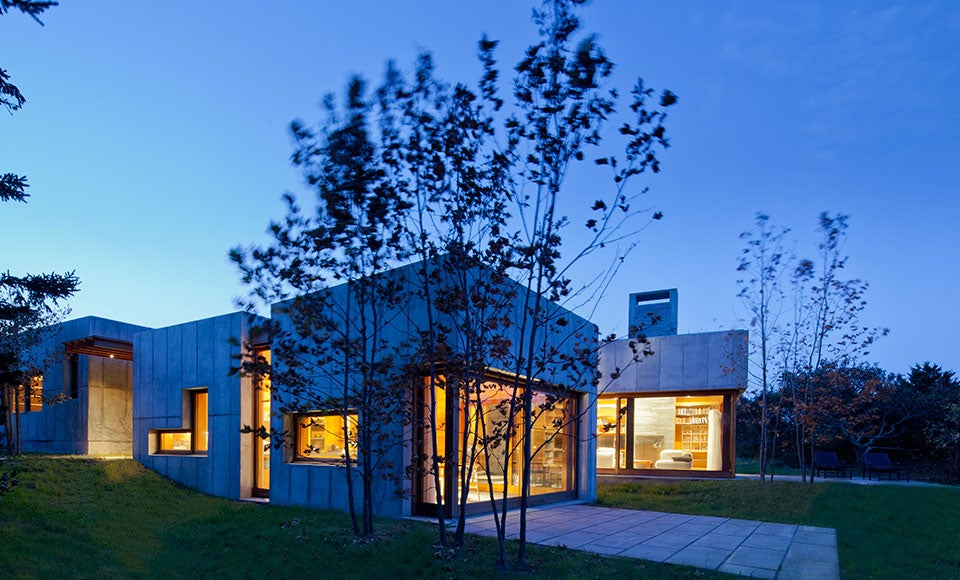
The “East House,’’ designed by Boston-based Peter Rose + Partners, recently won a Residential Architect Design Award.
As evidenced by the recent decision to move the entire Gay Head Lighthouse on Martha’s Vineyard to keep it from falling off eroding cliffs, some pieces of land on the island are not exactly stable.
Boston-based Peter Rose + Partners thought about this when building a Martha’s Vineyard home on a cliff and then won an award for it.
What the architecture firm calls the “East House’’ is on the west coast of the Vineyard, which has been faced with erosion for many years.
The 4,000-square-foot home consists of “site-cast concrete boxes and interstitial spaces made from conventional framing,’’ according to Residential Architect, all of which can be picked up and moved in the event of erosion.

The home won the 2015 Residential Architect Design Awards Custom/Over 3,000 Square Feet Award.
“It was a natural step, during conversations with the owner about coastal bluff erosion, to create a structure that could more easily be moved should that ever become necessary,’’ Christian Garland, the business manager of Peter Rose + Partners, told Boston.com. “The house design is framed around a number of ways to sensitively respond to the conditions of the site. This includes a geothermal climate system, green roofs to slow rain water movement and to minimize the house’s visual impact, and a cistern to collect and reuse rainwater.’’
The walls are concrete and 10 inches thick, ready to face any New England weather, according to the Peter Rose + Partners’s website.
Here was the architects’ thought process behind the moveable house:
“The solution was to cast the floors, formerly wood framed, in concrete, making each box a three- or four-sided structural unit that could be individually lifted and moved to a location far from the bluff should erosion occur. The 4,000 square foot house is thus divided into concrete boxes, individually liftable with all interior finishes in place, and interstitial corridors, light wood framed zones that are easily removed and rebuilt in the event the building is moved.’’
On top of the home’s unique design… it is also hidden. It is “embedded in the natural landscape’’ and is invisible from most points.



To comment, please create a screen name in your profile
To comment, please verify your email address
Conversation
This discussion has ended. Please join elsewhere on Boston.com