
What Is a Luxury Home, Anyway?
Different reports, brokers define different price points and qualities to be “luxury.’’
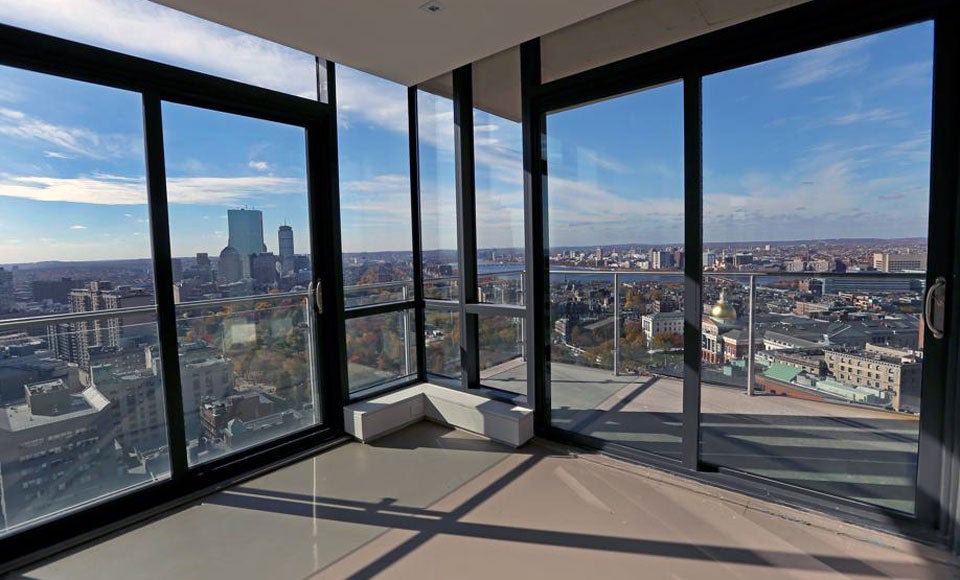
It seems luxury is everywhere in Boston these days.
Millennium Tower, which will open its doors in Downtown Crossing, calls itself the “evolution of luxury residential living.’’
Richard Friedman, developer of the new Four Seasons skyscraper, which will open in Back Bay in 2017, said of his building in comparison to other luxury buildings in Boston: “I don’t want to be cocky, but I don’t think we have a lot of competition.’’
Millennium Tower’s $37.5 million penthouse does put it in the “luxury’’ category, but as Boston gets more expensive and the “luxury’’ hype expands, the growing market becomes hard to define.
Even local agents don’t agree on what counts as luxury.
“Anything over $1 million,’’ said Linda O’Koniewski, CEO of RE/MAX Leading Edge.
“In my opinion, in downtown it’s $2.5 million, but in general Boston, probably $1.3 million,’’ according to Beth Dickerson, broker owner of Gibson Sotheby’s International Realty.
“It’s not a price point. It’s a set of finishes and amenities,’’ said Tim Marsh, principal broker of Marsh Properties. These amenities can usually be found in a set of tier-1 buildings, including the Four Seasons, The Carlton House, and Heritage on the Garden, he said.
But the term can be overused, Marsh admitted. “Some agents will use that term to create a perception of value instead of defining a value,’’ he said.
The National Association of Realtors, the largest trade association in the industry and is comprised of over 1 million members, doesn’t have a set definition for “luxury.’’
In its monthly and quarterly reports, NAR groups all sales $1 million and over in one category, but doesn’t denote the category as “luxury,’’ said Adam DeSanctis, an NAR spokesperson.
A lack of universal definition can prove problematic for sellers, buyers, or renters on the search. Depending on whom they ask, different agents and brokers may offer up different advice and varying ideas about how the market is performing, based on the definitions and data they ascribe to.
Tracy Campion, Massachusetts’s top selling residential real estate broker, said Boston’s luxury market is doing very well due to high demand and low inventory. Campion specializes in luxury locales like Back Bay and Beacon Hill.
The average sale price for Boston’s luxury condos was up 24 percent in 2014 from 2013, and the average days on market was 53, the lowest since before 2008, Campion said. The number of luxury condo sales was down 26 percent, which signals limited inventory, not decreased demand.
Her data comes from LINK, a local real estate listing and reporting service, which defines luxury as specific buildings in Boston, including Battery Wharf, The Carlton House, Ritz Tower I and II, and The Clarendon and are categorized by “luxe condominiums,’’ “hotel luxe,’’ and “luxe full service.’’
But O’Koniewski has a different data source and finds that the luxury market isn’t reaching its full potential due to homes being priced too highly and staying on the market too long.
“[Luxury home sellers] make a tragic error in not pricing it on the money and inciting competition,’’ she said.
O’Koniewski sees sale-to-list ratios and days on market as key indicators. She cited data from MLS listings from March 20, 2014 to March 20, 2015.
The average “luxury’’ condo in Back Bay over $1 million sold at 83 percent of its list price and stayed on the market for 152 days. Comparatively, condos under $1 million sold at 93 percent of their list price and stayed on the market for 86 days, on average.
Another report, this one by RE/MAX INTEGRA, praises the level of international investment in Boston’s luxury real estate.
“We are fortunate to have a large international community that believes real estate purchases in the greater Boston area make for an excellent investment,’’ said Dan Breault, executive vice president of RE/MAX INTEGRA.
The report handpicked 30 Boston neighborhoods and towns where luxury has taken off, and examined sales over $750,000 there, finding that sales increased 6.6 percent from 2013 to 2014.
Doug Miller, executive director of Consumer Advocates in American Real Estate, advises consumers to be wary of reports authored by agents. He argues agents will go to great lengths, including telling a homeowner his or her home is “luxury,’’ to obtain a listing.
Barry Zigas, director of housing policy for the Consumer Federation of America, said the term “luxury’’ is mainly a marketing tool, just like the oft-used “new and improved’’ and “more bang for your buck.’’
“Developers and real estate professionals can use the word ‘luxury’ to connote higher prices, marble countertops, fancy fixtures, which might or might not correlate with a much higher price,’’ Zigas said.
He advises home shoppers to place less weight on market reports and more on their own needs and values.
“Have a clear idea of what you can afford and what you’re looking for in a home,’’ Zigas said. “Consumers should shop for a home like they shop for any consumer durable. It’s one of the biggest purchases of their lives.’’



To comment, please create a screen name in your profile
To comment, please verify your email address
Conversation
This discussion has ended. Please join elsewhere on Boston.com