
Address Newsletter
Our weekly digest on buying, selling, and design, with expert advice and insider neighborhood knowledge.
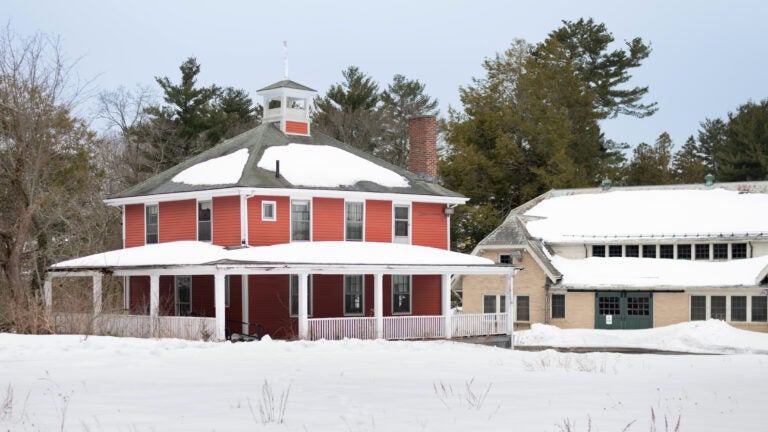
The Town of Weston wants prospective owners to come up with good ideas for three properties that have stood empty for 20 years: The Rand House, the Barn, and the Schoolhouse that are part of the Case Estate, named after Marian Case, who played an important part in preserving Weston’s agricultural history and traditions.
In 1909, after her father died, she began to accumulate land to serve as an experimental farm and work/study experience for local boys during their summer vacation. Eventually, about 40 acres, known as Hillcrest Farms, was under cultivation. Most of the manual labor was done by the “Hillcrest Boys,” up to 20 local boys aged 12 and older, who worked for between $4 and $20 a month. After 1913, academic study in the field of agriculture was added to the program, which Marian Case continued to lead. In 1920, the property was renamed Hillcrest Gardens, reflecting the new emphasis on horticulture, as well as new uses of the property for display gardens and as a plant introduction station.
Upon Case’s death in 1944, the property was willed to the Arnold Arboretum which, in the early 21st century, sold it back to the town. Among the buildings used by the Hillcrest Boys are the Schoolhouse, the Barn, and a ca. 1790 Federal home known as the Rand House. They stand in a picturesque row along Wellesley Street; the Schoolhouse and the Rand House share a common driveway. Now Weston has issued a Request for Proposals for the three properties.
“They can be purchased individually, or all together,” said Diana Chaplin, of Chaplin Partners, a Weston real estate firm handling the business end of the sale. “We are really hoping that someone will make them beautiful.”

The intention is to preserve the historic character of the individual buildings, the visual charm presented by the row of 18th, 19th , and early 20th century structures, and the wildlife and extended rural sightlines provided by the adjacent 19-acre meadow.
“The buildings all will need some level of renovation. They have not been occupied for 20 years,” said Leon Gaumond Jr., Weston’s Town Manager. “People can add to them, but there are conservation and historic restrictions, as spelled out in the bid documents. After the proposals are submitted, the Board of Selectmen will decide which are best for the town.”
Among the restrictions spelled out by the town is a provision designed to foster native plant life and pollinators: The meadow can only be mowed by the town, and no more frequently than three times a year. Historic preservation restrictions specify that the exteriors of the buildings be retained and maintained. In the Rand House, the main staircase, the flooring, the exposed corner posts, and the West Parlor fireplace surround are considered historically significant; in the Schoolhouse, that applies to the fireplaces, the cupola, and the hip ceiling.
“These properties are in the Case’s Corner Historic District, which is listed with the National Register of Historic Places,” Gaumond said. “So, we want the historic aspects of these buildings to be preserved.”
In August, 2025, prominent local architect Patrick Ahearn developed a proposed design for the three structures in which each serves as a single-family residence. The barn could become a 9,000+-square-foot six-bedroom home, while the Rand House and the Schoolhouse could respectively accommodate four and three bedrooms.
“The Rand House can be renovated and sensitively augmented on its 60,000+ square foot lot as a matter of right per the included design plans,” Ahearn pointed out in his prospectus. “The Stable building and Schoolhouse are separately sited on one 60,000-square-foot lot. It is proposed that a two-unit condominium form of ownership would be utilized to allow for the creation of two freestanding single family residences on this existing lot.”
His design proposal came before the town of Weston initiated a change that will make it easier for prospective owners.
“The one lot with the Schoolhouse and Barn is now being subdivided,” Gaumond said. And, while he, the selectmen, and Chaplin have agreed on dollar amounts to include in the listing sheets, they are anything but binding.
“In the case of each building, we will be looking for the value they bring to the town, and money is only one factor,” he said.



Our weekly digest on buying, selling, and design, with expert advice and insider neighborhood knowledge.




To comment, please create a screen name in your profile
To comment, please verify your email address
Conversation
This discussion has ended. Please join elsewhere on Boston.com