
Address Newsletter
Our weekly digest on buying, selling, and design, with expert advice and insider neighborhood knowledge.

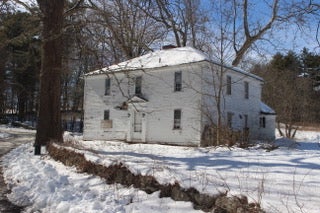
Two decades of fighting to save Natick’s oldest house halted Tuesday when Mass Audubon demolished the structure, reducing it to a pile of wood boards.
“It is quite an extraordinary story that has been lost to history,” said Peter Golden, a Natick resident, writer, and local historian.
From its construction in 1696 by Thomas Sawin, the Sawin House played an “extraordinary role in the whole American experience,” Golden said.
The house and the Sawin family played a critical role in America’s history, beginning with the aftermath of King Philip’s War, to the American Revolution, and later to the push to abolish slavery.
“The house is critical to all this, and now it’s gone. Why?” asked Golden. “What in God’s name does Audubon have in destroying that house? Shame. Shame.”
Mass Audubon confirmed the demolition of the house located at 79 South St., in South Natick, on Tuesday. The organization said that the town and concerned citizens had worked for 15 years to disassemble and relocate the Sawin House to another location. A plan was presented at the Town Meeting in 2014 but did not pan out.
For a decade, no substantive progress was made, said David O’Neill, president and CEO of Mass Audubon, in a statement. The house “fell further into disrepair and became an eyesore and a hazard,” with vandalism and multiple break-ins.
O’Neill said that the house, which has not been occupied since 2008, has reached a point of structural instability.
Mass Audubon filed for a demolition permit after years of no resolution to save the house. The six-month delay period ended last week.
“It’s unfortunate that we proposed a path forward that would save the Sawin Hosue at a different location, but we were met with dismissals and false accusations of insensitivity and eagerness to erase history,” O’Neill said. “In reality, we spent more than 10 years working collaboratively to do just the opposite.”
O’Neill said the organization salvaged a few original components of the house to be hosted off-site and will create a meaningful historic interpretation experience at Broadmoor in partnership with the Natick Historical Society and indigenous partners.
“The house was one of the few remaining things that was standing in existence that went back to the 1600s,” said Natick Heritage Preservation board member Frank Foss. “Its story is emblematic of Natick and the Praying Indians and how it all started, which is so important to how we live our lives today.”
“We now have nothing to honor,” Foss continued. “That makes it a sad day.”
Following King Philip’s War, the bloodiest conflict in America between the English and the Native Americans, Natick was established as an Indian reservation for the protection and conversion of local Native Americans to Christianity.
George Sawin, Thomas Sawin’s seventh great-grandson, told Boston.com the story of the Sawin family.
He said Thomas Sawin, a carpenter and miller, was invited to move to Natick and build a grist mill for the local natives. In return, the natives gave him about 50 acres of land.
Sawin was a soldier 10 years prior and fought at Great Swamp in Rhode Island, which killed hundreds of native people. “And now he’s choosing to live amongst native people,” Sawin said.
After building the mills, Sawin constructed the house, which stood for 325 years in different iterations until Tuesday, when it was demolished. The mill ran in collaboration with the Native Americans until 1910 when it burned down.
“This house symbolizes to me a great, wonderful story about what’s best about us as a people,” said Sawin.
For decades, the house remained a critical part of America’s history.
Fifty years after Thomas Sawin’s death, the house was a rallying point for the Natick Milita on the night of April 19, 1775. On that night, Thomas Sawin (grandson of the original) received word from two local child patriots riding to the Middlesex Alarm that British troops were on the march.
Thomas, his two sons, and many others from Natick responded to the alarm that would mark the start of the Revolutionary War, but they lost one man, Captain John Bacon.
In the 19th century, the homestead was home to Phares Sawin, whose brother Moses was silenced for speaking out against slavery and rejected from the town.
The homestead was sold to cousins of the Sawin family, the Morses, who later sold it to a physician and farmer named Stillman in the early 20th century. In the 1960s, the land was gifted to Mass Audubon.
Now that the house is gone, Sawin feels terrible that his children and grandchildren can no longer access this piece of history.
“We’re not just talking about old boards and old nails,” said Sawin. “We’re talking about the story, and that’s what’s so important, and that’s what I’m afraid of losing.”

Our weekly digest on buying, selling, and design, with expert advice and insider neighborhood knowledge.




To comment, please create a screen name in your profile
To comment, please verify your email address
Conversation
This discussion has ended. Please join elsewhere on Boston.com