
Back Bay’s Ayer Mansion and adjoining property sold in off-market deal
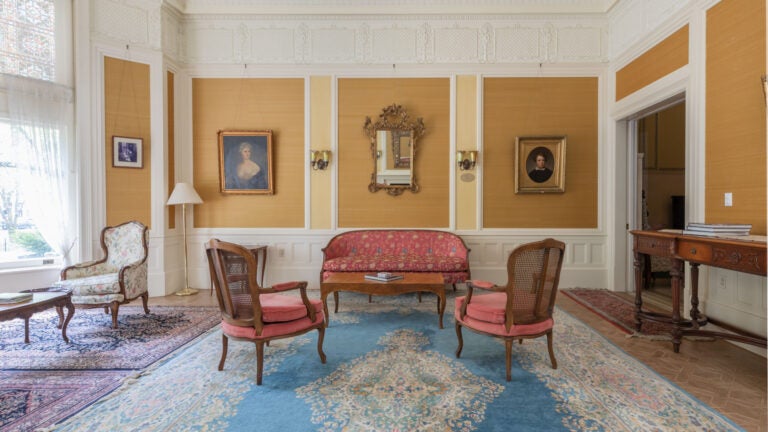
Back Bay’s Ayer Mansion was once a private residence, but it’s always been a work of art. Now, the five-story building just sold for the first time in decades in an off-market deal.
The deal comprises the Ayer Mansion at 395 Commonwealth Ave., and the adjoining dormitory building at 397-399. Originally listed for $22,500,000, the official selling price is not yet determined due to a planned potential expansion.

“They’re waiting to finalize the purchase price because they can expand onto Marlborough Street, so they don’t have a final purchase price yet,” said Regina Winslow of William Raveis Real Estate, the co-listing agent on the property with Mark O’Donnell.
The properties were purchased by Sea-Dar Development, which plans on turning the Ayer Mansion into a single-family property, and the adjoining property at 397-399 into condos.
With a total living area of 25,300 square feet, the two properties are very different buildings. The Ayer Mansion was originally designed by A.J. Manning with Louis Comfort Tiffany in 1899 for Frederick Ayer and his wife, and is one of the rare surviving properties exhibiting Tiffany’s exquisite work. Revolutionary at the time of its design, the granite exterior features mosaic panels set in limestone.

Designated a national historic landmark, the property is helmed by a four-story hanging chandelier and sweeping center staircase. The front entrance hall features intricate mosaic surfaces, especially noticeable on the stair risers under the semi-circular threshold.
“Mrs. Ayer was into the theater, and our understanding is that that was used as a stage for entertainment for her,” said Winslow. “It is spectacular to look at. It gives you the feeling that it’s three-dimensional, but it’s not.”


Intricate mosaics and lighting, a trademark of Tiffany’s, are noticeable throughout the five-story home, which has 12,650 square feet of living area, an elevator, a finished basement, and three double tandem parking spaces.

Meanwhile, 397-399, the dormitory portion of the properties, was built in 1924-1925. Also spanning five stories, it features 12,650 square feet of living space. Both properties were long known as the Trimount and Bayridge Residence and Cultural Center, which provided housing for college women in association with the Roman Catholic Opus Dei organization. There are two unique chapels in the building, added in the 1970s and 1990s, respectively.

By May of this year, a representative for the Trimount Foundation told The New York Times that the pandemic had prompted the property going up for sale since the student fees that provided money to operate the buildings had dwindled during the COVID era.
It was then Winslow said they determined an off-market deal would be preferable.
“We knew if we put it in the public marketplace we would have many people interested that didn’t understand the way the property needed to be preserved, or wasn’t familiar with development on downtown Boston,” Winslow said. “We didn’t really want it on the open market.”




To comment, please create a screen name in your profile
To comment, please verify your email address
Conversation
This discussion has ended. Please join elsewhere on Boston.com