
Address Newsletter
Our weekly digest on buying, selling, and design, with expert advice and insider neighborhood knowledge.
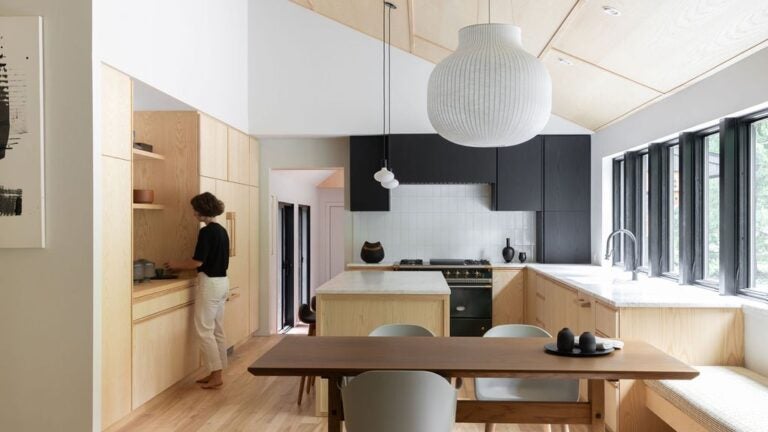
When Reo and Katy Matsuzaki were deciding how they wanted to update the 1980s expanded Cape they’d purchased in Great Barrington, the couple knew it would need to balance form and function.
Reo, who is half-Japanese and grew up in Japan, focused on form: “The vision started out as a house that felt warm, that felt modern, but at the same time, brought in a Japanese aesthetic,” he said.
Katy, on the other hand, considered function — namely how she and Reo, their two children, Reo’s mother, and two dogs would inhabit the 2,500-square-foot home. “There was the functionality of the house as a multigenerational living space, but also [prioritizing] the ability to be able to put everything in a nice, neat way, where everything has its place and can go behind a door or in a drawer,” she said.
They hired designer Jess Cooney of Jess Cooney Interiors to bring their Japandi vision to life, a style that merges Scandinavian minimalism with Japanese design principles. “We often bring a rustic Berkshires style into our projects, and so leaning more into the Japanese realm was really fun for us,” Cooney said.

First, the couple requested the home’s exterior siding be shou sugi ban, a traditional Japanese technique that chars wooden planks to help strengthen them. They also asked the firm to incorporate wood from fallen ash trees on their previous property; the ash was milled by a lumber company in Connecticut before being used for the home’s flooring and ceiling boards. This reuse echoes the Japanese concept mottainai, which underscores resourcefulness by rejecting waste and encouraging an efficient use of resources. The white ash brings in style, too: The light wood juxtaposed with the black from the burnt cedar on the exterior makes for a striking contrast.


Inside, the goal was to prioritize storage, maximizing every square inch of the home. This is especially true in the former screened-in porch, which became a combined mudroom and playroom that connects the garage to the rest of the house.
“Here was a space that we didn’t quite know what to do with,” Reo said. “It was an awkward location overall, but then it got turned into possibly the most interesting and useful room of the entire house.”
The space incorporates built-in benches with drawers, plus a mix of open and closed shelving. “After they moved in, [Katy] was like, ‘It feels like we have this Montessori school in our mudroom for the kids, because everything is so organized and easy for them to play on that tile floor,’” Cooney said. The room’s heated Fireclay Tiles floor was selected with longevity in mind.
“It’s super durable if the kids want to be painting or have Play-Doh, and then also super durable if you’re just coming in from outside in the rain or snow,” Cooney added.

Another clever example of built in-storage can be found in the primary bedroom. Cooney transformed several walls into floor-to-ceiling closets, cladding them with vertical slats so they blend with the rest of the room.
“Taking an opportunity to fill everything with storage but make it really beautiful and minimalistic at the same time was really the goal,” she said.
Beyond the bedroom, the primary bathroom exhibits traditional Japanese wet and dry areas divided by a glass wall. In the “wet” area, there’s both a soaking tub and a shower, where bathers typically fill the tub, take a seated shower, and then get into the bath.
“It was a funny scenario where the plumber came and looked at the design. He said, ‘This is all wrong. What do you mean by any of this?’ Because he was, of course, not used to designing a Japanese-style bathroom,” Reo said. “The architect said ‘No, no, this is correct. Just follow the specifications and it’ll be OK.’”
Cooney also adjusted the home’s layout slightly, adding more windows to the front of the house and pulling the kitchen forward to reconfigure its entryway. A deep green Lacanche range faces the modern limewash fireplace in the adjoining living area, and black cabinetry coordinates with the new black trim on the windows. A large paper lantern serves as a focal point over the dining table, while built-in seating and wood-lined shelves lead into the living room.

To bring more drama to the main living space, Cooney installed a series of ash planks under the stairway as a sleek divider wall. Elsewhere, additional shelving serves as space for the family to display art and Japanese pottery.
On the lower level, Cooney dreamed up a sleek in-law apartment where the children, ages 4 and 9, can visit their grandmother.
“What this house does is it serves a model of really functional multigenerational cohabitation,” Reo said. “How can three generations happily live together? Beyond all the aesthetics, achieving that was really important.”

Our weekly digest on buying, selling, and design, with expert advice and insider neighborhood knowledge.





To comment, please create a screen name in your profile
To comment, please verify your email address
Conversation
This discussion has ended. Please join elsewhere on Boston.com