

Address newsletter
Get the latest news on buying, selling, renting, home design, and more.
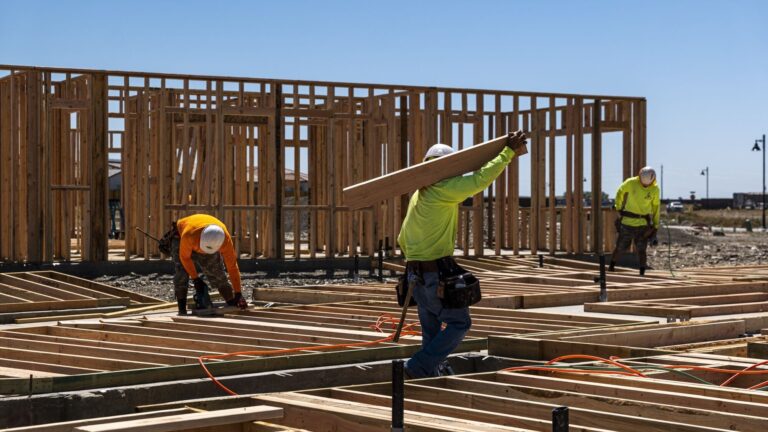
Since the pandemic, Americans have felt the pressure of rising housing costs. Due to Trump administration tariffs, those prices may increase even more.
Home prices still have not recovered from the COVID-19 pandemic. They currently sit 40 percent higher than they were at the start of the pandemic, and housing costs are rising twice as fast as overall inflation. In a 2024 Pew Research Center study, 69 percent of the Americans surveyed reported being “very concerned” about the price of housing.
Prices for floor coverings alone were already 14.85 percent higher in 2024 versus 2019, according to the US Bureau of Labor Statistics.
Amid these high costs, the Trump administration announced sweeping tariffs that, if implemented, could rachet up the housing costs. Trump nearly enacted 25 percent tariffs on goods imported from Canada and Mexico before suspending them for 30 days on Feb. 3. On Feb. 4, the Trump administration implemented a 10 percent additional tariff on Chinese goods, but later halted the provision for low-cost packages. On Monday, Trump imposed a 25 percent tariff on important steel and aluminum imports.
“Trump also reaffirmed that he would announce ‘reciprocal tariffs’, … meaning that the US would impose import duties on products in cases in which another country has levied duties on US goods,” the Associated Press reported Monday.
China already has retaliated with tariffs on American energy products, agricultural machinery, and large-engine cars.
“There is no question that tariffs will increase the input costs of key components in housing like flooring, millwork, and cabinetry,” the National Hardwood Lumber Association said in a statement to the Globe. “The reality is that production costs will increase with no increase in consumption of Real American Hardwood in the USA.”
The American Society of Interior Designers also told the Globe that “tariffs on foreign goods may increase costs for consumers.”
The US lumber industry, which provides materials used to build American houses, relies heavily on trade relationships with Canada, Mexico, and China. Canada and Mexico supply 70 percent of the United States’ softwood lumber and gypsum imports, essential materials for home building.
“Canada and Mexico are stable and vital partners for American hardwood lumber,” said the NHLA. “With Canada, hardwood logs have freely flowed back and forth across the border for generations.”
Because of the importance of these relationships, and before Trump suspended the tariffs on Canada and Mexico, the National Association of Home Builders pleaded with his administration to create a carve-out for building materials “to avoid exacerbating the housing affordability crisis.”
These international trade partnerships are reciprocal: Canada, Mexico, and China are the three largest US hardwood lumber export markets.
Some US lumber exports find demand primarily in Canada: “Demand for certain grades and products often exists in volume only on the other side of the border,” said the NHLA. “Without the Canadian market for some products, US hardwood producers will face structural challenges that will not be easily overcome.”
Though the United States has averted a trade war with Canada and Mexico for now, the threat of tariffs already has begun to affect these relationships.
“Contracts agreed to prior to the trade action are now being disrupted by tariffs,” said the NHLA.
American homebuilders also have begun preparing for the effects of the back-and-forth with China. The American lumber industry was hurt by past US-China trade wars and is bracing for another.
“In 2018, the hardwood industry had more trade damage than any commodity, losing 50 percent of its pretrade war market in China and never recovering,” said the NHLA. “Although China exemptions have been in place since 2022, the renewed tariffs and trade conflict will severely impact our industry.”
Indeed, an increasingly tense US-China trade relationship has caused Chinese consumers to turn toward domestic products.
“Chinese buyers have shifted away from purchasing American lumber, which supports countless rural jobs, and instead began building their own sawmills and buying raw logs, resulting in significant job losses in the US lumber industry,” said the NHLA.
American homebuilders hope tariffs may cause a similar shift in demand for domestic products in the United States. The interior designer society is optimistic about tariffs “potentially strengthening the position of domestic goods and making them more competitive.”
Still, tariffs would affect domestic manufacturing and consumption. There are almost no downright domestic US manufacturers; even companies that use American raw materials rely on components and equipment from other countries. Changes in the prices of international goods also would affect domestic prices. Following tariffs on Chinese stainless steel in 2012, domestic manufacturers took the opportunity to increase their prices as well.
Ultimately, industry leaders agree that international trade partnerships remain vital to the US housing market.
“NHLA sees a bright future for hardwood use,” the organization said. “International trade remains crucial.”
Get the latest news on buying, selling, renting, home design, and more.





To comment, please create a screen name in your profile
To comment, please verify your email address
Conversation
This discussion has ended. Please join elsewhere on Boston.com