
More than bargains: The social impact of free-stuff groups
Getting ready to sell your home? ‘Freecycling’ is an easy way to shed things you don’t want to move or furnish your new home without trashing the planet.
Wedding bells usually mean wedding bills. According to data from the wedding registry site Zola, the average wedding cost $33,000 in 2024. But with help from her neighborhood’s free-stuff online group, Catherine Allende of Medford was able to source all of her wedding’s decorations for free — and found her wedding dress there, too.
“It was the first thing that came out of my mouth when I did our first look with my husband,” Allende said, recounting the moment she revealed her wedding dress to him. “I was like, ‘I finally get to say it out loud that I got this through the Everything is Free Medford page, and brand new, too!’”

For Allende, and other members of groups with names like “Nothing for Sale” and “Buy Nothing,” it’s a point of pride to furnish entire homes — or at least rooms — with goods found for free online. Devotees of the groups say they’re bringing home high quality goods, saving useful items from landfills, and forging meaningful connections with neighbors while they’re at it.
It’s also a great way for home sellers to purge belongings they don’t want lugged into moving vans.
Allende said that when she moved out of her New Jersey apartment to attend graduate school in the Boston area, her mother told what she’d left on the street just sat there. That felt wasteful, said Allende, who joined the Everything is Free Medford Facebook group as a way to reduce duplicate items among her roommates. But when it was time to plan what she called a “microwedding” at Hammond Castle in Gloucester, her decor budget quickly added up. One important item would have cost $300 purchased new — and her total decor budget was $500. So, Allende took to the group and collected wedding tablecloths, an ornate gold mirror, and the dress itself, which she picked up from a neighbor at a local MBTA station.
Allende repurposed many of the items into her home decor after the wedding, but she relisted others back into the group. From time to time, she sees them reappear as posts, continuing their journey upstream to their next, though maybe not final, owner.
For Ginnette Powell of Dorchester, exchanging free home goods was a response to homebound pandemic boredom.
“All we could do was sit around, and then we started to Marie Kondo … our places,” she said. She picked up a futon and jettisoned other belongings.
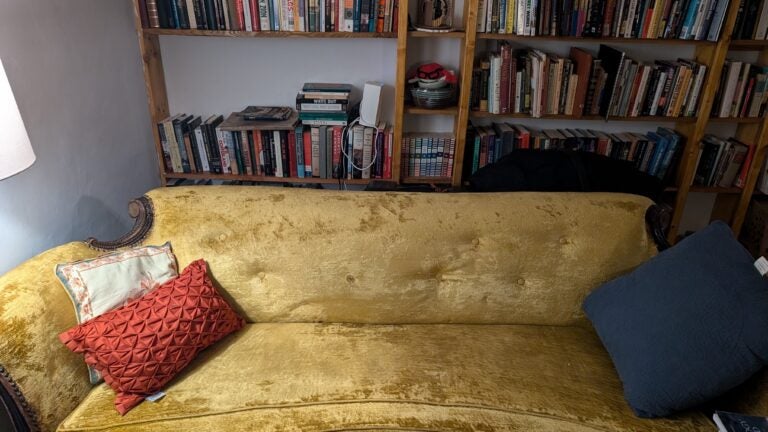
Instead of spending money on new goods, Powell has reallocated that budget for movers, using an app called Dolly. The futon, worth $500 at retail price, was free, and moving cost $250 from West Roxbury to Dorchester. Allende noted that one of her favorite acquisitions, a book shelving unit, would retail at $400 as sold new.
For the uninitiated, it’s important to pay attention to group and site rules across such Facebook groups, as well as the site Freecycle, which can be specific. Some offer a range of options for choosing a taker, such as “first come, first served,” or random lottery selection, and posts should follow designated formatting rules. (The Buy Nothing Boston Facebook group blocked this journalist after I tried to post a message soliciting member experiences, and Freecycle.org also refused such a post because, said moderators, it did not explicitly further the group’s mission of keeping items out of landfills.)
Altruistic reasons appeal to members, too, who see the groups as potential platforms for mutual aid in their neighborhoods. For instance, Powell said she was able to team up with neighbors to match Hurricane Maria evacuees from Puerto Rico with home furnishings. And during in-person pickups, conversations have offered clues into new ways to help. Powell helps rescue cats, and a neighbor at another pickup offered cat-care supplies. And she sometimes acts as a matchmaker of the potentially useful, obtaining items that might be helpful to others in the future. An aquarium setup came in handy in such a way recently, as did a microscope.
“You’re keeping [items] out of the landfill, and you might even be making connections with people,” Powell said.
In Roslindale, Anne Hernandez has successfully furnished her sunny, art- and plant-filled home with items she said speak to her soul — found mostly on Craigslist and Facebook.
“I am intentional about how I decorate my home, which is my place of peace and calm in such a chaotic world,” she said.


“The thought that all the items my neighbors have gifted me would have been trashed otherwise is sad,” Hernandez continued. “I love the community that is built through exchanging possessions with others. We live in a materialist world, so I appreciate that we can let go of things so that others can enjoy them.“
Stepping outside mainstream retail commerce is a money-saving effort, but in more ways than one, some see it as a radical act. Supporting free-stuff groups reduces waste and demand for item production, but the value of strengthening neighborly ties may outweigh that of anything being traded. Members argue that there is, if you know where to look, enough to go around — including good will.
Allende said some of her pickups turned into long visits, including mothers reminiscing with her about their children’s weddings, and another who surprised her with celebratory champagne.
Laurel Oberstadt-Petrik, a Brighton-based graduate student, said they have sourced hundreds worth in goods from the group, as well as used it to host an in-person clothing swap. But they said the social ties matter the most in the exchange. The groups can double as places to share news of potlucks and other community events, especially valuable in reaching a large and diverse membership.


“A group like this doesn’t necessarily exist to further political connections,” said Oberstadt-Petrik, “but it does act as infrastructure that already exists, in a system that already exists, that can be reformed or changed or shifted or utilized for political action.”
Lindsay Crudele can be reached at [email protected].






To comment, please create a screen name in your profile
To comment, please verify your email address
Conversation
This discussion has ended. Please join elsewhere on Boston.com