



Address newsletter
Get the latest news on buying, selling, renting, home design, and more.
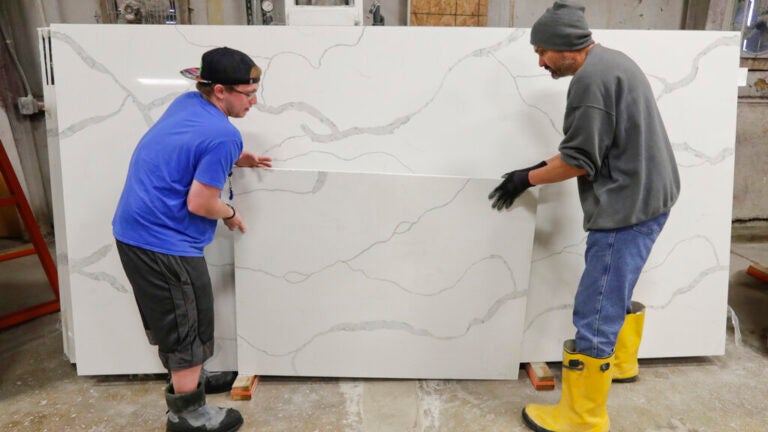
As quartz countertops rise in popularity, those manufacturing the stone are experiencing the repercussions of exposure to dust released by the material, but homeowners are not at risk, experts say.
“Probably zero risk to homeowners with quartz counters. Dust exposure only,” said Dr. David Center, an associate provost of translational research, a professor, and the chief of pulmonary, allergy, sleep, and critical care medicine at Boston University.
A study the Journal of the American Medical Association Internal Medicine published online Monday found a significant increase in the lung disease silicosis among quartz manufacturers. Quartz countertops consist of polyester resins, pulverized quartz, and pigments, according to This Old House.
The manufactured stone, known for its durability and sleek appearance, has become a high-demand material for new homes and remodels. That demand has led to increased levels of exposure to air filled with silica dust, which has been linked to the lung disease.
Silicosis is a lung disease caused by inhaling particles of silica dust, commonly found in rocks and soil. After exposure, it can cause severe damage to the lungs, according to the American Lung Association. The dust is emitted only during the manufacturing process.
Center said the effects of silica dust exposure can present in different ways.
“Silicosis can be acute with symptoms of cough and shortness of breath in weeks to months after heavy exposure, or chronic in which lung scarring, shortness of breath, and cough occur over years of exposure,” Center said.
In the study, conducted in California, 52 cases of silicosis were found among the workers, the majority of whom were male Latino immigrants. The median age of the workers was 45.
There is no cure or treatment for silicosis other than supportive care with oxygen, according to Center.
How can the workers protect themselves?
“Good ventilation, industrial grade N95 respirator masks, good goggles to protect eyes, [and] frequent breaks with ventilation of the grinding area,” Center said. “Both acute and chronic silicosis can progress to respiratory failure and death. It is a miserable way to die.”
According to the article, 48% of the workers diagnosed with silicosis continued to manufacture the material.
Get the latest news on buying, selling, renting, home design, and more.




To comment, please create a screen name in your profile
To comment, please verify your email address
Conversation
This discussion has ended. Please join elsewhere on Boston.com