
See how rough-around-the-edges cabin became restful retreat in Vermont
A newly renovated cottage snuggles up to towering white pines and overlooks meadows and a pond.
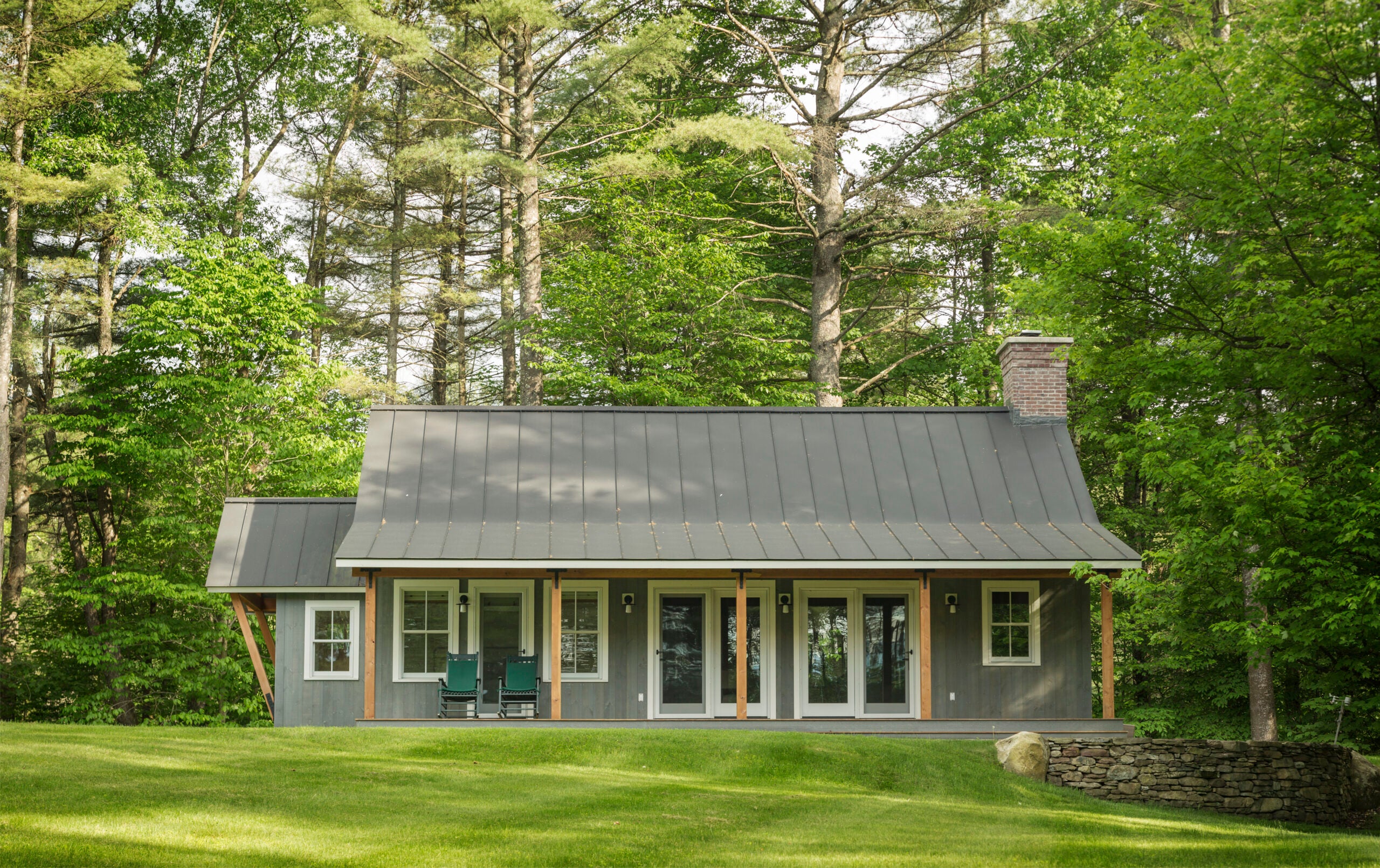
Halfway between the historic village of Stowe, Vermont, and the vacation condos on Mount Mansfield above it, a long dirt drive winds past fenced pastures lined with maple trees, snakes between a classic weathered horse barn and a gentleman’s farmhouse, and ends in a back corner of a 40-acre parcel. There, a newly renovated cottage snuggles up to towering white pines and overlooks meadows and a pond. At the request of the owners, who fancied a getaway spot as well as guest quarters on their property, Ernie Ruskey of Tektonika Studio Architects, with the help of Gordon Dixon Construction, both of Stowe, transformed a dreary cabin built in the 1970s into a fresh and inviting retreat.
First on Ruskey’s agenda was to bring more light into the 24-by-32-foot interior. With a roof and ceiling made of aged, unpainted wood, the building “was a bit oppressive,” he says. “Everything was very dark.” He had the rough-sawn cathedral ceiling boards painted a cream color and installed four patio-door panels facing the pond and its filtered views of Mount Mansfield. To the existing footprint he added a small, sunny bedroom with a mechanical room beneath it, a bright entry hall, a full bath, and an 8-by-30-foot porch facing the view.
Perhaps equally significant is what Ruskey did not do. He did not touch some of the original features that give the cabin its rural character: the rough-sawn boards and hand-hewn timbers overhead, super-wide plank floorboards secured with antique square nails, and a massive brick chimney and working fireplace. These three elements tie the building to its site and infuse it with a calming authenticity.

Especially impressive are the 8-by-8-inch timbers, silver-gray with age and bearing the rhythmic marks of the ancient adze. “Whoever built this cabin probably took the timbers from an old barn and made these trusses out of them,” Ruskey says. “The trusses aren’t from a barn, but the timbers they’re made from probably are.” They did pose a building challenge as new materials had to be scribed where they met the uneven surface of the beams, such as over the patio doors.
Ruskey replaced a slender fireplace mantel with an 8-by-8-inch beam, which makes a solid separation between the brick below and stucco above. A local blacksmith forged hefty wrought-iron brackets, which with the black wrought-iron candle sconces support the earthy theme.
Ruskey retained this agrarian character while introducing state-of-the-art energy-saving features. “It was a total gut back to the studs,” he says of the renovation. “We totally retrofitted the shell.” This included building a new standing-seam roofing system from metal, plywood, rafters, and insulation on top of the original wide sheathing boards, which remain exposed to the interior.
The original walls were framed with 2-by-4-inch studs; Ruskey built out a second 2-by-4-inch wall for extra insulation. He used urethane spray foam for an R-value of 33 in the walls and 60 in the roof, values that exceed Vermont energy codes. He finished the interior with pine shiplap that he stained with diluted white paint to blend with the white trim.

What might have been a tricky aspect of the project — fitting a modern kitchen into this rustic interior — turned out to be an unobtrusive success. Painted to blend in with the shiplap walls, maple cabinetry glides quietly along an entire wall, with lichen-colored limestone countertops solidifying the sense of place this cottage provides.
In designing the interior, Ruskey collaborated with Michelle Holland of Michelle Holland Interiors in Shelburne, Vermont.
The restraint both architect and interior designer expressed heightens the charm of the cottage. “The building called for that,” Ruskey says. “It has a nice country setting, and that called for simplicity, with a few touches of detail and interest to give it a little bit of character.” For example, the beadboard on the end of the banquette that serves as both living-room seating and a place for kids to sleep, and the rope-and-iron chandelier over the dining table both enhance the character of the room.
The style is not exactly rustic — the finishes and feeling are more refined — but the cottage is unmistakably tied to the horse farm at the other end of the property. “It’s almost as though it was a barn at one time and this is an infill to a barn space,” Ruskey says. Perhaps that is what makes the cottage so successful as a getaway. There’s a presence as calm and unhurried as the grazing animals about the place that makes a visitor want to linger here.
See more images of the rustic home here:





To comment, please create a screen name in your profile
To comment, please verify your email address
Conversation
This discussion has ended. Please join elsewhere on Boston.com