
Lessons learned from building an addition
Why you should get references from total strangers and more tips.
Russ and Dave. Dave and Russ.
When we shook hands with and signed papers last spring with the general contractor who was going to build our new family room, we assumed our relationship with him, the guy we’d be writing our checks to, the guy who’d come highly recommended to us, was going to be the most important relationship during the months of construction. We were wrong.
It turned out to be with two guys named Russ and Dave, guys we didn’t know, we’d never met, we had no references on, and we knew nothing about.
That was one of the valuable lessons we learned from the most expensive decision in our lives, other than buying a home.
In a Greater Boston housing market that is choose your adjective — inflated, insane, nuts, laughable, depressing, frustrating — I’ve noticed a trend in my town, Needham. And my community is not alone, it turns out. More people are remodeling and adding on to their homes.
A 2017 report projects that home improvement and remodeling spending, thanks to baby boomers investing in their homes, will remain robust at least through 2025, increasing 2 percent annually. The report said the $340 billion spent on remodeling in 2015 broke the all-time record, and that level of spending has been consistent the past few years for one simple reason. “Low, fixed-rate mortgages are a disincentive for people to move,’’ said Kermit F. Baker, director of the Remodeling Futures Program at Harvard’s Joint Center for Housing Studies. “It’s locked them in.’’
If you like your town, your street, and your neighbors, but you want change, you have two options: wade into that choose-your-adjective housing market and hope for the best or turn your home into the home you want, with a master suite or a new kitchen or, as we did, a modest, more open family room with a finished basement. “If you want to look to buy a new home, you’ll be out by 495,’’ Baker said. “You can trade up, but it’s expensive.’’
So now that I am sitting here typing this story in the addition we’ve just completed, and looking around at the choices we made, the obstacles we encountered, and the things we wished we’d done differently, the lessons we took away from the experience are fresh. Our experience was excellent, but I’ve heard enough stories of disappearing contractors, endless delays, blown budgets, and poor finishing details to know that’s not always the case. What follows is a collection of tips, advice from experts, and suggestions should you decide to build out rather than move on.
None of the tips will be to confirm licenses, check with the Better Business Bureau, or see whether the contractors have a history of lawsuits or arbitration (yes, you can do that, here is the website: www.mass.gov/ocabr/consumer-rights-and-resources/home-improvement-contract/check-a-contractor.html). Those steps should be automatic. You are about to invite in strangers, give them a key, and shell out $50,000, $150,000, or $500,000. Doing your homework is not being paranoid. That’s being smart.
Tip: Talk to references who are strangers.
You are about to spend a whole lot of money with someone you’ve met once or twice. You call multiple references on baby sitters you pay $15 an hour (right?). You should do the same for someone you might be paying six figures.
Don’t just rely on friends. It’s a fine place to get a name, but it can be awkward to have honest, heart-to-heart conversations with friends who might have just shelled out $200,000 and not been completely thrilled. They may feel embarrassed about their choices, reluctant to say how much they spent, and uneager to share certain stories, and you may be hesitant to ask them hard questions.
If you find contractors you like, get a list of references from them and call a few. Ask specific questions: Did they lay out a timeline for the project and stick to it? How easy were they to reach? Could you text them? E-mail? Did they call back quickly? What happened when there was a problem, how did they handle it? Did they stick to the agreed-upon budget? And when a new cost came up, a change-order, how was it handled? How many projects were they taking on at once? And finally, ask about their subcontractors.
Suggestion: Find out what town the contractors do the majority of their work in, and call architects in that community. Chances are they will know the contractor and maybe even have worked with them. Ask the architects tough questions regarding what they like, and don’t like, about working with these contractors. And they might even know a homeowner who used them you can talk to. Find strangers, rather than just using the contractors’ list of references.
Tip: The subcontractors are the key to your happiness.
For us, this was Russ and Dave.
Every general contractor is different. Some show up every day swinging a hammer and putting up drywall, but more common is the contractor who has a licensed project foreman and a small army of subcontractors and bounces among multiple projects.
“It’s important to note that in Massachusetts, there must be a construction supervisor, a licensed individual, on the site, representing the license,’’ said Kendall L. Buck, the former interim chief executive of the Builders and Remodelers Association of Greater Boston.
In the end, it’s important to like your contractor, but it’s just as crucial to like your subcontractors. So when you find a general contractor you like, ask about his or her subs: How long have they worked for you? Have you had any issues we should know about? Are they meticulous about cleaning up at the end of the day? What time in the morning would they start? Will they come on Saturdays?
And it’s OK to ask for their phone numbers. General contractors will want everything to go through them, but you can push back. When it’s noon and you’re at work and you suddenly remember something about the bathroom plumbing or the floorboards, you don’t want to be frantically trying to reach your general contractor and hoping he can contact your project foreman. You should have a direct line to the people inside your house. That’s not unreasonable.
Every morning by 7 for three months, two pickups would pull up in front of our house. They would respectfully wait a few minutes, just to be sure we were up and about in the kitchen, and they’d be in our house by 7:15, Dunkin’ cups in hand, while we were eating breakfast. We had told them that was fine, and they appreciated being able to start early. We also wanted our kids to get used to having them around, and we liked having a daily catch-up with the workers in case they had questions or we did.
But I never did get their cellphone numbers. I wish I had.
“Make sure the lines of communication between you, the customer, and the general contractor are clearly spelled out,’’ Buck said. “Who has the authority to make any decisions on the work? Are you allowed to talk to the subcontractors when issues come up, or do we need to run it back through the general contractor, especially if it impacts price or scheduling?’’
Suggestion: Ask your contractor for the contact information of his subs. Promise that you will use it only for emergencies, but explain it’s important that you be able to reach the people in your house. And on the first day, take a few extra minutes to talk to them. Ask their preferences: What time would they like to start? What time do they expect to wrap up most days? How can you make their work easier? They will be your new best friends for the duration of the project.
Tip: Keep a punch list on your phone.
It will happen. Guaranteed. At 2 a.m. you will bolt up awake and remember something you want to tell your contractor. About the flooring. Or the windows. Or the week when you’ll be on vacation, when he can show up anytime and work late. Then you’ll fall asleep, and at 7 a.m. you’ll be slapping your forehead, trying to remember that thing from 2 a.m.
Suggestion: We used Wunderlist, a mobile app that easily lets you share to-do lists. Google Calendar is fine. Just find what works for you, set up a “Construction’’ list, and every time something pops into your head, you can easily add it. You won’t regret it. Especially at 2 a.m.
Tip: Be firm about your end date and expectations.
It’s easy for builders to throw out a round number. Six months. Three months. You should request something specific. Tell them your expectations and put down a specific date when you’d like the work to be done, with the understanding that hiccups happen. Check in regularly as that date nears. If they are going to miss the deadline, ask why. Demand specific answers.
“Timing and scheduling seems to be an issue that pops up a lot,’’ Buck said. “When the field is very busy, scheduling becomes a challenge. How many projects do you have underway while you’ll be working for me? Do you have the manpower and supervisory capacity to make sure mine stays on schedule and you’re not overcommitted?’’
Suggestion: Give a reason why you need the project done by a certain date. A holiday gathering. A family celebration. It may not guarantee completion, but the extra pressure won’t hurt.
Tip: If you like your plumber, use that plumber.
You may have a plumber, an electrician, or a handyman you’ve used for specific jobs and you really like. So ask your contractor to provide a specific quote on that part of the job, and then ask the worker you’ve used to give you one.
Suggestion: If the worker can match it or beat it, ask your contractor to remove that work from the total bid and go with the person you’ve worked with in the past.
Tip: Details are everything.
A door is not just a door. Heating is not just heating. Flooring is not just flooring. Door locks are not just door locks. Wall outlets are not just wall outlets (seriously). Get the picture?
“Customers have a poor experience when they have little knowledge of the details,’’ Buck said. “Then when details surface during construction, you get questions about products being used, and pricing is a major element of dispute.’’
Pick the things that matter to you and ask your contractor to provide options, different quotes, so you can have a choice. For us, door locks and doors were not worth wrestling over; we trusted his decisions. Flooring was more important, but we told our contractor to give us just two options.
But we don’t have central-air conditioning, so it was important to find the best cooling solution, even if it cost a little more. We were thrilled with the idea he presented.
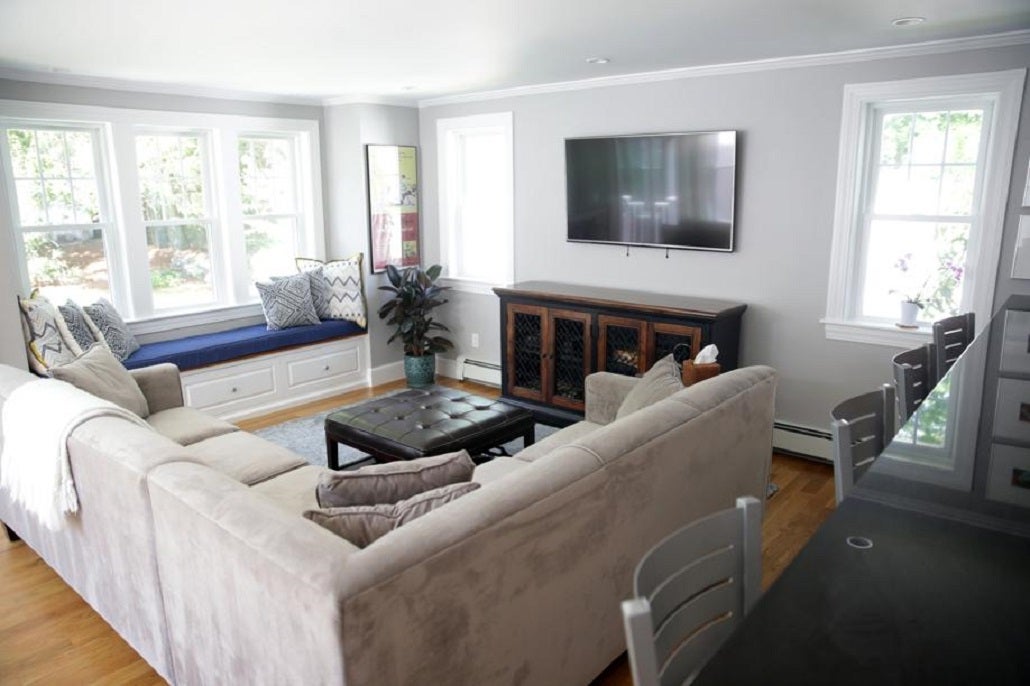
Also, because our couch was going to be in the middle of the room, we thought hard about outlets. We asked for several to be plugs and USB-charging capable. The electrician suggested a floor outlet under the couch so we could sit with a laptop and not have a cord running across the floor. We loved the idea and use the outlet all the time.
Suggestion: Pick your battles. Decide what’s important and what’s not. Do research on your own, so you can be educated when having these conversations. And request a few different quotes for different options, especially on heating and cooling. Baseboard heat, radiant heat, hydro-air, they all have pros and cons.
Tip: Request a written proposal and review it in person with the contractor — line item by line item.
If you talk about something on Feb. 15, four months later you will have different memories of that conversation. That’s exactly what happened to us on the question of venting our stove. In the end, after a minor panic, our contractor built a brilliant solution. But if it were written down, we would have avoided the stress.
Suggestion: Make sure the proposal is detailed. If your proposal is one page long, it’s not detailed enough.
Tip: Decide whether you have the financial ability, and necessary resources (school transportation for the kids, pets coverage, commuting flexibility) to move out during construction for any period of time.
Suggestion: Ask what steps could be taken to avoid having to move out or to make the amount of time you have to live elsewhere as short as possible. You might be surprised if you push. But you have to push. It’s your house, remember.
Sitting here now on a Sunday evening, watching “Saturday Night Live’’ clips in our new family room, we’re relieved, and maybe even a bit surprised, that our project went so smoothly. We had hoped it would take four months. It took five. I wish we’d had our subcontractors’ phone numbers, but I never asked. I wish we’d talked more about the drain pipe for the sump pump. We had to spend more on air conditioning than we budgeted, but it was worth it. And we had a miscommunication over venting our stove that could have been a major problem, but was resolved with flexibility by us and our contractor. “Flexibility.’’ It’s a word you, and your contractor, would be smart to live by.
Doug Most, formerly a Globe deputy managing editor, is now director of strategic growth initiatives. He can be reached at [email protected] and @DougMost. Subscribe to our free real estate newsletter — our weekly digest on buying, selling, and design — at pages.email.bostonglobe.com/AddressSignUp.





To comment, please create a screen name in your profile
To comment, please verify your email address
Conversation
This discussion has ended. Please join elsewhere on Boston.com