
Don’t want to pull out all those rusty nails? A trick to try.
Reader wants to save her bead-board ceiling, but the rusty nails will ruin any fresh paint.
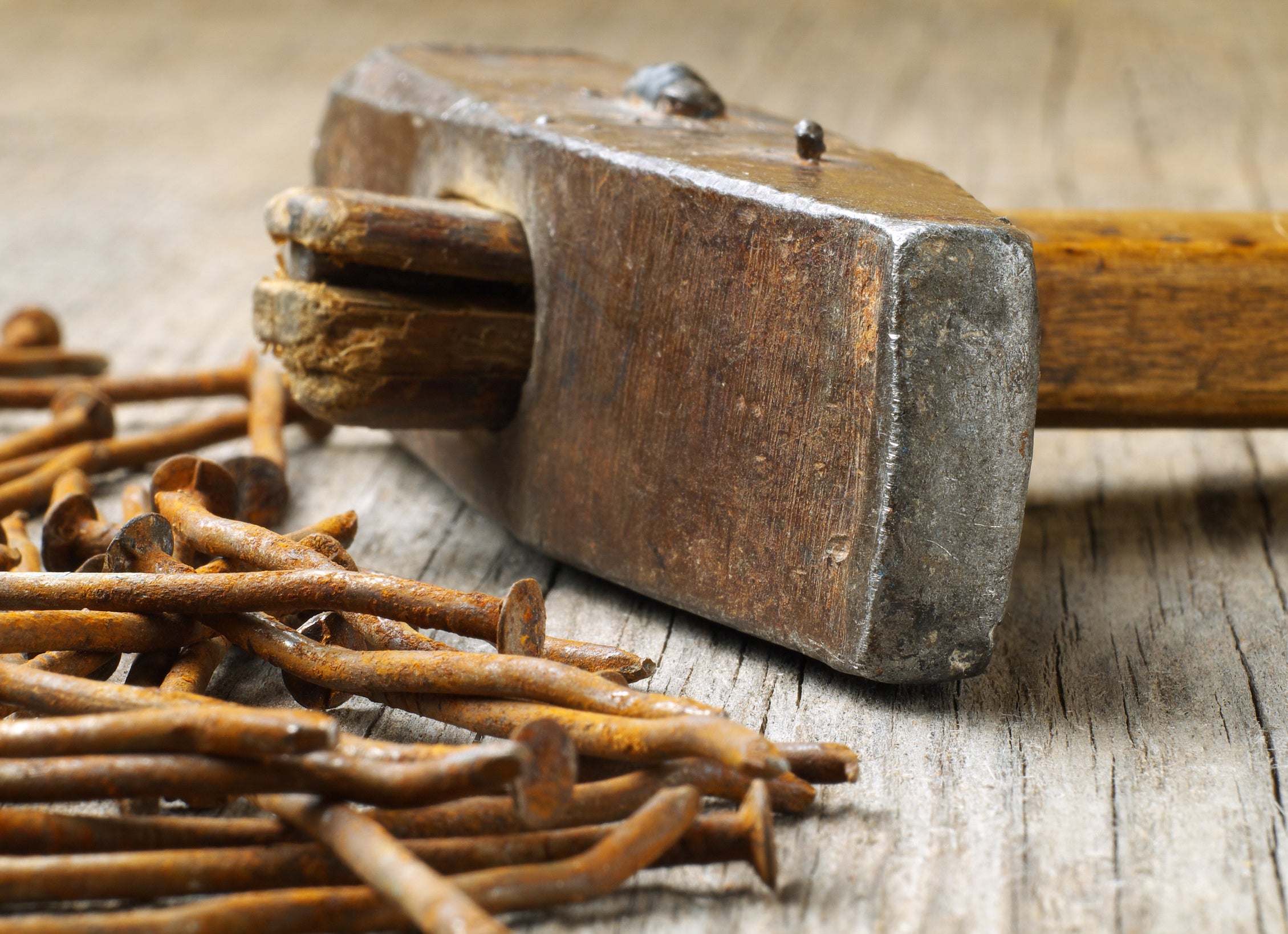
Q. I want to save the 110-year-old bead-board ceiling in my kitchen. We took off ugly tile to reveal dark brown bead board full of old nails. My contractor says any paint that we use, primer or not, will bleed through. (I don’t have the time or the budget to take out these old nails, which are 8 inches apart over the whole ceiling.) What product do you recommend to keep the rust from bleeding through? We want to paint the ceiling white after we prime.
Also, we want to paint over old wallpaper instead of removing and putting up sheetrock. I like the texture.
JANET BIXLER, Biloxi, Miss.
A. I’d set the nails (punch them below the surface) and put wood filler in the holes before priming and painting.
Regarding the wallpaper: You can definitely paint it.
Here’s how I’d do it:
■ Check for and repair any loose seams.
■ Remove all nails and switch plates.
■ Wash the wallpaper with a sponge, using dish soap and water, and don’t let the sponge drip. Excessive water can cause the wallpaper to lift or bubble.
■ Prime the wallpaper with oil-based primer. Water-based primer may cause the paper to lift or bubble, and, besides, oil-based primers bond and cover stains better.
■ Once dry, fill any joints (trim to wall, molding to ceiling, etc.) as needed.
If you were aiming for a smooth look — I know you said you like the texture — a skim coat of drywall compound can be used to hide the seams.
Paint with a washable eggshell finish.
Q. My daughter recently bought a 100-year-old South Philly row house with a fieldstone foundation. She has a dehumidifier running 24/7, but the basement remains moist. There is efflorescence on the stones and occasionally a few very shallow puddles on the floor after a heavy rain. What’s the best course of action to establish and maintain a dry basement in this setting? Should she start with repointing the foundation stones?
NMTELLA
A. The majority of issues I have seen in this regard are a direct result of the water migrating through the foundation wall. This is usually due to improper landscape drainage, lack of gutters, or not directing runoff away from the foundation.
Try to grade the ground around her house to achieve a slope of ¼ inch per foot for at least 6 to 10 feet — 10 feet being the best choice. Correct these issues first, and then “tuck-point’’ (the equivalent of repointing, but for stone) the foundation wall. Tuck-pointing is considered a maintenance issue, not a structural repair.
I had the same thing occur in my 1862 house. I have a brick-over-fieldstone foundation. We removed as much of the old mortar as we could and added new. Once that was done, we parged the bricks (plastered them with mortar). With this and some minor grading corrections, the water infiltration stopped completely.
Good luck, and please report back on your results.
Rob Robillard is a general contractor, carpenter, editor of AConcordCarpenter.com, and principal of a carpentry and renovation business. Send your questions to [email protected] or tweet them to @robertrobillard. Subscribe to the Globe’s free real estate newsletter at pages.email.bostonglobe.com/AddressSignUp.





To comment, please create a screen name in your profile
To comment, please verify your email address
Conversation
This discussion has ended. Please join elsewhere on Boston.com