
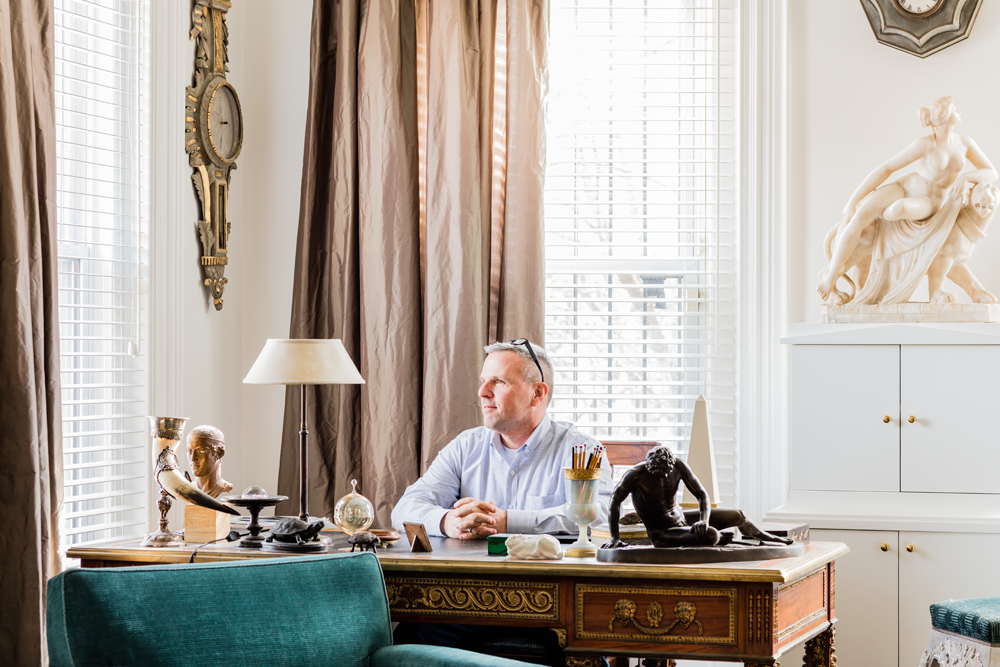
Interior designer Frank Hodge is proud to be traditional
To see this story with its original layout in the digital edition of Design New England, click here.
This story begins with a 12-year-old Frank Hodge combing through the flotsam and jetsam at the Amherst, New Hampshire, flea market with his aunt, Annette Desmarais, an antiques dealer who appreciated his eye for classic treasure. “I just had the innate ability to know what was good,” says the grown-up Hodge, proprietor of F.D. Hodge Interiors, the Boston design firm he opened in 2007.
Just as he had when he was poking around yard sales as a child, Hodge trusts his instincts. And so do his clients. “I believe that design is innate,” he says. “I immediately see a room spatially,” and the design flows from there.
Hodge doesn’t aspire to be all things to all people. He is a designer who unabashedly embraces his signature style: classic and classy. His rooms are traditional but not of another time. They are designed for physical and emotional comfort. “For the most part, the palette is neutral, which creates a more welcoming environment to be in,” he says. That backdrop is made rich with the patina of antiques, luxurious fabrics, and architectural details. “I’m very much a traditionalist,” says Hodge. “I don’t believe in trends and what’s in and what’s out. Design doesn’t have to be of the day or trendy to be successful.”

Hodge officially began his design career when he went to work for Judith Ross and Company, a respected design firm on Boston’s Newbury Street, after only two semesters at Boston Architectural College, where an interior design program had just been introduced. “The coursework just didn’t interest me,” he says with a shrug. But the real work of design did. After less than a year with Judith Ross, he landed a job with award-winning interior designer Charles Spada, whose creative sensibilities were simpatico with Hodge’s. “Charles was such a great influence on me,” says Hodge. “Working with him refined my taste in interior design.”
But the design bug first bit him as a child. “I grew up in a family of antiques dealers, and I would have to say that my aunt Annette and uncle Gerry were the most influential in teaching me the antiques business,” says Hodge. “From the age of 10, they carted me around to various country auctions and flea markets teaching me the trade.” The seminal moment came, he says, when Aunt Annette brought him to the Isabella Stewart Gardner Museum in Boston. “It was around Christmastime when I was 11 or 12,” recalls Hodge, “and that visit was life-changing. Upon entering the courtyard, I was awestruck. The vision of the Venetian court crammed full of poinsettias, fern trees, and Roman and Greek sculpture struck a chord in me that whet my appetite to start collecting and studying art and objects from all periods of time. It was a life-changing event for me, one I will always be indebted for.”

While he did not finish design school, Hodge appreciates the value a formal education can offer. Still, he recommends such a learning experience be augmented by an apprenticeship. “I would advise anyone starting out in this business today work a minimum of five years in a well-established office,” says Hodge. “That’s when you will really get your education.”
Hodge spent 10 years with Spada before going out on his own. “I started my business just as the economy crashed,” says Hodge, “but I stayed busy.” In 2008, he participated in the popular Decorator Show House sponsored by the Museums of Old York in York, Maine, and landed in the pages of Design New England (“White-Hot Summer,” July/August 2009). That show house also led him to an important design
client, a woman with whom he continues to work (“Bright Future,” Design New England November/December 2014) and, as with many of his clients, calls friend.

A native of Nashua, New Hampshire, Hodge for the last 18 years has lived in Boston’s South End in a three-room condominium he shares with his partner, Michael Nest, who works in pharmaceuticals, and a black cat named Houdini. In a classic brownstone town house, the apartment with its high ceilings, detailed mouldings, and marble fireplace is a perfect canvas for Hodge’s design vision. His favorite pieces are an antique map of Wales that hangs above the sofa, the bronze doré-and-crystal chandelier over the circa 1840 American Empire dining table, and an 18th-century Italian side chair, its seat upholstered in worn silk velvet. It all speaks to the philosophy that underlies his designs. “My work feels like a home,” he says. “I’m a collector. Objects appeal to me.” Which may be why some of the designers he most admires — Spada, William Hodgins, Roger Lussier — are also people who “love things,” a trait he says is becoming rare in the design industry. “People today are paring down,” he says. “They find things unnecessary.” But that can leave a design cold and soulless, he says. “Layering and depth create a luxuriousness in a room.”

While Hodge designs with sophistication, there is an understatement that makes his work unpretentious, much like the designer himself. “Many people don’t like their homes, but they don’t know why,” says Hodge. “A lot of the design process is educating the client and developing trust. That is the most important thing between client and designer.”
Frank Hodge, F.D. Hodge Interiors, Boston, 617-267-8103; fdhodgeinteriors.com.





To comment, please create a screen name in your profile
To comment, please verify your email address
Conversation
This discussion has ended. Please join elsewhere on Boston.com