
How two Connecticut craftsmen bring nature’s exuberance indoors
To see this story with its original layout in the digital edition of Design New England, click here.
David Whitman and Peter Stiglin have a need for nature that is not negotiable.
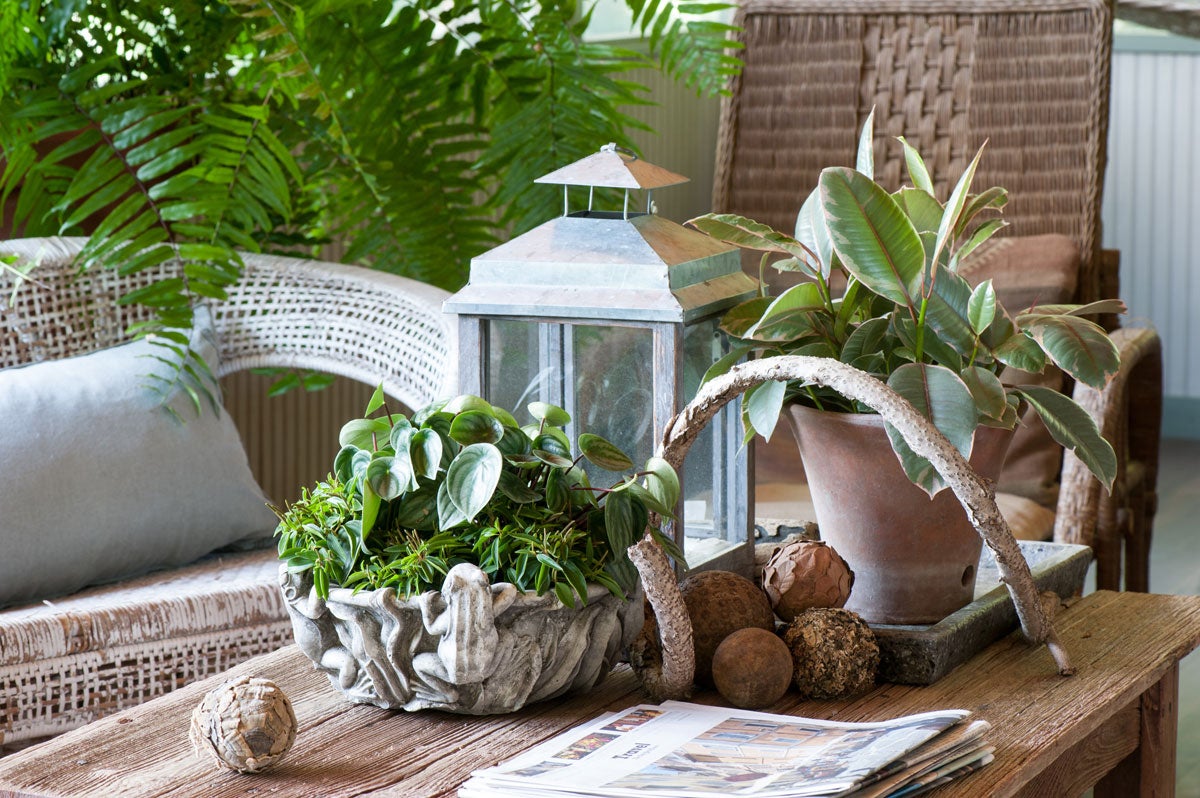
Through the winter and into the early spring mud season, it is even more imperative. It is then that their indoor space most requires an abundance of green — living things that will bask in their less-than-perfect growing environment with severely minimal care. Such green applicants also should possess the right physical profile. “The plant material has to feel appropriate to the local vernacular,” says Whitman. It is a tall order filled by nearly indestructible plants with an emphasis on peperomias, ferns, and similarly unassuming little plants that don’t look flashy and don’t feel foreign, even though they are natives of tropical climates. They possess a simplicity that works with the interiors Whitman and Stiglin created in the Massachusetts Berkshires house they loved, and hated, when they purchased it in 1999.
They were irresistibly drawn to the rural beauty of the area. “Something about the web of pastures, fields, and wetlands with very few houses felt right,” says Whitman. So when they got the inside track on a little bungalow not yet on the market, they nabbed it. Built in the late 1980s, it wasn’t really their type of house. They preferred old; they wanted patina; it had issues. But it boasted wide-board cherry floors of wood milled from trees on the property and a fireplace wrought from stone found on the land. The attraction wasn’t the house, but its property: 4 acres of a one-time orchard. Outside their door is untamed nature, and civilization is held at arm’s length. Conservation land is their neighbor. For a couple of guys who spend all their time in the woods, it was perfect. “It felt like where we wanted to be,” says Whitman.
A few years later, Whitman and Stiglin opened Pergola, their destination shop in nearby New Preston, Connecticut. Its stock-in-trade is a combination of artisan-forged pieces and antiques and nature’s flotsam that the two have foraged from the woods. Toward their goal of bringing people together with botany, they have filled the shop with houseplants, each displayed reverently and thoughtfully, their compositions echoing the native woods and nature’s own art.
They honed that craftsmanship with plants at home, where, though initially lukewarm about the house, they literally saw the light when winter first came. With the trees around them bare, the light flooded in through the windows. “It just streams in at the end of the day,” says Stiglin, “especially when the leaves are down.” Suddenly, all those fallen lichen-covered branches, old birch logs, leafy bouquets, artistic stones, seedpods, and twigs they collected from the forest are illuminated. The stone fireplace and wood floors gain a shine and become part of a dialogue.
Twigs and branches are all well and good, but Whitman and Stiglin still needed indoor plants to complete the image. The two shopkeepers do not have the luxury of spare time, so they required easy-care specimens that would bask in a less-than-perfect indoors. Despite its delightful aesthetic, the house’s interior suffers from the same litany of botanical challenges as most homes: fluctuating temperatures (they have a wood stove), occasional lapses in watering, and light that is charming but not strong when it’s needed most.
The peperomia and ferns possess the simplicity that works with the couple’s sensibilities and settle comfortably into the sorts of containers they collected on excursions to Japan and other far-flung places. Most of the plants don’t claim a lot of space for themselves. Instead, they nestle into niches, working with the whole to create a textural interplay. They blur the lines between man-made and wildling as they blend with twigs, bark, lichen, and pine boughs. When man and nature live together in this way, there’s an intimacy that occurs. Whitman and Stiglin’s lives are dedicated to forging that close relationship and demonstrating to everyone just how to strengthen the bond. “It’s the difference between a person in a crowd and a friend,” says Whitman. “If I have a dialogue with nature, I’ll know it better, especially if we bring it into the most intimate environment — our home.”




To comment, please create a screen name in your profile
To comment, please verify your email address
Conversation
This discussion has ended. Please join elsewhere on Boston.com