
A Second Empire home in Concord exudes practical luxury after a skillful makeover
To see this story with its original layout in the digital edition of Design New England, click here.
It’s hard to tell whether this Second Empire house in the center of Concord, Massachusetts, is a big house that feels human scale or a small house that feels roomy. With its 10-foot-high ceilings and mansard roof, the 1864 structure, the Julius M. Smith house, is noble and normal all at the same time. As interior designer Lisa Tharp puts it, it’s an architectural style in which “the full volume is experienced.”
In line with that heritage, Tharp set to work laying out a calm and neutral interior plan that would be comfortable and elegant but never fussy. Her clients — a housing developer and an at-home mom with a master’s degree in holistic health — wanted to respect the history of the house but not dwell in the past. Especially the recent past. The house, sited at a busy intersection in a historic district, was “hiding in plain sight,” says the husband. With its charcoal exterior and dated decor, the dwelling, which had been on and off the market a handful of times over the span of a few years, looked glum.
But with its east-west orientation and location within walking distance of town, the light-filled house felt like the right fit for its new owners, whose three children were approaching and already in college. Although they didn’t exactly downsize — the house is 4,800 square feet — the couple were happy to give up the maintenance of a pond, stream, and barn on the 3½ acres they left behind in a more rural part of town.
Designer and clients agreed on a palette of muted colors with variations on light mushroom and stone hues on the walls and glossy complementary colors on the trim. “The tone is one of spare sophistication,” says Tharp, whose firm, Lisa Tharp Design, is also in Concord. “This envelope could be formal, but the clients wanted the luxury of comfort and calm — not formality.” Although the scheme is monochromatic and there is a strong sense of continuity, each room feels distinct.
Tharp tapped the wife’s love of gardening and nature to inform the design. For example, an oversize pendant made of meticulously hand-folded paper “blossoms” makes a grand gesture in the living room. “The light fixture is about not being too serious in this traditional framework,” says Tharp. “That’s a theme throughout the house.”
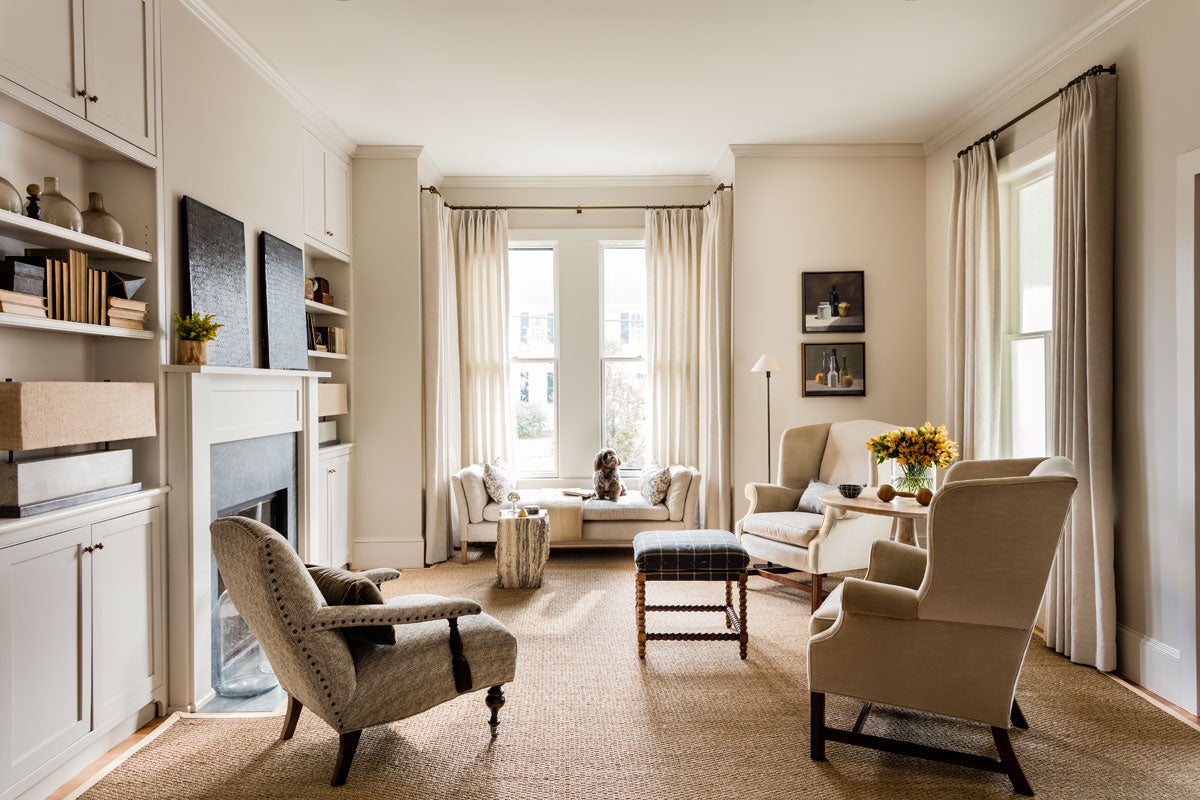
Luxury comes by way of studied simplicity, with textural changes separating spaces and adding interest. “When you strip away the color,” says Tharp, “you see all that ‘dark-light.’ ” In the living room, a sea grass rug transitions to the pale gray flecked cotton velvet on the chairs and the soft beige linen curtains, while the black marble fireplace surround contrasts with glass sconces.
In the family room, where a wall was removed, allowing light from the south-facing room to flood the kitchen, new built-ins have clean, modern lines, lending elegance to the room.
The kitchen was gutted and new custom cabinets by Crown Point Cabinetry of Claremont, New Hampshire, were taken all the way to the ceiling. The two cupboards framing the kitchen’s north-facing windows have glass-fronted doors, which lighten the look and seem to expand the view. Large white pendant lights with brass detailing are a striking focal point above the island. Off the kitchen, a 375-square-foot deck was transformed into a year-round sunroom.
The simplicity of the palette endures in the dining room. Linen pendants and a trestle table offer both comfort and structure. Six-foot-tall, narrow botanical prints create a vignette by a bar cart. That rectangular geometry can be found in details throughout the space. “You might not be aware of it,” says Tharp of the subtly repeated shapes, “but it means you experience the house in a different way — and have a sense of calm because of it.”
For the master suite, a small bedroom became an elegant bath. A marble vanity and oversize hand-cut subway tiles are understated indulgences. To add “a little sparkle,” Tharp sourced a Capiz shell chandelier.
Aside from her signature dramatic lighting choices (“Lisa made me appreciate lighting in a way I never had before,” says the wife), Tharp allows spaces and people rather than a particular style to drive her work. “I don’t have a look,” says the designer. “I have ingredients. My inspiration comes from three things: architecture, setting, and the clients — who they are and how they want to feel in their space.” In this case, she says, “they were ready to go spare.”
“It’s a big house, but it feels natural,” says the husband. “We wanted a fresh start.”





To comment, please create a screen name in your profile
To comment, please verify your email address
Conversation
This discussion has ended. Please join elsewhere on Boston.com