
Architect Elizabeth Herrmann brings the tiny house concept to new heights
To see this story with its original layout in the digital edition of Design New England, click here.
“You gave me a jewel box,” the delighted client told architect Elizabeth Herrmann when his small house was completed in only four months and within its modest budget. “The house is so well done,” he said, “you have made it impossible to add to it.” Given that his new home has a footprint of little more than 400 square feet, that was no mean compliment.
For her part, Herrmann observes that with a tiny house, “everything is right there — so it gets noticed — and it has to be done with great care.” So this house in rural Vermont had to be more than a trailer or a converted gypsy caravan. The architect insisted that what she designed be “first and foremost a lovely place to be, with all the variety of a much larger home.”
Its spectacular setting is one reason this cabin-sized house never feels like a claustrophobic box. The client, a painter and contradance caller, purchased an acre plot in the country, the most prominent feature of which was a dramatic view of Camel’s Hump, the third-tallest peak in the Green Mountains. Anything here could be dwarfed by the landscape, but the view of the mountain was integrated into the house via a picture window.
The taller side of this wedge-shaped structure faces the mountain, while the other side shelters private spaces, like the bath and sleeping area. The entrance is at the lower end of the sloping frame, where a corner has been notched out to form a welcoming porch. There is a similar bite from the cedar-sheathed, shed-roofed building on the opposite corner. These playful planar changes offer relief from the severity of the cubic form. Herrmann, whose firm, Elizabeth Herrmann Architecture + Design, is in Bristol, Vermont, describes such “unpredictable” offsets as “the logical and whimsical expression of its contents, its functions, and views.”
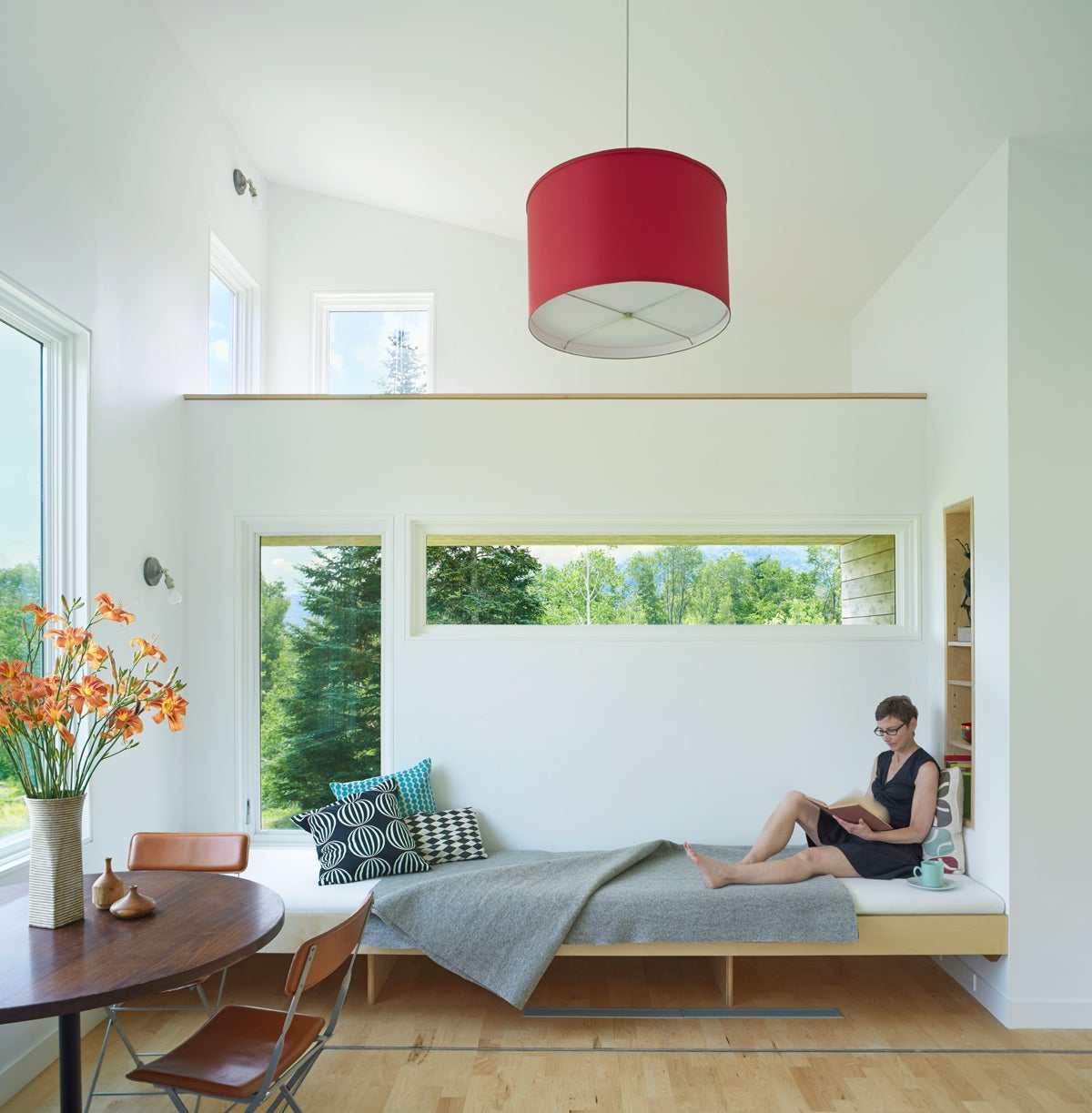
A variety of window sizes respond to the house’s internal functions and to the views. (The oversize square picture window facing the mountain is a bit like “an aunt who talks too loudly at a party,” the owner jokes.) The vertical slits and the horizontal bands, which Herrmann calls “sleeping windows,” both frame and edit the views, giving each “room” a distinctive focus. Set against the flat white walls, the geometric window arrangements create an homage to 1920s Modernism, an aesthetic ideally suited to such a minimal expression of living space.
The client had a specific program — “a beautiful, tiny, energy-efficient house, large enough to square-dance in,” he says — and a budget of $150,000. In an unusual progression of house-making, the size decreased to stay within budget. There were certain economies, like the $35 Herrmann-designed wall lamps made of galvanized pipe, but scale and the sense of spaciousness were not compromised.
Must-haves included a bathroom, a sleeping area, kitchen, storage, a dining/worktable, living space that could accommodate overnight guests, and a sleeping loft. To keep the living space uncluttered, a full basement for storage, mechanicals, and laundry is accessed through a hatch in the floor. There is a designated space for everything, perfect for an artist who travels a lot and who wanted “a small house for someone who doesn’t want to own a house.”
It is important, says Herrmann, to have “those transitional spaces that give a sense of arrival or simply a change of scale appropriate to use,” so they are sculpted to define purpose. For example, the “bedroom” is tucked under the lowest part of the roof, while the bathroom is approached through a storage area rather than being directly off the living space. Neither static nor confining, the home pleases its occupant. “I never feel cramped,” he says.
In a small house, Herrmann notes, the “intimacy of spaces requires a level of finish that has to stand up to close scrutiny.” The materials palette was kept light and simple. The walls are painted drywall, while the windows, framed in wood with peripheral shadow lines, constitute the only embellishment. Custom kitchen cabinets are white, the countertop white concrete, and the storage cabinets birch plywood. Typical of the attention to detail throughout, local maple, cut in short lengths and laid perpendicular to the view, gives the floor a waterlike texture. The only bursts of color are the yellow door and a red lampshade over the table.
With a 12-foot ceiling at one end, and each wall offering an individual composition of windows and views, this does not feel like a one-room house. Move the table and the daybed, and there is enough room to square-dance. It is a misnomer to label this a micro house; rather, it is a distinctive and substantial dwelling that happens to be small.
Given its size, affordability, and possible template for similar houses, it is a laudable design exercise in social responsibility. As Vermont Public Radio commentator Don Kreis opined on-air, “Only the wealthiest among us can afford an architect-designed house,” but, he added, Elizabeth Herrmann’s jewel of a house “is a distinctly Vermont rebuttal to that notion.”





To comment, please create a screen name in your profile
To comment, please verify your email address
Conversation
This discussion has ended. Please join elsewhere on Boston.com