
An architect gives a second life to his old barn in Newport, Rhode Island
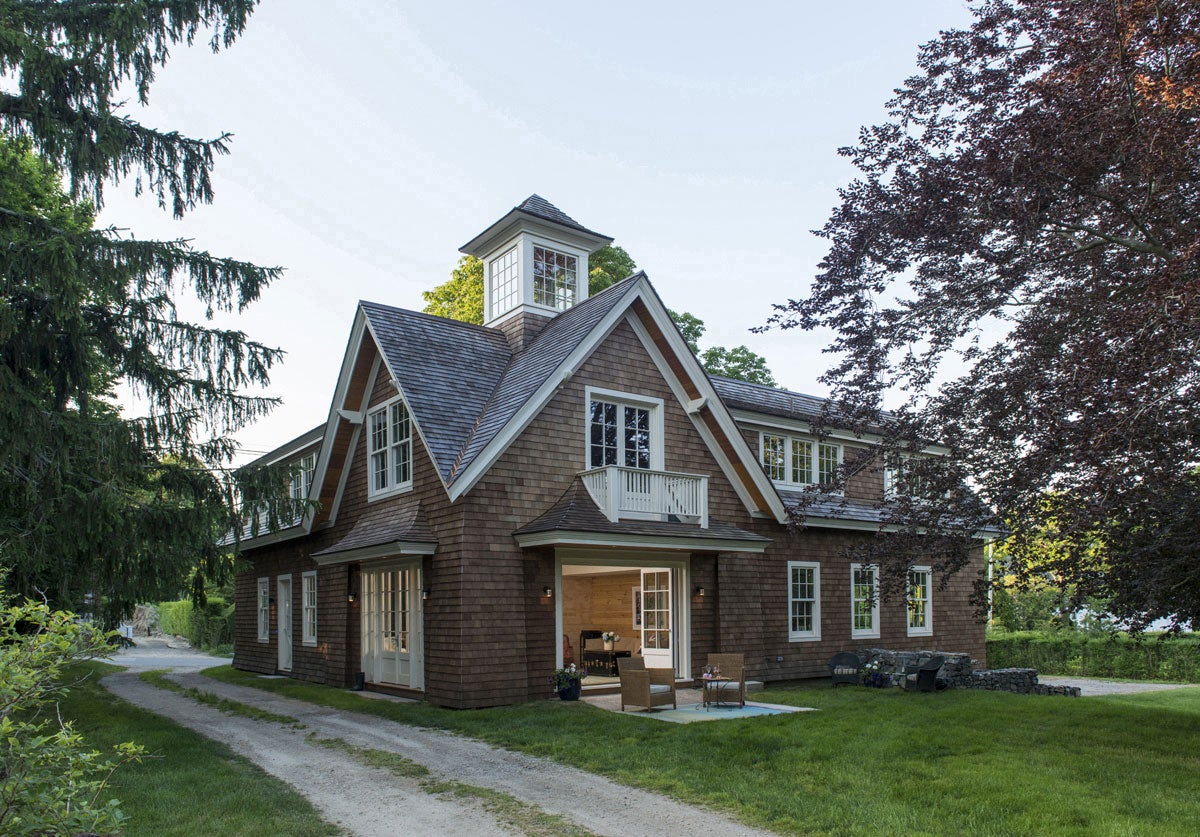
Looking for a place to raise their young family 13 years ago, architect Paul Weber and his wife, Bonnie, chose a tree-filled property off storied Bellevue Avenue in Newport, Rhode Island. The 1½-acre lot had once been part of a 19th-century estate, but when they bought the land, the only vestige of that past was an old barn. And while some old barns in Newport possess carriage-house charm, this one did not. Over the years, it had received such inglorious additions as a modern garage door and a tacked-on shed. Nestled amid towering evergreen and oak trees, the old barn needed a new chapter.
The first plan of action, however, called for the Webers to build a house, and they chose a location about 100 feet from the barn after walking the site many times with their two toddlers in tow. The house that Weber designed, featuring cedar-shingle gables, an irregular roofline, and deep overhangs, was completed in the late 2000s and suited the family perfectly.
But the barn proved an irresistible challenge for this architect, whose practice, Paul Weber Architect, is in Newport. The possibilities prompted many sketches and schemes, but the final plan, which became reality in 2014, was for a two-story, 2,200-square-foot, multipurpose space that includes a game room, guest quarters, boat storage, and homework haven. There was no shortage of family debates along the way. “I nearly lost the battle for a first-floor boat storage area to a squash court,” laughs Weber, an avid sailor whose daughters, now teenagers, are nationally ranked squash players.
Although the barn’s function evolved to meet many needs, there was no question what its style would be. “We updated the barn to be in the same family as the house,” says Weber. “The two structures relate to each other in detailing, with the same eaves and returns and dormers. But we wanted to keep it rustic, not finished, and a big goal of mine was for there to be no sheetrock in the barn.”
Working with Matt Cullen of MC Squared Construction in Newport, Weber began peeling away the layers of the old barn, which had a utilitarian second-floor loft and barnboard walls and ceilings. Weber’s design called for a raised roof and the addition of gables and dormers, all to gain the volume needed for the second-floor guest space while preserving the lofty barn aesthetic for the first-floor game room.
Old interior walls and ceilings were carefully removed with the intention of reusing the barnboard, timbers, and windows in the new spaces. “We salvaged everything we possibly could,” says Cullen. On the first floor, a new concrete floor with a radiant-heat system gives the space year-round functionality. A drywall ceiling, one of the few instances of a conventional finished surface in the barn, conceals ductwork for the forced hot air and air conditioning installed to service the second-floor guest rooms. Salvaged barnboard and framing timbers, plus some new knotty pine (that Weber intends to whitewash) and shiplap-style MDF boards, cover nearly every wall and ceiling. “We wanted the barn to be fresh and crisp and new, with its own aesthetic,” says Weber.
The first floor is essentially one big game room, with pine-covered walls, sofas for lounging, and two sets of French doors that let in the light. The second floor functions as a guesthouse, with three bedrooms, a galley kitchen, and living/dining areas. Weber transformed the dark interiors of the original barn with windows or French doors placed in every gable, wall, and dormer so that natural light filters through the entire structure. To add even more light, he reused the original barn sashes as clerestory windows in the second-floor interior hallway. “To bring more light into the second floor, we built a new cupola and placed it at the cross gable,” says Weber, noting the glass-sided cap that tops the barn.
The utilitarian nature of the structure is still very much intact. For example, two side-by-side guest rooms share an oversize pocket door that can be opened to transform the space into one large bunk room. On the first floor, a series of sliding barn-style doors can close off one end of the space to create a separate sleeping area if needed.
There are other possibilities in the offing, with a first-floor kitchen, an outdoor swimming pool, and an outdoor kitchen all under discussion. For now, however, the wide-open first-floor game room is a favorite retreat for the girls, who head over to do homework, hang out with friends, or simply get out of the house. That alone is a great new function for an old barn.





To comment, please create a screen name in your profile
To comment, please verify your email address
Conversation
This discussion has ended. Please join elsewhere on Boston.com