


Address newsletter
Get the latest news on buying, selling, renting, home design, and more.
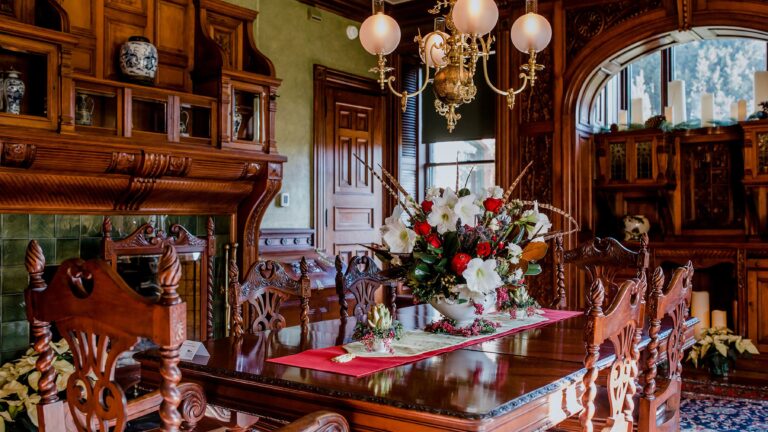
Late November brings dozens of garden club members to The Wayside Inn In Sudbury to decorate for the holidays. They get specific guidelines from Jo Ann Forester.
“This year, our theme is White Christmas,” said the volunteer and Sudbury resident who has been heading up the decorating extravaganza for 10 years. “But no matter the theme, we do not allow nails or tacks in the historic walls or woodwork.
“No glitter: It’s impossible to get rid of, and it acts like tiny knives that cut fabrics and rugs. No feathers, because there are fireplaces with open fires, and feathers are very flammable. And,” Forester added emphatically, “No pink!”
She insists on a traditional Colonial sensibility that features greens, red ribbons, and lots of faux candles.


“It’s a tricky concept because, when the first part of The Wayside Inn was built in 1716, Christmas was not celebrated in Massachusetts,” Forester said with a laugh.
Christmas decorations are driven by sentiment and family traditions, but we can also let the age and style of our house guide us, whether that means creating a candlelit 18th-century interior that never was or displaying the shiny baubles of atomic style.
Laurel and Richard LaBauve lived in a low-slung mid-century modern multilevel in Cape Elizabeth, Maine. It was designed and built in 1972 by John Leasure, one of Maine’s best-known architects, for his own family.
“We both grew up with mid-century modern,” said Laurel, who flips houses in southern Maine. “We knew silver aluminum Christmas trees with all the ornaments a single color and a color wheel aimed at it and turning on the floor nearby.”
She said that the aluminum tree was not hard to find but that reproduction color wheels “get terrible reviews online. They are, apparently, fire hazards. We used varied-colored lights instead.”


They decorated the tree with Shiny Brite ornaments saved from Laurel’s childhood and, on the house’s exterior, strung large, solid-colored lights popular during the middle of the 20th century. The LaBauve home looked as though Leasure himself had decorated for the holidays.
For a period of the 17th century, celebrating Christmas was illegal.
“The Puritans forbade it,” said Christie Jackson, director of collections at The Trustees of Reservations. This year, the organization will decorate rooms in several of their historic properties, including Concord’s The Old Manse, built in 1770.
“Even during the 18th century, December 25 was just another day,” Jackson said.


“The earliest picture of a Christmas tree dates to around 1812, arguably the first known sketch of a Christmas tree in America, drawn by John Lewis Krimmel, a German immigrant who lived near Philadelphia.
“Interestingly,” Jackson added, “it does not show an evergreen, but what looks like a citrus tree.”
Closer to home, Karl Charles Follen, a German immigrant who was a professor at Harvard, put up a Christmas tree for his son in 1835.
“By the 1850s and ‘60s, Queen Victoria and Prince Albert had popularized Christmas in this country, as well as in England,” said Jean Contino, program coordinator at Old Sturbridge Village.
“The first Christmas trees were on tables, more of an event than a decoration. Children were brought into the room where the tree, lit with candles, held treats and small toys. A bucket of water stood nearby, and the candles were lit only for a short time.”

Displays at Old Sturbridge Village show how Christmas decor grew during the 19th century, from handmade straw ornaments to a room representing an 1876 celebration where a small Christmas tree is covered with American flags to mark the Centennial.
“In 1870, Christmas became a federal holiday,” Christie Jackson explained. “But even then, the celebration was much more subtle than now. Evergreen swags and wreaths were popular, and citrus fruits were rare and precious gifts.”
The Eustis Estate Museum in Milton, a Historic New England property, shows off high-style late-19th-century holiday decor.
“We incorporate fruit, evergreens, handmade items,” said program assistant and lead guide Amy Morgan Link. “By the end of the 1800s, people were bringing in big trees. Victorians loved peacock feathers; we use them in holiday centerpieces.”


The Edwardian and Arts-and-Crafts eras of the early 20th century saw Christmas celebrations that approach what we know today.
“They put up big trees, exchanged cards, and decorated with tinsel, which at the time was made of lead,” said David Berman, a designer who makes reproduction wallpaper at his Plymouth atelier, Trustworth Studios.


“Good-looking cards on the tree or the mantel, feather Christmas trees, historic toys – all evoke the period.”
And bring comfort and joy.
Regina Cole can be reached at [email protected].

Get the latest news on buying, selling, renting, home design, and more.





To comment, please create a screen name in your profile
To comment, please verify your email address
Conversation
This discussion has ended. Please join elsewhere on Boston.com