
Address Newsletter
Our weekly digest on buying, selling, and design, with expert advice and insider neighborhood knowledge.
She owns several properties across Massachusetts and Florida, carries no mortgages on any of them, and spent years paying premiums that kept rising while insurers kept dropping her anyway. When the last company canceled her Florida property — after she’d already cycled through three carriers in five years — she’d had enough.
“Screw them,” she said. “Why am I jumping through hoops begging them to take my money?”
She stopped carrying insurance on the Florida property entirely.
The woman (who, for privacy reasons, has asked not to be named) is a retired legal professional with real estate holdings on Nantucket. She acknowledges she’s not a typical homeowner: She has a financial cushion to absorb a loss.
In fact, homeowners without a mortgage are typically the only ones who have the option to forgo homeowners’ insurance.
“When a home is financed, the lender relies on the property as collateral, which is why homeowners’ insurance is required in almost all mortgage scenarios,” explained Jared M. Donovan, a loan originator with Barrett Financial Group, LLC. “In most cases, having insurance isn’t just encouraged, it’s a requirement tied directly to the loan terms.”
But there a growing group of homeowners: Those who have done the math and concluded that the risk of “going bare” with no homeowners’ insurance is more manageable than the cost of finding coverage.
While the above homeowner maintains insurance on her property in Massachusetts, she has opted out of insurance on the Florida property because it comes with significantly lower replacement costs. But others on social media report doing the same to properties on Nantucket and the Cape — even reducing perceived risks by cutting down trees.
They aren’t the only ones. American homeowners saw their home insurance premiums increase by an average of 24 percent between 2021 and 2024, according to a Consumer Federation of America report last year.
Amid soaring premiums, dropped coverage, or fears of underinsurance when forced to take a policy with state-provided insurers of last resort, these homeowners are deciding they either can no longer afford to insure their property, or they can self-insure with a rainy-day fund if they do the math correctly — a risky bet.

The number of uninsured homes rose 6.6 percent nationwide from 2023 to 2024, with increases in all but five states, according to a Lending Tree report out last month. The Boston metropolitan area added nearly 10,000 uninsured properties in that single year. while Massachusetts saw nearly 13,500 uninsured properties added, per the same report.
While Massachusetts, Vermont, and New Hampshire have some of the lowest overall rates of uninsured homes nationally, the trend is still on the rise in New England: Vermont’s 21.5 percent increase in uninsured homes between 2023 and 2024 was the highest of any state in the Lending Tree study. Rhode Island came in second at 19.4 percent.
The Providence metropolitan area’s 21.8 percent gain in uninsured homes in that timeframe was the fourth-highest of any metro area nationally. Bridgeport, Conn., had a 19.7 percent gain and was the only other New England metro area in the top 10.
A 2024 study by the Consumer Federation of America estimated $1.6 trillion of American homes were uninsured in 2021.
Increasing climate risk is a frequently cited factor driving rising home insurance premiums and even dropped coverage. But it’s not the only catalyst, experts say.
Dominick Dusseau, a researcher at the Woodwell Climate Research Center based in Falmouth, notes that sea level rise and more powerful rainfall events are real and worsening. But Karen Collins, a vice president at the American Property Casualty Insurance Association, argues the more immediate catalyst was an inflation shock that the industry simply couldn’t absorb fast enough. Building materials and labor surged 50 percent to 60 percent in 2021, she says, and on a cumulative basis, remain roughly 30 percent to 40 percent above pre-pandemic levels.
“The short-term impact of inflation was probably the most significant driver of this current market cycle,” Collins says.
While climate change is a factor, the industry’s own data points to the inflation surge as the larger near-term force, she added.
For Cape and Islands homeowners, the market failure predates the recent surge in national attention. Jane Logan, an insurance agent who has worked the Cape for more than 30 years, marks the real turning point at 2004, when Andover Cos. non-renewed roughly 14,000 policies in Barnstable County. The dominoes fell from there, with Vermont Mutual Insurance Co. and Norfolk Dedham Group putting a halt to new Cape policies days later.
“Everyone’s either on the FAIR Plan [state-run insurance programs] or Lloyd’s of London,” Logan says before cautioning about the high costs associated with the latter: “Having a lot of coverage in Lloyd’s of London just isn’t good.”
The dilemma highlights a growing crisis for homeowners: state-backed FAIR Plans frequently provide such stripped-down coverage that residents remain functionally underinsured, while surplus insurers like Lloyd’s demand punishingly high premiums to offset the risk.
The recent headlines about carrier retreats, she notes, are somewhat misleading, as most carriers have already left.
“They pulled out so long ago,” Logan added. “There weren’t that many left to pull out.”
What remains is a market propped up by the state’s insurer of last resort: The Massachusetts FAIR Plan caps residential coverage at $1 million. On a coastline where mid-range homes routinely list above that threshold, that leaves many homeowners underinsured compared to how much it can cost to rebuild.
Logan describes homeowners who need more coverage being forced into patchwork arrangements, stacking excess property coverage on top of their FAIR Plan policy — adding cost to an already strained situation. But Collins notes the Massachusetts FAIR Plan is unusual nationally, as it still competes with the private market rather than function as a true last resort, which partly explains why it has grown so large.
For those who exit the insurance market entirely, the financial logic is seductive but shaky. Rainy-day funds in high-yield savings accounts can accrue interest, leading some to believe they’d come out ahead. But a so-called 100-year storm event — one with a 1 percent annual probability — carries a 26 percent chance of occurring at least once over the life of a 30-year mortgage, Dusseau notes.
“There is a very reasonable chance that you do get hit,” he says, and the savings account races against construction cost inflation it may not outpace.
“Those construction costs are going to keep increasing too,” Dusseau added.
Logan adds a liability blind spot that self-insurers rarely consider.
“If people are going bare, they may not realize that they also need liability coverage” for the slip-and-fall on your property, the dog bite, or any potential lawsuit arising from issues arising at your home.
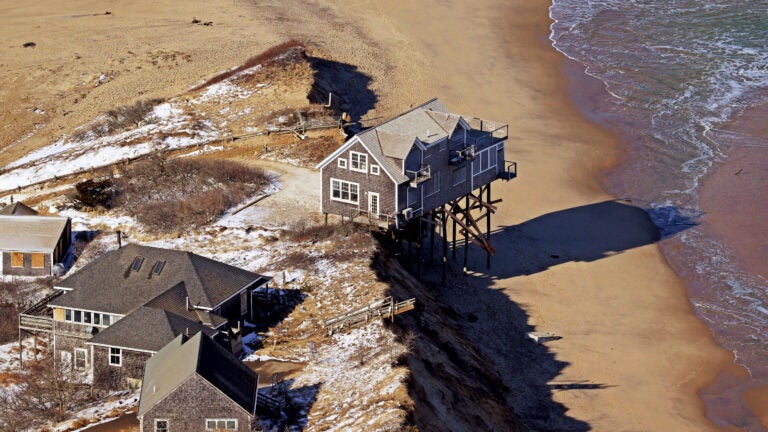
There is also a coverage gap that affects even the insured: standard policies don’t typically cover flooding or erosion. For a coastal homeowner, those perils are increasing in regularity.
Rising insurance costs can feed into softening property values, lower municipal bond ratings, declining tax revenues, and eventually, a community’s diminished capacity to maintain the infrastructure that makes coastal living viable at all.
“We’re not there yet,” Dusseau says. “We still have time to make adjustments.”
Whether the market cooperates is another question. Collins is cautiously optimistic and notes rate increases have slowed sharply, reinsurance costs are easing, and some carriers have begun reducing premiums.
Logan is harder to convince. She pays more than $3,000 a year for her own 864-square-foot house in Sandwich, well inland, with a $7,000 deductible.
“People on Social Security, they can’t afford it,” she says.
Our weekly digest on buying, selling, and design, with expert advice and insider neighborhood knowledge.





Be civil. Be kind.
Read our full community guidelines.To comment, please create a screen name in your profile
To comment, please verify your email address