
Address Newsletter
Our weekly digest on buying, selling, and design, with expert advice and insider neighborhood knowledge.
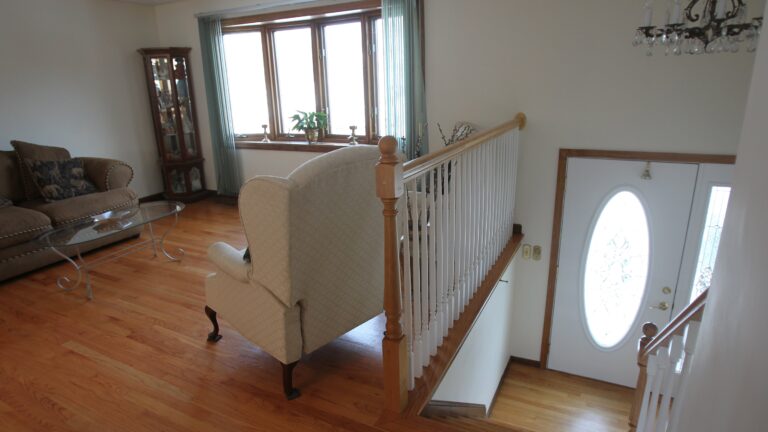
Back in 2021, realtor Katelyn E. Sullivan remembers helping a couple of first-time homebuyers find their dream house.
“The wife had said, ‘Katelyn, we are not looking at any split-level homes,’” Sullivan recalled. “‘We hate split-level homes.’”
Even if you’re not familiar with the term “split-level,” there’s a good chance you could recognize one. Split-levels are two-story homes where the first and second floors are staggered. Upon entering, a flight of stairs leads to the upper level, and another flight leads down to the lower level.

Once commonly shunned by buyers, split-levels are no longer being written off.
The architectural style sprang up across the United States during the baby boom following World War II. From the 1950s to roughly the early 1980s, it was a popular choice for builders, as they could maximize square footage on relatively small lots. Because of this, split-levels are practically ubiquitous in many suburbs, including those in Greater Boston.
Yet they get a bad rap. Plenty of homebuyers associate split-levels with being unfashionably outdated — perhaps because in 1975, split-levels accounted for 12 percent of all new homes on the market, according to the National Association of Home Builders. “In New England, they’re tolerated but not beloved, in my experience,” said Kate Ziegler with Arborview Realty in Boston.
But that doesn’t mean their minds can’t be changed. Those clients Sullivan had been working with a few years ago? “Sure enough, they bought a split-level,” said Sullivan, who works for Coldwell Banker Realty Boston, Natick & Framingham. “They eventually opened their minds.”
Similarly, Rahel Choi, a broker associate with eXp Realty in Boston, has worked with clients who’ve had a change of heart. “I’ve had buyers come in set on single-level living or Colonials, but then fall for a split-level that surprised them,” Choi said. “One couple was hesitant at first, but a split with a sunroom, walkout basement, and updated kitchen totally changed their minds. Now they love how the layout separates entertaining space from the bedrooms and work-from-home areas.”
In today’s high-priced market, some shoppers are increasingly seeing split-levels as suitable, budget-friendly homes with the potential for customization. Plus, when inventory is light, buyers become less picky, Sullivan added.
“Most buyers aren’t actively seeking out split-level homes as their first choice, but with affordability top of mind, especially for those priced out of other property types, they’re starting to consider a wider range of options,” Choi said. “Split-levels often offer more square footage at a better price point, and savvy buyers are realizing that with the right updates, the layout and finishes can really be tailored to fit their style.”
Choi said that split-level homes that lean into their retro, mid-century pedigrees tend to drum up more interest, pointing to two split-levels that recently hit the market in the same week.
“The one with clear mid-century appeal received multiple offers and sold for about 14 percent over asking,” she said. “The more traditional split-level? It only got one offer. Price definitely played a role, but the design and aesthetic clearly made a difference.”
One of the biggest selling points for split-levels is their adaptability for multigenerational living. Brian Harvey, owner of Harvey Home Modifications in Natick, pointed out that split-levels work especially well for creating additional dwelling units, or ADUs.
“Split-level houses are abundant where we live. And they’re great because it’s essentially two houses: two ranch homes stacked on top of each other,” Harvey told the Globe in November. “The lower level can be made accessible and self-sufficient very quickly.”
Even when the downstairs living area isn’t slated to become an in-law apartment with a full bathroom and kitchenette, Sullivan said having the extra living space can be attractive to both remote workers and families with young kids.
“I definitely see people using lower-level rooms in the splits as offices or at-home gyms,” she said. “And I also always encourage people who have kids to go for them, because those bonus rooms downstairs are great for playrooms. You can hide all the toys downstairs, whereas the open dining room and kitchen flow upstairs can be your more classy, elegant entertaining area.”
Buyers may not be as quick to reject split-levels these days, but they still come with some legitimate drawbacks. The entryway, for one, is tight; it’s often just a tiny landing that separates the two stairways.
“And when you walk in, there’s no immediate coat closet. There’s just limited space to put your belongings,” Sullivan said.
Plus, having multiple sets of stairs can be tough for those who’d like to age in place. They’re the reason Sullivan has success selling these homes to first-time buyers, but less so with downsizers.
Even with their shortcomings, split-levels seem poised to shed their ugly-duckling reputation. What then will become the house style buyers shy away from most often? Victorians, Ziegler said.
“They need too much upkeep, if not actual renovation,” she said. “First-time buyers right now are very wary of projects or ‘labors of love.’”
Compared with homes built in the late 1800s and early 1900s, split-levels are quite contemporary. “Exactly once I have had a client specify that they were interested in a split-level over other housing styles,” Ziegler said. “But that preference had more to do with the age of the genre: ‘newer’ by our standards.”

Our weekly digest on buying, selling, and design, with expert advice and insider neighborhood knowledge.





To comment, please create a screen name in your profile
To comment, please verify your email address
Conversation
This discussion has ended. Please join elsewhere on Boston.com