
Address newsletter
Get the latest news on buying, selling, renting, home design, and more.
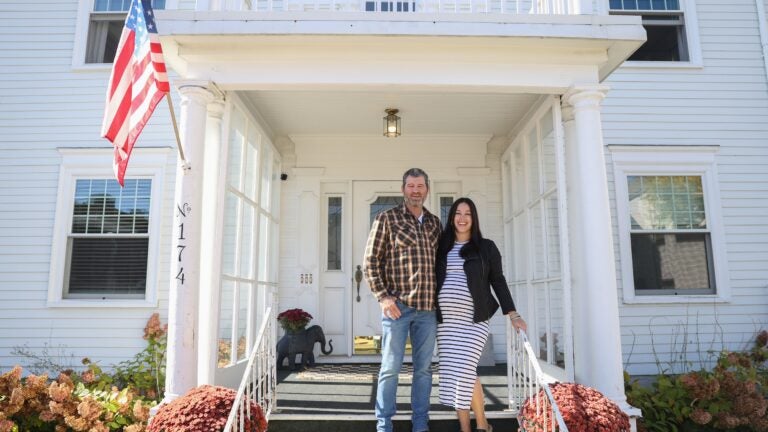
When Robin and Mike Legere purchased the former Frazier Funeral Home in Winthrop, the guest book podium where visitors signed in for funerals still sat at the front entrance.
The pink-tinted specialty lighting that shined down on open caskets was still bright. In the basement preparation room, a flushing embalming station and drainage pipes fed into the floor.
“They left a gurney in the back,” said Robin, noting that she and her husband use it to move wood in the backyard.
The owners of Legere Homes — a construction, design, and project management company — Robin and Mike had previously renovated several area properties. But the Winthrop property, a late-1800s Colonial Revival, was their first with a lengthy history as a funeral home. Amid a housing crisis in Massachusetts, the Legeres aren’t the only ones who have embraced housing stock in historic buildings with funereal histories.
Shortly after purchasing the property in 2017, Robin visited with her mother and sister and felt the space was “so dark and so creepy.” The rooms were covered in stale, smoky carpeting, and she felt an eerie thickness in the air.
“You couldn’t tell where other ‘people’ were standing, whether they were in another room or right behind you,” Robin recalled. “It was so weird.”
The couple tore out the carpets that same weekend, exposing vertical-grain fir floors underneath. Soon after, the entire home lit up with sunshine.

“It almost felt like we were being accepted into the house. And after that, I never felt scared or nervous ever again,” said Robin.
They found several interesting items, including scalpels in the walls, during the process of converting it into a three-family residence. Robin’s discovery of a veteran’s marker led her to reach out to the local cemetery. It was installed on the gentleman’s grave.
The couple live in the three-bedroom unit on the second and third floors and rent out the two units on the first. They nicknamed the property “Our Final Resting Place.”
When Erika Eucker, broker and owner of Media Realty, took over the listing for the former Turgeon Funeral Home in Millbury in 2023, the Greek Revival still had everything from the embalming table and its chemicals to crucifixes on the walls.
“There were still ashes there,” recalled Eucker. “There were a lot of cremations remaining.”
Seeking to get the listing the attention it deserved, Eucker posted the “for sale” sign out front with a placard on top that read “Probably Haunted.” The listing went viral and received multiple offers. It was sold to someone who hoped to convert it into multiunit housing but ended up selling it to the funeral home across the street.
Of course, some people purchase units in former funeral homes unaware of the history. Cassidy Norton, a newspaper publisher, bought a two-bedroom condo in a historic Chelsea building in 2017. Built by the son of the “Potato King of Chelsea,” the Queen Anne-style building was known as Casey’s Funeral Home until 1974. Norton was unaware of its history, but neighbors soon notified her. Still, she was unbothered by it.
“It was always my theory that by the time someone comes to a funeral home, all the trauma has passed,” Norton said. “If they’re going to haunt somewhere, they’re not going to haunt the funeral home.”
Get the latest news on buying, selling, renting, home design, and more.
Hilary Foutes, a realtor with Sagan Harborside Sotheby’s International Realty, helped her client Tanis Yannetti, owner of a store called Dragonfly, purchase the former Nichols Funeral Home in Marblehead in 2021. (Yannetti’s brother, David, is Karen Read’s defense attorney.)
Impeccably renovated, the six-bed, five-bath home features elements from its past, like the fireplace and the side driveway, where they believe a hearse would ferry the coffins.
And then there are the supernatural elements.
“She’s convinced there are ghosts in the house, but it doesn’t freak her out. She says they feel happy,” Foutes said of Yannetti, who has found night tables left open upstairs. “It always sounds like children are running around the third floor.”
In some cases, people live in the same building as operational funeral homes.
When the Magrath Funeral Home in East Boston moved into a newly constructed building, six residential units were put in above it. Many of the residents (the breathing ones) seem unbothered.
“Traffic is the biggest concern,” said Meg Grady, an agent with Lantern Residential/Eastie Love, who sold two of the units and has rented three, all of which went quickly. “A funeral home as an establishment is a great neighbor because it has no living occupants in there 24/7. They don’t talk back.”
Brett Herr, a financial and accounting consultant, purchased a unit in the building in 2019 and now rents it out. He had no concerns about being in the same building as a funeral home but said he “was, and still am, a little worried about resale value. But to be honest, they’re great neighbors.”
As for Robin and Mike, they’ve lost a few potential tenants over the years who Googled the address only to have the name of a funeral home pop up. But they easily won the approval of Mr. Frazier, whose funeral home previously occupied the space. The couple would invite him over for a beer in the backyard, and he’d often pop by unexpectedly until shortly before he died in 2020.
“He was always very excited about what we were doing,” Robin said. “He loved the fact that we were moving in and loved and respected the house as much as he did.”
Follow Megan Johnson on X @megansarahj and Address @globehomes.







To comment, please create a screen name in your profile
To comment, please verify your email address
Conversation
This discussion has ended. Please join elsewhere on Boston.com