

Address newsletter
Get the latest news on buying, selling, renting, home design, and more.
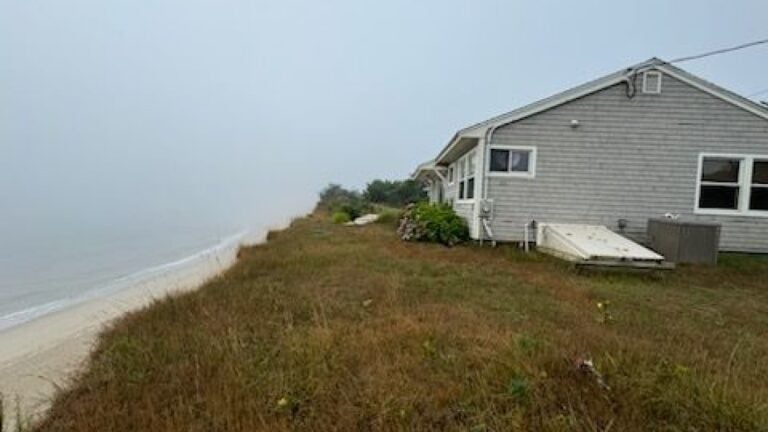
David Moot knows you might think he’s crazy, but this Cape Cod homeowner is perfectly OK with that.
The Pittsburgh resident purchased a three-bed, two-bath home in the Cape Cod town of Eastham for $395,000 in December of 2023. Measuring 1,422 square feet, the home is a mere 25 feet from the edge of the bluff it’s perched on, which sits just 75 to 85 feet from the beach. Eventually, the bluff’s overhang will get increasingly weak, break off, and collapse.
“So they think I’m crazy,” Moot told Boston.com, “which part of me is.”
A longtime visitor to the Cape, Moot, who works in design, long had the idea to buy a property there. A frequent browser of real estate websites, he connected with an agent in the area and was aghast at the price tags. But then he noticed some of the prices were dropping.
“How is a million-dollar house going down to less than half?” Moot recalled thinking. “And the main reason is the erosion along the coast.”
When Moot first came across 157 Brownell Road, which was built in 1956 as a two-bed, one-bath bungalow on a 1-acre lot, it was already under contract. Soon, it became available again, and Moot got to work on his research. He soon learned that decades ago, a road called Nauset Light Beach Road stretched along the waterfront of the home. However, in the following decades, about a half-acre of land, including the road, had fallen. Despite the climate change that threatened the home, Moot decided to go for it.
“What I said in other stories is that life’s too short. It may or may not go in my lifetime,” said Moot, whose story was first reported by Bloomberg. He notes that depending on the weather, he could lose 3 to 5 feet per year of his property. “If it were going to go in six months to 12 months, would I have done it? I don’t know.”
He’s just going to enjoy it as long as possible, he said, “and do what I can to keep it as long as I can.”
Moot noted that certain things can be done to prolong the home’s existence, like planting beach grass along the edge of the bluff and expanding on the home’s backside.
These days, Moot finds the house to be the picture of peace and serenity. He’d even like to share the property with family and friends and is tossing around ideas of how to use it as a space for terminally ill people to have an opportunity to be so close to the ocean. Meanwhile, he’s planning on renting it out to cover the cost of taxes, insurance, and remodeling to the front of the home. But he’s also become increasingly interested in the lessons of environmentalism, citing the documentary “Sand Wars“ as particularly influential.
“These articles focus a lot on this house, the time frame and blah, blah, blah. But the thing is, we as a society and different countries are using dredging and draining sand from the ocean to use in our everyday lives. Sand is used in plastics,” Moot explained. “Sand is used in building materials. So when you have many different countries using sand year after year after year, that has also been a reason for why we have a sea level rising.”

Get the latest news on buying, selling, renting, home design, and more.





To comment, please create a screen name in your profile
To comment, please verify your email address
Conversation
This discussion has ended. Please join elsewhere on Boston.com