
For workers, finding housing is an uphill climb in ski country
A pandemic-fueled exodus north and a lack of inventory are creating an affordable housing problem in northern New England. .
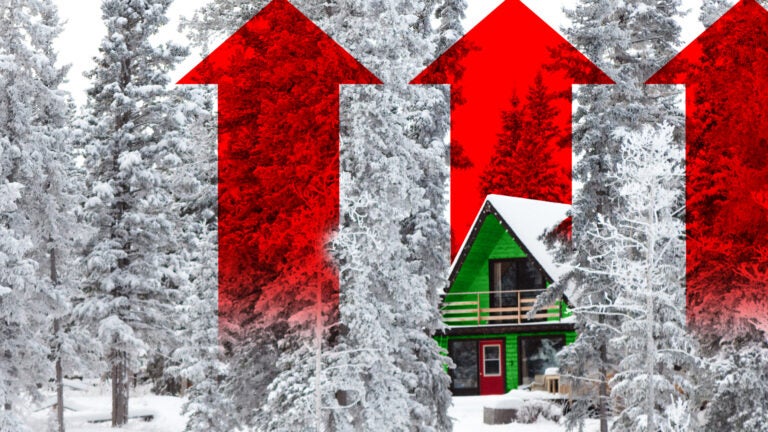
In 2019, buying a home in New England ski country was feasible for locals and out-of-towners alike.
In Stowe, Vt., for example, the median cost of a single-family home in February 2019 was $442,500, according to realtor.com, and availability was about normal — with 65 to 85 homes on the market, Michael Hickey, president of the Vermont Association of Realtors, said last month.
Today, “normal’’ is a long way off. As of press time, there were only eight homes on the market in Stowe. Of those, just one was listed for under $1 million.
It doesn’t get easier for renters. In North Conway, N.H., the vacancy rate for rentals was 0.7 percent at the end of 2021, drastically below the typical 5 percent in a well-balanced market, Harrison Kanzler, executive director of the Mount Washington Valley Housing Coalition and a former state legislator, said.
It’s no secret that the pandemic has slammed the affordable housing market across the country. But in remote vacation destinations — places like Stowe and North Conway, where people fled for open space during the height of the pandemic — the impact is even more pronounced, and it’s taking a toll on the already vulnerable: seasonal and part-time workers.
Across New England, ski resorts are facing staffing shortages, and a lack of available, affordable housing is partly to blame. Loon Mountain, Sugarloaf, and Sunday River are all at roughly 80 percent of their full staffing levels, Julie Ard, senior vice president for corporate communications at owner Boyne Resorts, said in an e-mail.
“There are many short-term rental properties that offer weekly rates but few long-term rental options, making it difficult for seasonal, part-time, and full-time workers,’’ Ard said.
It’s a similar situation at the Killington and Pico resorts in Vermont, where there are about 1,200 employees this season, down from 1,800 in a normal season, spokesperson Kristel Killary said via e-mail.
“A lot of ski areas will tell you that they have people interested in working, but their next question is well, do you have housing? And often the answer is no, and they can’t necessarily point people to opportunities either,’’ said Jessyca Keeler, president of Ski New Hampshire, a trade association that represents 33 sites across the state.
The causes are multifold, each exacerbated by the pandemic. One of the most controversial is the increase in short-term rentals. In Vermont, that number grew exponentially, from 1,000 in 2015 to 8,000 in 2019, according to the Vermont Housing Finance Agency. The more homes and apartments are listed as short-term rentals, the more difficult it is for seasonal workers to find affordable housing. Living in a short-term rental for the entire season is likely out of the question: In Carroll County, N.H., home to North Conway, it can be as expensive to stay in a short-term rental for a week as it is to rent an apartment for a month, Kanzler said.
“We have a lot of folks who live here in the summer and then go to somewhere else in the South for the winter,’’ Kanzler said, “and so they would rent their house to a ski resort employee for the winter.’’ Now, more of those people are turning to the short-term market.
Remote work and a longing for more open spaces also have compelled people to flee the cities in favor of northern New England, buying second homes or staying in ones they already own instead of renting them. From 2019 to 2020, the percentage of out-of-state buyers in Vermont increased 38 percent, with a large portion of them coming from Middlesex, Norfolk, and Suffolk counties in Massachusetts, according to property transfer data at MapVT.com.
In Maine, 34.2 percent of home buyers were from out-of-state in 2021, up from 24.4 percent in 2019, according to data from Maine Real Estate Information System Inc.
“If you’re someone who lives around here and is looking for your first home, it’s going to be hard. It’s going to be a struggle to find something just because there’s so many other people who are looking for those properties as well,’’ Keeler said of the New Hampshire market.
Though the pandemic brought the housing crisis in these areas into the limelight, it’s an issue that has been boiling below the surface for years. In the Mount Washington Valley area, it’s been an issue since the housing market crashed in 2008, Kanzler said.
“If you look at the number of building permits issued for multifamily and single-family homes, that plummeted in 2008, and it’s taken a long time to go back up,’’ Kanzler said, “and it’s still not back to where it was in 2004, 2005.’’
In Stowe, prices first shot up in 2017, rising around 20 percent after Vail Resorts purchased Stowe Mountain Resort, Hickey said. Three years later, the pandemic caused another serious jump, this time by about 30 percent.
Stakeholders are considering a number of possible solutions, though few seem to be able to bring immediate relief. Many resorts offer housing, leasing rooms on-site or in town houses or motels to employees for $110 to $175 a week. This housing is limited, however, and is typically provided only to full-time employees. Some, like Sugarbush, have tried a “Tenants for Turns’’ program, offering landlords lift passes and mountain access in exchange for them leasing their units to resort employees instead of to short-term renters.
Affordable housing advocates are calling for new zoning laws that would expedite building. In Vermont, legislation known as Act 250 requires builders to obtain a special permit from the state if they want to develop more than 10 units of housing within a 5-mile radius within five years.
“It’s a huge restriction on the builder that wants to put in a development with affordable housing,’’ Hickey said. If they build only 10 units in five years, expensive units that will bring in more revenue are more appealing. The state contends that about 98 percent of Act 250 applications are approved.
The Mount Washington Valley Housing Coalition is looking at the creation of land trusts that would allow people to build homes on land they lease from a nonprofit, saving them about 20 percent of the cost, Kanzler said.
Affordable housing advocates also are calling for more stringent rules on short-term rentals, with opponents arguing that short-term units bring more business to the region. Right now, there is a bill in the Maine Legislature that calls for impact fees on short-term rentals to fund the construction of affordable housing, according to the Portland Press Herald. An amendment to a bill before the New Hampshire Legislature looks “to give towns more rights to inspect [short-term rentals] and even charge a ‘reasonable’ fee to do so,’’ according to the NH Business Review. A bill in Vermont that would have imposed a residency requirement on those offering their homes as short-term rentals was shelved last year, the Saint Albans Messenger reported.
Whatever solution or combination thereof, housing advocates and those working in ski country hope the relief is swift. It’s a problem that, beyond the repercussions for the workers, will likely trickle down to those visiting the mountains, causing longer lift lines and less access to rental and restaurant services in the area.
As Keeler put it, “People just can’t take jobs where they can’t find a place to live.’’
Kelly Garrity can be reached at [email protected]. Subscribe to our newsletter at pages.email.bostonglobe.com/AddressSignUp. Follow us on Twitter @GlobeHomes and Boston.com on Facebook.





To comment, please create a screen name in your profile
To comment, please verify your email address
Conversation
This discussion has ended. Please join elsewhere on Boston.com