
Where nobody knows your name — yet. … The newcomer’s guide to Boston
First, not everything you’ve heard about Boston is true, but one thing is: It’s wicked expensive to live here.
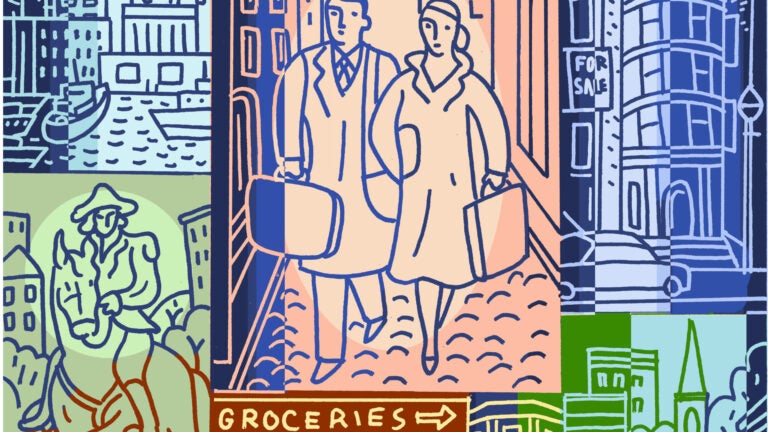
Welcome to Boston! If you’re new here, take heart: Despite the sometimes frosty reception outsiders receive from locals, you’re not alone. More than 40,000 Bostonians arrived from another state or country in just the past year, according to census estimates.
And that’s just in the city proper, which is our focus today. Yes, the Boston metropolitan area extends all the way up to New Hampshire and south to Rhode Island, encompassing millions of people in more than 100 cities and towns. All of those communities have their charms and challenges, but if you’re set on living inside the state capital itself, here’s what you’ll need to know.
First, not everything you’ve heard about Boston is true, but one thing is: It’s wicked expensive to live here. Boston’s $2,500 median asking rent for a one-bedroom apartment in February was third-highest in the nation, according to rental listings site Zumper, below only San Francisco and New York. And with a median sales price of $723,000 in January, according to national brokerage Redfin, residential real estate in the city limits outpriced that of New York, Seattle, and every other major city outside California. So here’s hoping that you’ve got a great job waiting for you, or friends who’d make good roommates.
Gratefully, there’s a lot of variety — including in price — to be found in Boston’s neighborhoods and the smaller enclaves within them. There’s more racial diversity than people sometimes realize, too, with Mission Hill (36 percent white, 20 percent Black, 18 percent Asian, 24 percent Hispanic) and the South End (46 percent white, 18 percent Black, 15 percent Asian, 18 percent Hispanic) most closely resembling the city as a whole. Boston’s neighborhoods all have their own personalities and architectural styles; in fact, some were completely independent towns until Boston annexed them more than a century ago.
If you’re looking for the Boston you’ve seen depicted in paintings, postcards, and TV shows, you’re probably thinking of a brownstone on a street with brick sidewalks and gas lanterns, which you’ll find in the more historic parts of the city. “Generally speaking, Beacon Hill, South End, Back Bay, and Charlestown are where you will find the classic brownstones, which are my favorite,’’ said Kiernan Middleman, a broker with Berkshire Hathaway HomeServices Warren Residential in Boston. You’ll also find them in tiny Bay Village (tucked between Back Bay, Chinatown, and the Mass. Pike), as well as in pockets of Mission Hill and Roxbury.
Middleman is particularly partial to the architecture and Esplanade of the Back Bay, where she relocated nine years ago. “I moved in early June, and was amazed when I opened my windows and the smell of fresh magnolias filled the apartment … It really does feel like living in a postcard.’’ But the South End is also near the top of her list. “It’s a bit more laid back than Back Bay, and is certainly less touristy,’’ she said.
It’s also home to gorgeously preserved swaths of Victorian row houses and what is arguably the center of Boston’s food scene. “I think the South End is the most full-fledged neighborhood, with shops on every corner and restaurants on every block, that does have that true sense of a community,’’ said Phil MacArthur, a broker with Compass in Boston.
Another iconic piece of Boston architecture is the three-decker: a “layer cake’’ of a house with three units, one per floor, built from the Victorian era into the early 20th century to accommodate the waves of immigrant families moving to Boston. Whether the units are rented out by the owner or split up into condos, they offer a somewhat more affordable entry point to city life in medium-density neighborhoods, where you can expect a porch and maybe even a shared yard. “Your triple-deckers are going to bein Southie [South Boston], Dorchester, Mission Hill, Roslindale, and Jamaica Plain,’’ Middleman said.
(Now might be a good time to mention that many of our neighborhoods, like our package stores, have affectionate nicknames: as in, “You can buy beer at a packie in Southie, Eastie, or Rozzie.’’ “JP’’ simply refers to Jamaica Plain.)
“JP also has a lot of really spectacular Victorians, as does Dorchester,’’ Middleman added. But if you’re looking for a typical single-family home with a yard and a driveway, neighborhoods to the southwest — like West Roxbury, Hyde Park, and Roslindale — have the most suburban vibe, she said. Almost two-thirds (62 percent) of the housing stock in West Roxbury is comprised of single-family houses, and residents are more than a decade older, on average, than in the city as a whole — and twice as likely to have had a child in the past year, according to the census.
Speaking of kids, if you have school-aged children, your address will have some — but not absolute — influence over the schools they’re eligible to attend: a list that generally includes every school within a 1-mile radius, plus citywide schools and other specialized options. Many families will have 10 to 14 choices, according to BPS enrollment materials, and every family should have at least six options available to them. Enter your address at DiscoverBPS.org to see what options are available.
There are a few thousand seats available for Boston’s free preschool program for 4-year-olds (called K1) and 3-year-olds (K0), while full-day kindergarten (K2) is guaranteed for kids who are 5 years old as of Sept. 1. You’ll have the best chance at getting your top choice of school if you apply during priority registration, which was held last month for pre-K, middle school, and ninth grade; priority registration for other grades runs from Feb. 10 to April 3 this year.
The greatest concentrations of young singles, meanwhile, are in Allston, Brighton, and the Fenway — near Boston University, Boston College, and Northeastern University. More than half of Allston residents are in their 20s, and the median age in the Fenway is just 22, according to census data. These areas, as well as Back Bay, also offer a lot of “older and therefore more affordable studio apartments,’’ Middleman said, not to mention cheap eateries and plentiful nightlife options.
Those looking for the glamour and amenities of a high-end high-rise have no shortage of options. “Luxury high-rises are almost everywhere these days, but the greatest concentration of them is along the northern part of the city, from Fenway to the waterfront,’’ Middleman said. Expect to pay more than $1,000 per square foot for a unit in a downtown luxury development, according to Redfin, plus a monthly condo fee that can touch four figures for perks like 24-hour valet parking. New developments also are available at a slight discount in South Boston, Middleman added — which, while more expensive than JP or Dorchester, is directly adjacent to downtown. “South Boston offers a great mix of affordability and proximity,’’ she noted.
Across the harbor, East Boston — which boasts “really the premier view of the Boston skyline,’’ MacArthur said — also has experienced a growth spurt, in both construction and green space along the waterfront. Between the Blue Line and the city’s push for more water transportation, East Boston provides good value and great access to downtown, agreed Joe Rogers, a broker with Coldwell Banker Residential Brokerage in Boston. “It will take a few years to evolve, but much like Charlestown has the ferry to downtown, there will be similar options for East Boston residents in the near future,’’ he said.
Did we mention that a few hundred Charlestown residents take a boat to work each day? The MBTA — the T — operates a handful of surprisingly reliable ferries and has promised improvements to its subways, buses, and commuter rail trains.
That brings us to another important consideration: Our traffic is infamous, so you need to give serious thought to how you’ll get around each day. “Transportation is a big deal. You may love your neighborhood, but if you need to take two buses and then the T to get to work, then you’re not going to be happy,’’ Middleman said.
Downtown Boston is compact, so if you work or go to school in the center of the city, you’ll be able to commute on just about any subway or commuter rail line. Workplaces in Back Bay or the Longwood Medical Area are generally best served by the Green and Orange Lines, and if your job is across the Charles in Cambridge, you’ll want access to the Red Line.
More than half of commuters who live in the Fenway, North End, Beacon Hill, and downtown, meanwhile, walk to work, according to the census, and about a third or more get to work on foot from the Back Bay, South End, Mission Hill, and South Boston Waterfront (the Seaport District).
As you walk, keep in mind that Bostonians have places to be, and you will annoy those around you if you don’t keep up the pace — whether it’s on the sidewalk, on the road, or in line for coffee. “We tend to walk quickly and not dilly-dally,’’ Middleman said. “There are a lot of very intelligent people doing very interesting things here, and it’s so inspiring to be around … [but] it’s a fast-paced place. If you don’t go as soon as that light turns green, you’re getting a beep.’’
And as for that car, every neighborhood offers free on-street parking with a resident permit sticker — but there are more permits than spaces, and snowbanks compound the shortage. If you’re hell-bent on securing a private spot, some condos come with deeded parking — but regardless, almost every neighborhood has some type of rental parking available, Rogers said. “Closer to downtown, it’ll be $300-$450 per month, and outside the heart of the city it’ll be closer to $200 a month for an outdoor spot, maybe $150.’’
Public transit and ride-sharing services are ubiquitous enough that you can also consider ditching your car altogether; more than a third of Boston households get by without a vehicle, according to the census. “A lot of our clients just get rid of the car and rent one when they need to,’’ MacArthur said.
That’s made possible by Boston’s small size, extensive transit, and vibrant neighborhoods that make it easy to accomplish daily tasks close to home. While the North End is famous for Italian restaurants and Chinatown for its Asian eateries, you probably won’t have to leave your own neighborhood for an evening out, no matter where you live. “Though Boston is a world-class city, it’s a lot smaller and more manageable than people may think,’’ Middleman said.
“If you’re coming from New York, LA, or San Francisco, you’ll be amazed at how quickly you can get from neighborhood to neighborhood within the city,’’ she added, and newcomers from small towns generally find it less overwhelming than other major cities. “It’s walkable, it’s parkable, you will learn the T in a couple trips — and we still have grocery stores with parking lots.’’
Jon Gorey blogs about homes at HouseandHammer.com. Send comments to [email protected]. Follow him on Twitter at @jongorey. Subscribe to the Globe’s free real estate newsletter — our weekly digest on buying, selling, and design — at pages.email.bostonglobe.com/AddressSignUp. Follow us on Facebook, Instagram, and Twitter @globehomes.





To comment, please create a screen name in your profile
To comment, please verify your email address
Conversation
This discussion has ended. Please join elsewhere on Boston.com