
Expanding Cohousing: The New, Old-Fashioned American Dream
Cohousing advocates think they’ve found the best way to live in Boston.
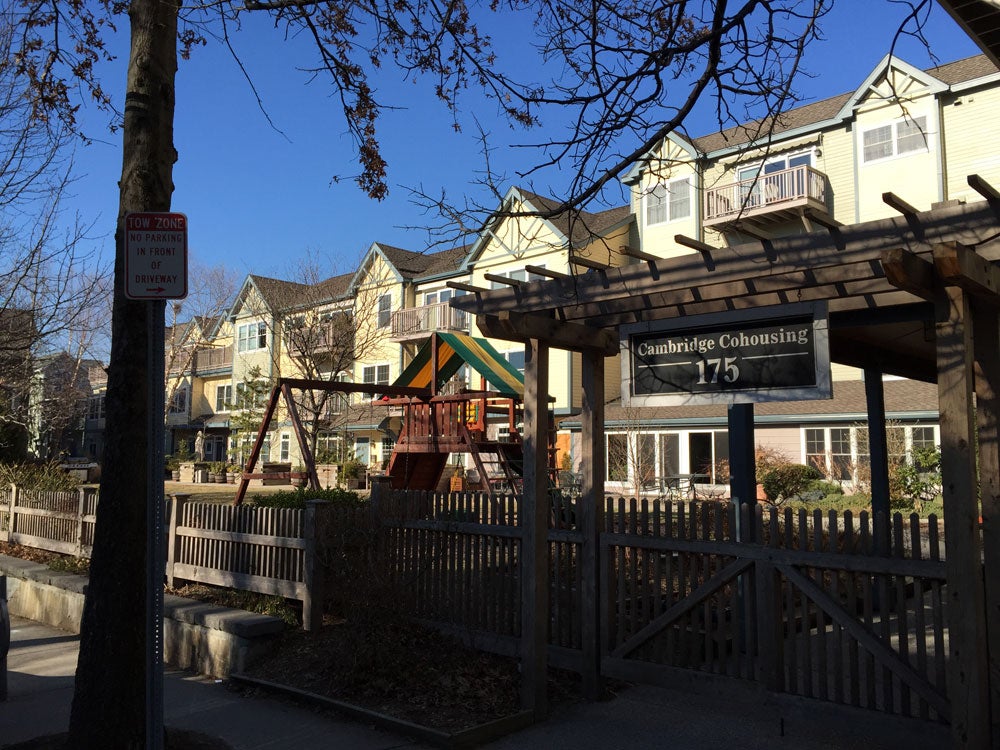
After recently pitching more than half a dozen TV executives on a sitcom inspired by her life in a Cambridge cohousing community, Melissa Burch came to a simple conclusion:
“People never heard of this. Not at all.’’
The cohousing movement, which has existed in the U.S. for more than 25 years, came to the Boston Metro area in the mid-1990s. There are now two successful cohousing communities – in which people live in condominiums specially designed to encourage sharing and neighborly interaction – in Cambridge and one in Jamaica Plain.
The idea behind cohousing is a mix of old and new cultural philosophies. Advocates often talk about rebuilding the support structures they believe Americans lost when they stopped living in the same small towns as their parents and grandparents. But they also hope community design encourages sharing of resources and leads to a more sustainable way of life.
Almost two decades after the first cohousing communities landed in Boston, Hub cohousers are confident their experiment has worked, and some advocates are betting the time is right to attract a new wave of cohousing devotees.
“I think there’s a shift going on where people are interested in connecting,’’ Burch said.
Cohousing still has obstacles to overcome if it is to grow into a movement capable of reorganizing the way Americans live, not the least of which is explaining to people what exactly cohousing is.
How It Works

The tagline for Burch’s cohousing sitcom is “Where neighbors become family, whether you want them to or not.’’ In reality, says Ariane Cherbuliez, Burch’s neighbor, most people who choose to live in a cohousing community do want to feel a kind of familial connection to their neighbors, like they’re living among – if not brothers and sisters – at least aunts, uncles and cousins.
“We wanted the sense of not being an isolated little family unit in a big city in a big world,’’ Cherbuliez said of her and her husband’s decision to buy into Cornerstone Cohousing. “We wanted a sense of connection to the world around us.’’
Cohousing communities generally consist of a “common house’’ – which contains a big kitchen, dining hall and other shared spaces like libraries, rec rooms, gyms and even woodshops – plus a surrounding collection of private homes. In more rural communities, often no one lives in the common house, but the limited space of urban environments usually means the central building also includes one- or two-bedroom flats.

Each private unit, whether a small flat or a three-story townhouse, has all the amenities of a normal American home. Kitchens and living rooms tend be on the smaller side, however, because people can take advantage of the common areas when they need to.
One thing cohousers stress when explaining their situation to the uninitiated is that there are relatively few requirements for life in the community. These are not communes where residents share an ideology or try to create a new economy. Everyone owns their own unit and can spend as much time in it as they want.
For most, the major benefit of the group housing structure is that if they don’t want to spend time alone in their house, there is always somewhere to go nearby and someone to hang out with.
“Our next door neighbor loves watching the Red Sox. The rest of his family doesn’t give a sh*t about baseball,’’ Cherbuliez explained as an example. “So he will come over and watch baseball just cause it’s much more fun to watch the game with someone else. And we would probably never know him if we didn’t live in this community.’’
The History
Burch and Cherbuliez live in Cornerstone Village Cohousing, a complex near the Alewife T stop in North Cambridge. According to the community’s website, the history of Cornerstone goes back to 1993 when a small group sketched out a cohousing development plan and started looking for land somewhere northwest of Boston that they could purchase and develop independently.
The first residents of Cornerstone didn’t move in until December 2001, nearly a decade later.
“The first wave kind of collapsed,’’ Burch said. “It was a new thing. It was hard to find the money.’’
Obstinate city governments, nervous land sellers and the difficult dynamics of a growing group added to the struggle. Lyrics from a tune called “The Story of Cornerstone’’ chronicle the group’s early years, including the fight to buy the plot of land where the complex now sits:
Then we found the land on Harvey Street
All of our needs, it did seem to meet
But alas, its owner would not sell
Unless he could get land in the town of Lowell
Ken hatched a plan to buy it for him
Somehow he convinced us to put money in
When half of our group and our architect jumped ship
Ken calmly said, “we’ll develop it.’’
“It’s a big pain in the butt to create a cohousing community,’’ Cherbuliez, who joined the group a few months before construction finally began in 2000, admitted. “It’s a lot of work.’’
Aside from convincing sellers, city governments and community boards to accept the novelty of communal housing, one major factor contributing to the long incubation period of cohousing plans is the group decision-making process.
All three Boston-area cohouses follow the example of the Cohousing Organization of the United States in using a “consensus’’ model for making decisions. The details vary, but the main ideas are that every member gets an equal say, and any member can block a decision they strongly disagree with. Hence there must be at least group-wide tolerance of every decision.
The group members behind Cambridge Cohousing, a community just a 15-minute walk away from Cornerstone, used the consensus model even when developing the site layout and designing all the buildings themselves. The idea of Cambridge Cohousing came about a few years after the Cornerstone group was formed, but, perhaps thanks to the path-breaking efforts of the latter, construction started earlier and residents moved in by 1998.

Norma Wassel, an original member of Cambridge Cohousing, said although having a group of amateurs self-develop a condominium complex by group consensus can be painfully slow, it was also key to the long-term success of the project.
“It gives you the potential to live more according to your values,’’ Wassel said.
She pointed out that the complex was built with a geo-thermal heating system, one of many things a typical development company would never have done.
“No developer would leave the amount of open space we have,’’ Wassel said. “That would be wasted money. But we saw it as a value.’’
The group also decided to outfit the common house with handicap accessible elevators, even though they were more expensive, because it would allow residents to stay in the community as they aged.
“We saw this building as a community that could sustain you over the lifespan,’’ Wassel said.
The Future?
One thing about a building complex designed to support people throughout their entire lives is that people actually stay there for their entire lives. On one hand, that’s good news for the stability of the cohousing movement.
“There’s not even one example of a cohousing community that hasn’t lasted,’’ said Patti Lautner, who lives in Jamaica Plain Cohousing, which has been the only such community in Boston proper since it was built in 2005. But on the other hand there’s a problem of “aging-in-place.’’
Happy residents stick around, and as they get older, the cohousing community starts to look more and more like a retirement home. There is a growing interest in senior co-living around the country, but Boston-area cohousers place a priority on maintaining a multi-generational community.
“It offers relationships you wouldn’t normally have,’’ Wassel said. “You’re living with people who you wouldn’t normally live with and learning how to make compromises.’’
Some, like Cherbuliez, were first attracted to the movement because of the organic supports it offers to parents.
“The kind of things that if I lived in some teeny old village, neighbors would automatically just be like, ‘Hey this kid is acting a little funny, maybe the parents need some help,’’’ Cherbuliez said.

So when units do come up for sale – either because an owner has died or actually decided to move away – the communities are focused on finding young families looking to buy. Lautner said JP Cohousing was pleasantly surprised to realize that is not very difficult.
“It’s just crazy how easy it is to sell these units,’’ Lautner said. “We’ve never used a broker. We’ve never advertised, not once.’’
She said Bostonians’ interest in cohousing is completely out of scale with the number of units available in the city. “If you want cohousing you can’t find it. So the demand is just huge.’’
The question now is whether the interest Launter sees can be turned into something concrete – like the foundations of a new cohousing complex. Young families are dying to move into an already successful cohouse, but are they willing to build one themselves?
“Self-developed co-housing communities is not really a sustainable model,’’ Lautner said.
The time, energy and money required to apply for a loan, buy a huge piece of land, design buildings and oversee construction is just too high a hurdle for most groups, she said.
“It’s extremely risky and a lot of people just don’t have the stomach for it.’’
Lautner is building a new model right here in Boston that she hopes will kick off a cohousing Renaissance on the east coast. Her company, Communitas Development, aims to give groups the expertise and financial security they desperately lack, while allowing them the design input and messy decision-making process a normal developer would never tolerate.

“A real developer is scared to death,’’ of something like a cohousing design meeting, Lautner said. “When you are a real estate developer, you do your market research, but you don’t want to deal with your buyers until it’s time for you to sell.’’
Lautner also pointed out other developers don’t have her commitment to the cause.
“They don’t care if there’s a common house,’’ she said. “Are you kidding? They’d rather make that three more units and make $90,000 more.’’
It will take more than one understanding development company to shepherd a significant cohousing movement in the Boston area. Fortunately for Lautner, the neighborliness of cohousers extends beyond their condominiums.
“There is a sense among cohousing communities that we owe it to support each other,’’ Cherbuliez said. “We wouldn’t be here if it weren’t for the work of those who came before us.’’
The Cohousing Association of the United States aims to make resources and expert advice available to communities all over the country.
There are architecture firms seriously committed to expanding community-oriented design, and the first generation of cohousing enthusiasts has dispelled some of the movement’s mystery among the general populous and, they hope, paved the way toward wider acceptance.
Peter Goldstein, the founder of Boston’s newest cohousing initiative, Bay State Commons, is grateful for the wider community.
“Every single time that you speak to people who have been involved in cohousing, they will give you their hard-won pieces of wisdom about what to do and not to do,’’ Goldstein said.
A 2008 Brown University graduate, Goldstein said his group will probably not self-develop all the way through the process. It’s still in the early stages of building out a community and searching for land, but Goldstein expects to rely on the professional network growing up around cohousing.
“This is a really exciting time,’’ Goldstein said. “You can be idealistic without letting your ideals get in the way of things working.’’



To comment, please create a screen name in your profile
To comment, please verify your email address
Conversation
This discussion has ended. Please join elsewhere on Boston.com