
Address Newsletter
Our weekly digest on buying, selling, and design, with expert advice and insider neighborhood knowledge.
The hallmarks of a New England summer are heat and humidity; the amount of each, respectively, can render conditions pleasant or oppressive. Suppose we set aside the influence of our winters. In that case, the climate here allows gardeners to cultivate vegetables, annual flowers, and other tropical flora that would be considered perennial in warmer, more southerly climes.
Tropical flora provides us with bold textures, featuring large leaves and brightly colored flowers, which extend the bloom season and add flair and panache to our garden designs. Sadly, as autumn and winter approach, reality sets in, and many of these tender treasures become dreams of the next growing season.
The focus of my column today is an excellent small fruit-bearing tree, native to the region but belonging to a family of plants that is otherwise entirely tropical. That tree is the pawpaw (Asimina triloba), one member of over 120 genera of the custard apple family (Annonaceae). This family produces economically and culturally important fruit like sugar apples, soursop, cherimoya, and, of course, the pawpaw.
Pawpaw is a glacial relict and an ancient plant in our flora, representing a period of geologic time between ice ages when warmer, wetter conditions blanketed the eastern United States, allowing this tree to migrate north from Central and South America. While only one species of pawpaw is cold-hardy in New England, there are four to five species still found in Florida, and more species are found further south in the Caribbean and beyond.

One of the challenges of growing pawpaws is good pollination, and therein lies an interesting story.
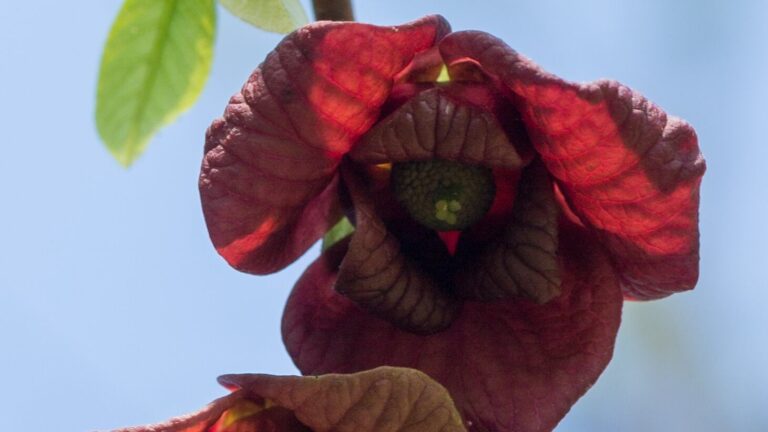
Pawpaw evolved 75 million years ago, long before bees had been invented, and the only insects flying about were beetles. Beetles are not attracted to sweet, sultry, or musky perfumes like moths and bees; instead, they prefer flowers that are either white or dark maroon, bearing fetid, musty odors like overripe fruit or gym socks. That’s not my preference, but I always tell my kids never to yuck someone else’s yum. Pawpaws, magnolias, and sweetshrub are evolutionary survivors from a time when insect pollination first developed.
From a gardener’s perspective, pawpaws have a lot to offer aside from their delicious fruit. They produce long, drooping, coarse-textured foliage, a nod to their tropical heritage, which turns an excellent butter yellow color in autumn.
The tree grows clonally, sending up suckers and shoots from the mother tree to form dense colonies. With sufficient sun and soil moisture, the tree will reach 20 to 30 feet in height at maturity. The gorgeous black and white zebra swallowtail butterfly considers the pawpaw its larval host, making it another reason to consider growing this small tree. Cutlivating the tree, however, is not what most gardeners struggle with; it is how to encourage good, consistent fruit production. A reader submitted the following question, one I typically hear from folks growing pawpaws.
Q. My plants are 10 years old and have never had flowers or fruit. Afternoon sun. Good moist soil. Some shade from a Japanese maple. Why no flowers or fruit?
John Gilmore, Roslindale
A. Pawpaw trees do take as little as five years to flower and fruit, but sometimes longer if conditions are not ideal. They do not tolerate extended periods of drought, so be sure to supplement with irrigation during these long, hot, dry spells.
Regarding flowering and fruit production, pawpaws are self-incompatible, meaning that if you have a single tree, or even a colony borne from a single tree, sparse to no fruit will develop. I recommend you plant at least two distinct individuals to promote outcrossing.
The flowers of the pawpaw emerge in May before or as the foliage expands and range in color from cream white to deep maroon and purple. It is a rugged, durable flower, as beetles are rough customers! Flies will also visit the flowers; some commercial growers have been known to suspend roadkill from the branches to concentrate flies and beetles, ensuring better pollination.
Some home gardeners take pollination a step further by hand-pollinating their trees to ensure good fruit set. Collect the pollen from the male flower parts into a small container, and when you have enough, use a small paintbrush to transfer the pollen to the female parts immediately, as it won’t store for long. If you are successful, the tree will reward you with clusters, typically up to three fruit per cluster, of heavy, lumpy, kidney-shaped green fruit.
Pawpaw fruits ripen late, once the skin has begun to turn yellow brown and is soft enough to eat. They can be stored green in the refrigerator for a few weeks, but are best left at room temperature to ripen fully. The flesh is said to taste like a banana custard and contains Vitamin A, Vitamin C, and more potassium, magnesium, and phosphorus than apples, peaches, or grapes. Even if the fruit is unappealing to you (some folks love the taste, others not so much), the tree is worthy of cultivation for its aesthetic appeal and ecological function.
Ulrich Lorimer is the director of horticulture at the Native Plant Trust in Framingham. Send your gardening questions, along with your name/initials and hometown, to [email protected] for possible publication. Some questions are edited for clarity.
Our weekly digest on buying, selling, and design, with expert advice and insider neighborhood knowledge.





To comment, please create a screen name in your profile
To comment, please verify your email address
Conversation
This discussion has ended. Please join elsewhere on Boston.com