
Ask the Gardener: Believe it or not, spring has sprung
Plus, steps you can take to revive rhododendrons (hint: it involves water).
It’s official: Spring has finally arrived! The spring peepers in the marsh behind my house have confirmed it by beginning their evening chorus last week.
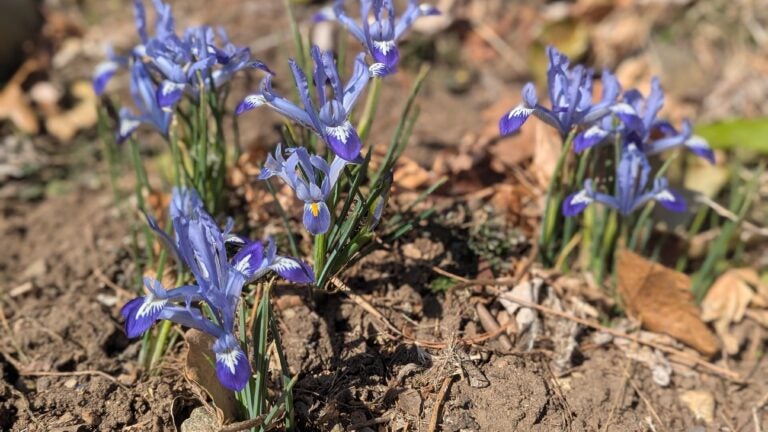
With winter in the rearview mirror, it is tempting to forget about the cold and snow and move toward sunny skies, warm sunshine, and fresh new green growth. Crocus are blooming, the first shoots of daffodils are up, and my snowdrops are almost past peak bloom. One of my favorite early risers in the spring is dwarf or reticulate irises (Iris reticulata). They can be found in bulb catalogs in the fall and are best planted at that time of year. Fully perennial in our climate, these dwarf irises are so charming! The species features deep blue blossoms, which appear as the foliage emerges, reaching a diminutive height of 3 to 5 inches.
Another selection from this group that adorns the sides of my back patio is Iris ‘Katharine Hodgkin’, with lovely pale blue, striped, spoon-shaped petals with a yellow background and flecked with matching blue splotches. Be sure to look for these beauties in the bulb catalogs this fall.

Out at Garden in the Woods in Framingham, the otherworldly flowers of skunk cabbage have emerged, their appearance ranging from dark maroon to pale green with streaks, spots, and swirls of red and purple. These are easy to miss at this time of year, but worth seeking. The flower, known as a spathe and spadix, can be up to 15 degrees warmer inside than the ambient temperature, an adaptation to lure early pollinators into spending the night, thereby better guaranteeing pollination.
One of the reasons I look forward to spring is the idea that everything in the plant world is getting a fresh start at growth, the resumption of an age-old cycle of dormancy and rebirth. Sadly, some plants still bear visible signs of last year’s drought and the stresses of the winter season. None show the signs of the past season more than evergreen rhododendrons. This reader’s question resonates with me, especially as I have seen the same signs on the rhododendrons at my home and in the garden.
Q. I have two large rhododendron bushes in front of my house that seem to have not gotten through the winter very well. The leaves and branches on the front half of both, that face out into the front garden, appear withered and possibly dead. These plants were here and mature when I moved to this house about 25 years ago and have never done this before. My question is what could have caused this and what should I do about it? Should I prune off all the dead branches and if so, will the bush regenerate and fill back in, or do I need to give up on them? They will look rather sad once half of the plants are removed.
MSM, Dedham
Years ago, I attended a lecture from renowned rhododendron grower and breeder Hank Schannen at his RareFind Nursery in New Jersey. He explained the top 10 things to do to grow great rhododendrons, and the top eight words were drainage. With few exceptions, rhododendrons do not like consistently wet or damp soils. But, almost paradoxically, they do like water and consistent amounts of it.
Natural rainfall was in rather short supply last summer and into autumn. Prolonged droughts are particularly tough on older established rhododendrons, setting them up to enter the challenges of the winter season in an already stressed state. Once the soil freezes, those large evergreen leaves become a liability, as the plant cannot replace moisture lost to winter winds if the water in the soil is still ice.
Rhododendrons attempt to reduce that moisture loss by causing their foliage to droop and curl inward, thereby reducing the surface area exposed. I think of them as nature’s thermometer: A quick glance at their foliage can tell me if it is above or below freezing for the day. The loss of water further exacerbates their stress, resulting in entire branches, foliage, and dieback. The stress also can weaken the plants, making them susceptible to soil-borne fungal pathogens that can cause foliage wilting and branch die-offs.
But there are several steps you can take to help your rhododendrons. The first step is to prune out as much of the dead branches and foliage as possible. It is important to inspect the stems to look for signs of discoloration in the wood, a good indication that a fungal pathogen in the plant’s internal plumbing is at work. Be sure to clean up all the fallen foliage as well. Rhododendrons respond well to severe pruning, although it will take years for a large shrub to reattain its former glory.
If further pruning for shape and form is needed, wait until the growing season is here, especially if the shrub still has viable flower buds. Moving forward, be sure to cover the root zone with a good layer of mulch. This helps the shrub retain water during the hotter and colder months of the year.
Lastly, cast ahead in the weather outlook. If we are forecast for heat waves or extended droughts, water your shrubs deeply just ahead of the hot times. We often set up a sprinkler on a timer and let it run for a few hours a night during the summer. Our veteran rhododendrons appreciate the extra care and enter into autumn and winter ready for the stresses of the season.
Ulrich Lorimer is the director of horticulture at the Native Plant Trust in Framingham. Send your gardening questions, along with your name/initials and hometown, to [email protected] for possible publication. Some questions are edited for clarity.





To comment, please create a screen name in your profile
To comment, please verify your email address
Conversation
This discussion has ended. Please join elsewhere on Boston.com